
Family genealogy
History to Understand
In the following pages, my intention is to understand how this small people, having been dispersed for more than two thousand years, was able to develop in Poland until the middle of the 19th century and almost everywhere else.
It was necessary to examine the institutional realities of this country which allow us to understand how a part of the Polish nobility welcomed Jewish communities, which were expanding rapidly from the 15th to the 17th century.
At the same time, they allowed it a certain autonomy which helped it to develop, to structure itself and to preserve its originality.
Yiddish became the language of these communities, with variations in both Polish and Lithuanian territories. My family spoke a wonderfully melodic Yiddish called "Polak." Those living in Lithuania were referred to as Litvak.
These favorable conditions did not prevent deadly catastrophes, throughout history, because as in Western Europe, Catholics developed by advocating the mother religion, using violence, abuses, and murders to impose themselves.
A terrible period, decimating a large part of the Jewish communities in the mid-17th century, beginning in 1648, which was called "The Flood". Cossacks successively attacked Poles and Jews to expel them from Ukraine, followed by a series of wars, notably with Sweden, creating a painful climate for the Jewish communities.
The Russian conquest of Poland after the Third Partition in 1795 saw Jews become scapegoats for the Russian authorities, triggering numerous pogroms in the mid-19th century. This resulted in the emigration of over 2 million Jews, primarily to the New World.
We come from this history...
My story is that of migrants and a people uprooted for more than two thousand years.
It is necessary to understand a thousand years of Jewish presence in Poland
The situation of Jewish communities is intertwined with Polish history, with its riches and its sorrows.
My maternal family did as two million other Jews from Eastern Europe did; they chose exile. For them, it was France.
A successful integration into 20th century France.
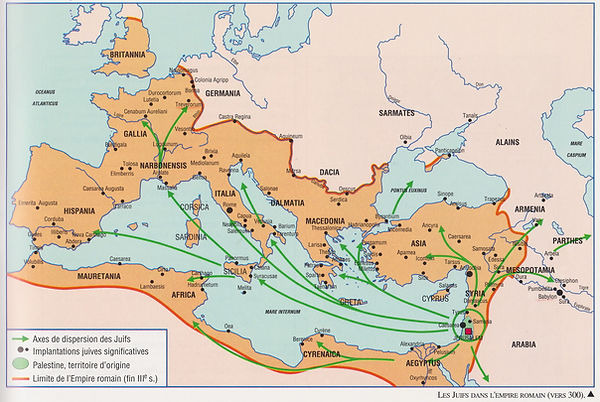
The Jews dispersed throughout the Roman Empire around 300 AD.

Christianity spread widely around 600 AD, across Europe and parts of the Levant.
Muslim rule began to take hold around 900. It improved the condition of the Jews both in Alexandria and in North Africa and Spain.
Babylon remained the great center of Jewish academies until the middle of the 9th century.

In the 11th and 12th centuries, in a climate marked by the crusades and the Christian reconquest (Toledo was recaptured in 1085), an anti-Judaism developed which led to massacres in Western Europe.
The Lateran Council (1245) provided a legal basis for this rejection, and Jews were henceforth required to wear a distinctive badge, the yellow badge.
The movements and displacements of Jewish communities will accelerate from France and Germany towards the East, including Poland.
Maps borrowed from the website "Les crises": the dispersions of the Jewish people (Olivier Berruyer)
Genetics and archaeological research are beginning to reveal hypotheses that still need to be verified.
A genetic study conducted by an international team in Great Britain puts forward two hypotheses:
1- The most widespread, not necessarily completely accurate, postulates that the Ashkenazi Jews arrived from Palestine and its surroundings, around the 1st century AD, after the destruction of Jerusalem and its temple by the Roman army.
Mixed unions with native European inhabitants would have produced a certain amount of genetic mixing.
Some are said to have settled in the South of France, others in the Rhineland, which they are believed to have fled in the Middle Ages under the blows of expulsions and massacres, to settle further East, particularly in Poland.
They were the ones who created Yiddish.
However, some population studies consider it impossible that approximately 50,000 Jews, who are believed to have moved eastward from the 13th to the 15th century, resulted in a population of 8 million by the beginning of the 20th century.
The birth rate would then be ten times higher than that of the local populations, despite the economic difficulties, diseases, wars and pogroms that ravaged the Jewish communities.
2- The other hypothesis posits that Ashkenazi Jews have a primarily European origin and come from indigenous populations, mainly from Italy, converted to Judaism.
Some specialists refer to the mass conversions in the Khazar empire, a semi-nomadic people of the North Caucasus, following the adoption of the Jewish religion by its ruling class between the 9th and 10th centuries.
Thus, the main regions of origin of the Ashkenazi population would be the Levant, Europe and the North Caucasus.
In my DNA test conducted by "My Heritage," the origin of my own DNA is 90% Ashkenazi, Central and Eastern European - which is normal given that my genealogical research since the mid-18th century locates my family in Poland.
but the remaining 10% could confirm the Khazar hypothesis.
6.5% of my DNA is of Greco-Italian origin;
2.6% would be "misrahi," which I translate as Levant.
and 0.9% of "Inuit" origin.
However, the Khazar empire collapsed in the 13th century, attacked by the Mongols and a victim of the Black Death.
The Khazar Jews fled west, settling partly in the Kingdom of Poland and in Hungary.
"We conclude that the genome of European Jews is a mosaic of ancient populations, including Judaized Khazars, Greco-Roman Jews, and Jews from Mesopotamia and Palestine."
explains Eran Elhaik, geneticist (Johns Hopkins School of Public Health in Baltimore, USA).
The settlement of Jews in Poland and Russia could have originated from a dual movement, from the Rhineland and the Eastern Balkans.
So this is the possible path of my very distant ancestors.

In Persian, the Caspian Sea is called the Khazar Sea (daryâ-ye khazar).
Its designation in the Turkish and Turkmen languages (Hazar Denizi) has the same meaning.
Their Turco-Mongol origin probably means they came from the Altai, a mountain range in Russian, Chinese and Mongolian Central Asia.
The Khazars spoke a Turkic dialect and had a Mongoloid appearance.
This long-extinct people left their mark on this region of Asia to the point of giving their name to this closed sea, considered the largest lake in the world (with an area of 370,000 km²) and which shares its waters between Russia, Kazakhstan, Turkmenistan, Iran and Azerbaijan.
So I had to approach these thousand years of Jewish presence in Poland.
The situation of Jewish communities is "intertwined" with Polish history, while retaining its autonomy, with its riches and its sorrows. Nothing is linear, however.
The Polin Museum in Warsaw is a source of information and fundamental research.
My paternal family, particularly the Czalczynski family, has been located in southern Poland since the mid-18th century.
Everything went up in smoke between 1942 and 1945.
Like two million other Jews in Eastern Europe at the end of the 19th century, my maternal family made the "choice" of exile.
For them, it was France.
A rather successful integration into 20th century France, despite an anti-Semitism that always surfaced.
I try to compare the lives of my families with the historical, economic and political developments they faced.
Poland today

A dive into the history of France
My story, like that of my mother and her family, is intertwined with French history, at least for a few years before the First World War. But the aura of France among progressive Polish Jews dates back to the French Revolution and the rehabilitation of Captain Dreyfus.
Since the French Revolution of 1789, France had acquired a certain prestige in the Ashkenazi Jewish communities, the first to have emancipated its Jews and made them full citizens.
However, this did not erase a millennium of persecution, expulsions, and segregation suffered by Jews, which is never mentioned in our history books.
.jpg)
In 1290, the King of England expelled his Jews and confiscated their property.
They find refuge in Northern France and Germany.
Between 1132 and 1321, the Jews of the Kingdom of France were expelled and recalled four times…
The expulsion of 1394 was the last and remained in force in many provinces of France until the Revolution.
There were no professional limitations on the economic activities of Jews in Rome, Byzantium, or Muslim countries.
But these appear in the medieval West.
Jews were thus unable to own land or become members of a Christian merchant or craft guild. A number of them, when they were able, therefore became moneylenders.
In the 13th and 14th centuries, Jews also suffered persecution in the Muslim world, from Egypt to Spain.
My French family, arriving at the time of the First World War, I will mainly address the political and social climate that my families faced, while also making a digression on the achievements of the French Revolution, the question of the treatment of Jews by Napoleon, the secular work of the 3rd Republic and the entrenchment of a strong anti-Semitic current in the middle of the 19th century.