
Family genealogy
Our uncle Raymond
We were never able to call him "Uncle Raymond".
A severe family feud kept him away from the family for thirty years.
I had never seen him before 1983 when the time for reconciliation could finally come.
We knew of its existence, without ever having seen our cousins.
I recently learned that my uncle Victor had always been in contact with him: he was the only one in the family besides Aunt Genia, her second husband Felix, and Madeleine, my mother's cousin. She told us about it recently.
When we were little, my sister and I knew that our uncle was a taxi driver. And the rare times we took a taxi with our mother, we would carefully look at the driver to see if it was our uncle. But it never happened.
It's a sad story!
Salomon/Raymond was born at the end of the First World War, on August 16, 1918 in Epernon, 85 km from Paris.
First question: Why?
Undoubtedly due to the German attacks on Paris.
From March 1918, they unleashed hundreds of shells on the capital, with cannons with a range of 130 km, the "Parizer Canonen".
Consequently, the government decided, between May and July 1918, to partially evacuate the most vulnerable: the sick and especially children. A "child welfare service" placed 30,000 Parisian children in the countryside for 45 francs a month. Did my aunts benefit from this, to protect themselves from "Big Bertha"?
The fact remains that my grandmother ended up in Epernon, certainly thanks to the help of social services.
She lived at 712 rue Saint Pierre in Epernon; when she gave birth, her grandfather wasn't there, and it was the midwife Armandine Louise Caquet (45 years old) who assisted with the delivery. She was the one who registered Salomon's birth at the town hall.
I also don't know when Salomon and his mother returned to Paris and 7 rue St Claude?
Then life went on as usual.
I don't know if my uncle attended a nursery school, nor which primary school he went to. In those days, girls' schools were separate from boys' schools. I know from his daughter, Martine, that he obtained his primary school certificate. He didn't go any further and began an apprenticeship... in leatherwork, like his father.
His childhood was spent in a poor family. He suffered from only having his sisters' clothes, altered to fit, and his mother often made him wear her own stockings as socks, which mortified him.


Raymond and my mother are in this photo.
Raymond (13/14 years old) is on the far left below the man in the cap; mom (5/6 years old) is on the far right, in a dark coat.
I think he had just moved to 99 Avenue Simon Bolivar around December 1931 or 1932.
The photo was taken near their home, in front of the "Goulet Turpin". To the left of this shop is a pharmacy (which still exists today).
I also don't know when or why he decided to adopt the name Raymond. Perhaps he followed the example of his cousin Marie Kronental's husband, who, named Salomon Zantman, also took the name Raymond. For him, it sounded "less" Jewish.
Was it the same for Raymond?
Raymond did his military service and basic training in 1938 at the 91st Infantry Regiment in Charleville-Mézières.
He had to return urgently because a son, Jean-Claude Leizerson, had been born to him on February 20, 1939.
He married his mother Paulette, Marie-Louise Leroux, a paper merchant residing at 20 Avenue Mathurin Moreau, on April 15, 1939.
He received permission to get married. His parents, as well as Paulette's parents, attended their wedding at the town hall.
Paulette, like Raymond, was a young person from the same housing project. It had three entrances: 99 Avenue Simon Bolivar, Rue des Chaufourniers, and 20 Avenue Mathurin Moreau. Paulette was three years younger than him, and therefore 18 years old when she had her baby.
I suppose he was demobilized at the end of the "Phoney War", in August 1940.
Apparently, they lived with Paulette in Montreuil, at 37 rue des groseilliers.
We do not know how and on what (he was registered as a leatherworker) they lived until the tragedy of 1941 when, in two months, he lost his son and his wife to pneumonia.
Jean-Claude died on March 10, 1941 at the Pitié Salpêtrière hospital in the 13th arrondissement and Paulette died at her parents' home, at 20 Avenue Mathurin Moreau, on May 14, 1941. Paulette's parents were extremely angry with Raymond.
Raymond found himself alone, but not for long, since at the ball on July 14, 1941, he met Renée Carrière, according to Martine, their youngest daughter.
What did my uncle do between July 1941 and February 1943? Neither Martine nor I know.
It is said that he and my uncle Victor (Marie's husband) engaged in black market activities, like many others.
I don't know if he saw my mother and her parents again during the occupation.
But in the archives of Bad Arolsen (in Germany), I found a list of those requisitioned for the STO (Service du Travail Obligatoire, or Compulsory Work Service), where he was between February 20, 1943, and April 24, 1944, the date of his return to Paris. An enigmatic location: "Mar. Gem. Lager Hansastrasse."?
On this list, he appears under the first name Raymond. I don't believe he wore the yellow star during the war.
The STO was made compulsory on February 16, 1943. We do not know how Raymond was forced to be requisitioned.
After Hitler ordered the conscription of 300,000 German workers into the army on December 15, 1942, the Nazis demanded on January 1, 1943, that in addition to the 240,000 French workers already in Germany, a new contingent of 250,000 men be sent by mid-March.
To satisfy this second "Sauckel action", on February 16, 1943, Pierre Laval, after having negotiated in vain , clarified the previous law of September 4, 1942 (art. 1) by establishing the Compulsory Work Service (STO) which mobilized young men for two years "in order to distribute fairly among all French people the burdens resulting - according to the terms of an official communiqué - from the needs of the French economy" and in fact from the German economy .
With the introduction of the STO, recruitment is now done by entire age groups.
Young men born between 1920 and 1922, that is to say those of the classes of 1940, 1941 and 1942, were obliged to go and work in Germany (or in France), as a substitute for military service.
Young people, as a whole, become the target of the STO .
In total, 600,000 men left between June 1942 and August 1943.
Laval used the labor inspectorate, the police, and the gendarmerie to carry out forced labor conscription and hunt down those refusing compulsory labor service (STO). This prevented the occupying forces from being mobilized for this operation. The STO further alienated public opinion from the Vichy regime and provided considerable support to the Resistance.


Monique was born on July 29, 1942. She was therefore conceived in October 1941, the date on which Raymond and Renée got together.
Renée and Raymond were married on February 17, 1945
A second daughter was born, Nicole on May 31, 1945; then came Gérard on April 19, 1948 and finally their last daughter, Martine on November 10, 1953.
Raymond set up shop as a leather goods merchant at 19 rue Vilain, in the 20th arrondissement. He founded "Maison Raymond" (coin purses, wallets, card holders, powder compacts, and belts). When demolition work affected rue Vilain, he relocated to rue Botha.
In 1950, he sold shoes and sandals as a traveling showman. The business registration record closes the activity in April 1951.
Was it at this time that he became a taxi driver? When I met him around 1990, he had the swagger of a Parisian: a true Parisian street urchin.


These were still family times. Monique and Nicole were with William. Raymond was at his sister Suzanne's wedding. They lived on Manin Street, not far away.


Little Gerard
_JPG.jpg)


Gérard at my parents' wedding in July 1950: he was 2 years old
Martine, the youngest, born in 1954, whom we knew in the 1980s.
The falling out, or even the break
Raymond's son, Gérard, died on December 3, 1952. This tragedy affected the family, especially since my Aunt Annie had lost a little Gérard six years earlier.
When the funeral announcement arrived at my grandmother's house, it bore a cross. For them, my grandmother and her daughters, it was a shock.
They experienced it as a denial of their Jewish identity.
My grandfather had died from the suffering caused by the war. My grandmother had lost her two brothers and my grandfather's sister. My mother had lost her cousin, her playmate. They couldn't bear it. That was the breaking point. When my mother lost her son, Raymond wasn't told.
Worse still, my mother and my aunts did not inform him of his mother's death in August 1957.
Victor, my aunt Marie's husband, continued to see Raymond "clandestinely". He kept him informed of family events.
Félix, Génia, and Madeleine continued to see Raymond and his family. They had a small cabin near the suburban town where Raymond and his family lived. They would meet on weekends for a nice meal. Madeleine remembered the enormous Easter egg she received from Raymond.
It was Martinre, the youngest, born to replace her brother, as she says, who re-established contact with a family she had never known. She found an effective ally in our cousin William, Victor's son.
At that moment we learned that Raymond and René had lost their two eldest daughters to cancer: Nicole in 1973 and Monique in 1976. This ended the rift, and the time for reconciliation had arrived. We learned that Raymond and Renée, overcome with grief, did not take care of Gérard's funeral arrangements; the idea of the cross on the announcement came from the company that handled the funeral.

Monique and Nicole


Martine


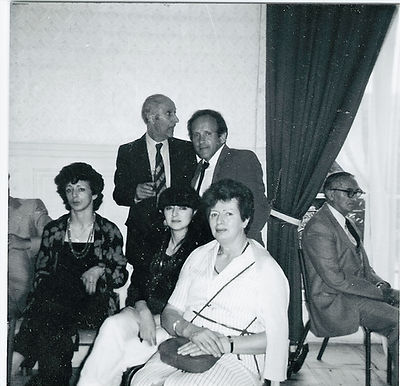
Photos of the reunion.
Top left: Monique and Nicole Leizerson; right: Martine Leizerson
The photos of the reunion date from 1984.
Sarah, my niece, was one year old. My aunt Marie is holding her in her arms, under Raymond's tender gaze. Annie is all smiles.
On the right, Raymond surrounds his two sisters, the eldest and the youngest.
In black and white, Raymond and his little cousin Hélène Chwast-Goldenberg.
On the right, Martine, my sister Cathy and Renée, Raymond's wife. Above, my uncle Victor and Jacky Firer.