Family genealogy

Daniel, the cousin, Mom's playmate
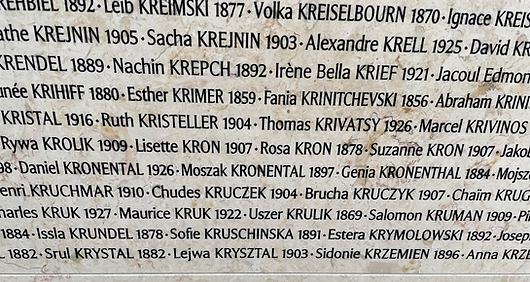
Daniel, the son of Max and Genia, was born four months after my mother's birth on November 30, 1926.
It's safe to say they had a similar childhood. When my grandparents moved to the 19th arrondissement, they were barely a ten-minute walk from each other.
Like all French children,Daniel attended public school: first, the one closest to Rue Corbeau, 200 Rue St Maur, then on October 1, 1937, when they moved, the one on Rue des Vinaigriers, in the 10th arrondissement, where he finished his primary school up to CM2.



Daniel's class photo, probably from CE1 or CE2 (third from the left, top row), 200 rue St Maur. It's rare that there isn't a report card at the end of the school day.
He enrolled at the Turgot school, a municipal upper primary school on Rue Turbigo. His academic performance deteriorated during the 1940-1941 school year; uncertainty was already gripping the family. His mother was pregnant, and Madeleine was born in July 1941. His grades plummeted. He did not return to school for the 1941-1942 academic year, as he had to take over his parents' business.
He had the status of an apprentice.
During his primary schooling, he took advantage of holidays, I suppose after the social movement of June 1936.
Paid holidays were all the rage!
We still have some photos that show him like all little boys.


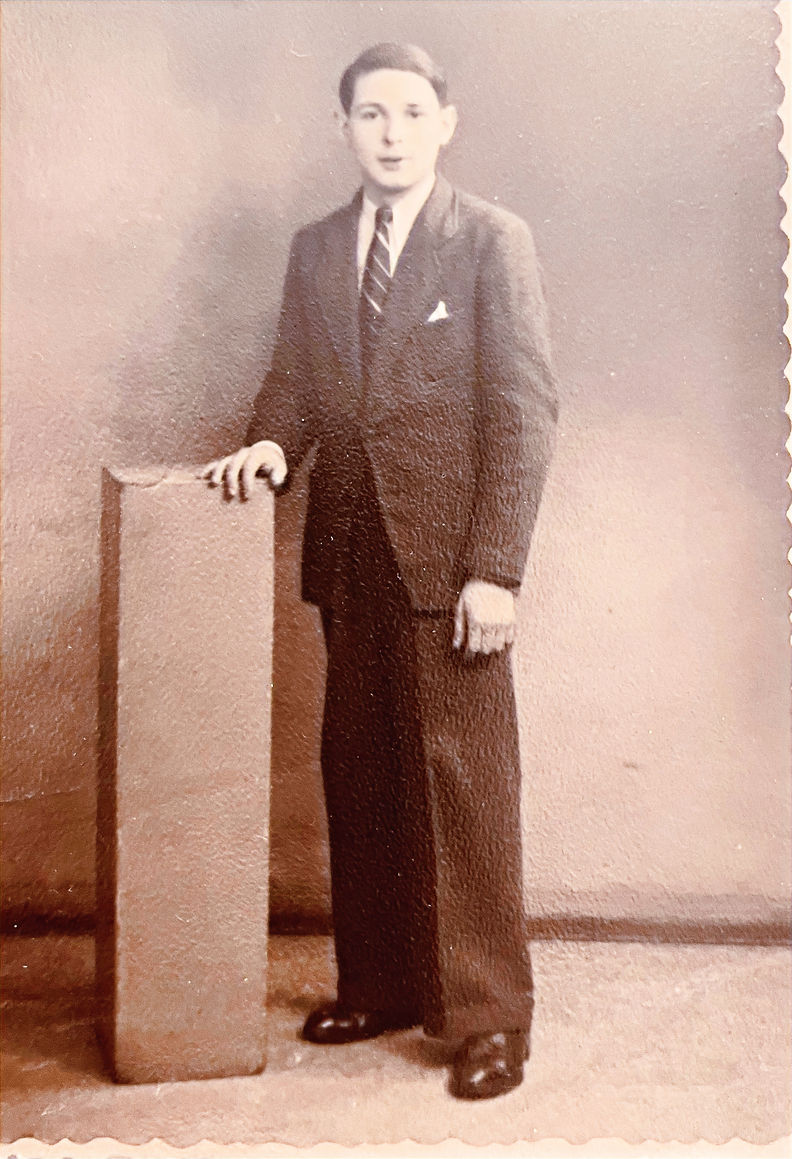
We will refer to the dispossession file, mentioned on Max's page, to understand what he had to endure as a teenager under 16, having to take over his parents' business during their (forced) absence, and the relentless pressure from the Property Administrator in charge of the dispossession. My mother hinted that she saw him during the year 1942-43.
During his two months at the Drancy camp, Daniel sent letters, which I am including here, to Stacha, his nanny, who informed the recipients, family and neighbors. He always tries to reassure the family.
I think it wasn't the first letter. And he was receiving postcards from the family, from what I'm reading.
The first one, in the possession of his sister Madeleine, front and back, dates from June 12, 1943.
The second, more specifically addressed to his mother, alludes to the festival of Shavuot (the Jewish Pentecost) which fell on June 8, 1943 this year.
And the last one in our possession dates from June 27, 1943. Is it the last one? Its handwriting is less secure!
They were deported 3 weeks later, on July 18, 1943.
Letters from Drancy in June 1943
These letters are all the more moving because one senses a shift throughout June. At first, the goal is to organize one's life as best as possible, with the hope of escaping. Then, towards the end of June, the convoys heading east accelerate, acquaintances leave, and hope dwindles...

This letter expresses surprise at Stacha's silence and concern. It highlights their lack of activity and the boredom that leaves them waiting for news.
They receive the packages sent by Stacha and request that they arrive on Tuesdays and Saturdays to better manage the improvement of the daily routine.
Daniel places his orders:
He asked for ingredients to make vinaigrette, cinnamon, and a sharp penknife, as they didn't have a knife. Since there was a kitchen, he asked her for dried beans.
He instructed her to keep her letters and confirmed that he had received the certificate(?). I think he meant that the seals had been lifted on their apartment and suggested she remove the clothes and food from their home.
Apparently, they can, every 15 days, give their dirty laundry to be washed, provided that someone comes to collect it and send it to them as a parcel, without a special label and with a maximum of 3 kg.
They have been in this camp for a month and they are organizing their lives as best they can!

In this second part of the letter, Daniel orders clothes, ink, shoe polish, shoes, scissors, two plates, and a small saucepan. Apparently, they were entitled to food and clothing parcels. Daniel suggests sending books from the "select collections."
He asks Stacha to kiss his mother, which implies that she is going to see her.
He begs her not to worry about them and to take care of herself. A family they know has just arrived in Drancy. He informs Stacha that she will receive two money orders for 50 francs each.
Life continues to organize itself.

This letter, also dated June 12, is addressed to his mother.
Daniel is worried about not receiving any news. Again, he reassures her: their morale is excellent, they're out until 10:30 pm.
They meet many of their clients.
He asks her to stay healthy until they come to get her. Daniel is also worried about Stacha's morale. He hopes that the certificate they received will allow them to avoid deportation.
He wants his mother to write a short note on the next card.
The end of the letter is addressed to our grandparents and my mother, whom he nicknames "Zizi." Apparently, they correspond, since he says he received their card on June 6th. The good news reassured him. He asks them to contact Stacha so she can answer the questions he had posed to her.

In this half of the letter, he inquires about Marie and Victor, about Raymond, my mother's sister and brother, his cousins.
He also embraces Charles and Hélène, his other cousins.
The workshop (his parents' workshop) worries him: he doesn't believe it will work for 15 days with only the worker.
Their morale is still quite good.
Clearly, he's hoping to see his family again.
He is waiting for letters in return.
The ending is addressed to the Szulevicz family, their neighbors in the same building. He asks about their entire family. Daniel and his father were pleased to have received chopped fish and cinnamon pasta, which they attribute to Mrs. Szulevicz.
It was perfect timing for Shavuot.
Max went to the shule.
His father hopes they can all play hockey together soon.
This letter still exudes optimism.

This last letter is all the more moving,
that Stacha's news seems good and that Genia added a few words.
Daniel thanks her for taking care of his mother, " which is also a comfort to us ."
Max and Daniel hope she will look after Madeleine and ask her for a photo and news of her.
What is poignant is the feeling of reading his last recommendations.
At the same time, he describes to her how they organize themselves, how they cook, and how the parcels improve the camp's daily life.
They watch all their friends leave, one after the other:
Mrs. Gesunheit, Feldwalb, Mr. Katz, the young man working at Eichel's. Only Mr. Bleiberg remains with them.
He tells us that Max is angry with Genia's mother, who is also in Drancy. We won't know why.
He requests a new clothing parcel and to use the clothing vouchers. He also wants food parcels with items that can be stored for 15 days or a month. Daniel says he doesn't know what might happen.
I find his writing more confusing; many words are difficult to decipher.

The end of the letter is addressed to my grandparents and my mother.
I don't know what " we thank you for your inconvenience " refers to? Perhaps my grandparents see Genia, that he stops by the workshop...?
They send their greetings to my two aunts Marie and Anna and their husbands, Victor and Jean, as well as to Charles and Hélène.
What is certain is that Daniel did not die at Drancy and that he boarded convoy number 57.
He was 16 years and eight months old! He was French by birth.
Did he die during the convoy, as some survivors had heard from Max before his murder?
Did he suffer the same fate as the majority: being gassed?