Family genealogy
The story of my father Szmul and his brother Itzack


Our surname is related to the small hamlet of Czalcyn, 4km from Lopuszno.
The Jewish community lived not only in Lopuszno but also in small villages (shtetl) dependent on Lopuszno (called kolonis).
It appears that four generations of Czalczynski were born in Olszowka, one of these small kolonis, 5 km from Lopuszno.
My father was born in Lopuszno and lived in Wloszczowa, about thirty kilometers away.
Many of his relatives lived in Jedrzejow or further south in Miechow.
His mother's parents lived in a small shtetl "Klimontow" south of Jedrzejow.
Klimontów and Mstyczów are two neighbouring villages located in the Świętokrzyskie Voivodeship, in the Jędrzejów District, in the municipality of Sędziszów.
The distance between them is only about 4 kilometers. They are located in southern Poland, north of Krakow and southwest of Kielce.
My grandfather Kasriel lived there with his family until his wife's death in 1919.
He remarried and went to settle in Wloszczowa

My father, a story of uprootedness
I was fortunate enough to record his story, from his birth in 1915 to his arrival in Paris in November 1946. He lived there for 60 years.
He died there a week after my mother on September 14, 2007.
My father was born in Lopuszno and lived in Wloszczowa, about 30 km away. Many of his relatives lived in Jedrzejow or further south in Miechow.
His mother's parents lived in a small shtetl "Klimontow" a little south of Jedrzejow, near Sedziszow.
My grandfather Kasriel lived there with his family until his wife died in 1919. He remarried and moved to Wloszczowa.
The young Czalczynski family lived in Klimontow
Perele Landschaft's family, my father's mother, lived in Klimontow. I suppose the young couple settled there immediately after their marriage.
They were ten years apart in age. My own parents were eleven years apart.
When my father was born, he had a brother, Meyer-Ber, born in 1911. I found him in the register of Wodzislaw.,which recorded civil status reords for the Klimontow area.
I also discovered that he had another brother, Jakob-Leybus, who was born in 1913 and died young, as our fether never mentionned him to us.
When his mother died of typhus, my father said, in 1919, she had just given birth to Moshe in 1918. My father was not yet 4 years old.
He was taken in for a few months by one of his aunts, Blima, his mother's older sister in Miechow. Blima and her husband owned a mill.
Little Moshe was looked after by Kasriel's mother, Fajgla, and the older one by Perele's mother, Ruchla, in Klementow.
The blended family settled in Wloszczowa
After the traditional year of mourning, my grandfather remarried Fajgla (Feigele in Yiddish) Mordkowicz. She was originally from Jedrzejow but lived with her family in Wloszczpwa. Her father was a tanner there.
The blended family settled at 4 rue Wessola.
They lived in a large room in which my grandfather set up his rope-making tools and machines.
The parents slept in one bed and the children in a large bed. There were three of them until December 1926 when Itzack, the last boy in the family, was born.
The family's income was modest, but they never had to resort to community charity.
Kasriel was very observant and raised his children with respect for religion. All the children went to the Heder (religious school) from the age of 5, where they learned Hebrew and Yiddish.
All the boys had their Bar Mitzvah.
From the age of 13, they entered into apprenticeships for two years, Meyer Ber with a baker, but he was bothered by the dust, then with a saddler.
He made it his profession
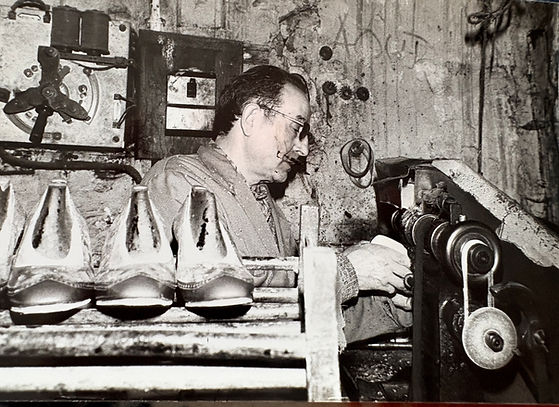
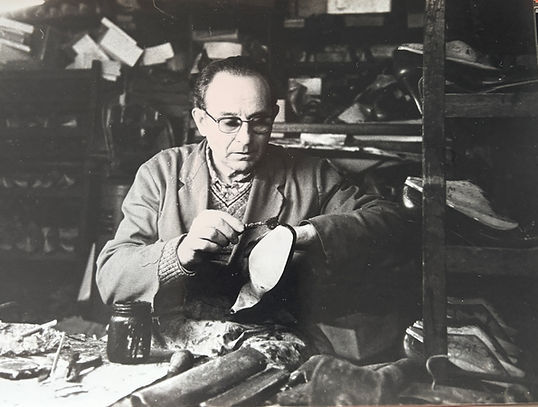
My father did his apprenticeship with a shoe upper cutter.
He later attended a vocational school run by ORT in Warsaw to become a shoe designer. This became his profession in Wloszczowa as well as in Paris.
My Father's Zionism
Youth movements provided guidance for young people in many cities and shtetls. After spending a year in "Ha Shomer Ha Tsayir" (a left-wing Zionist movement, which collapsed after a few years), he joined a right-wing Zionist movement, brand new in his city, which attracted a large part of the youth: Betar.
In 1932/33, with his father's permission, he left to undertake a two-year internship to prepare for his departure to Palestine. Along with about thirty other young men, they formed a small community, supporting themselves through various manual labor jobs and receiving paramilitary training under the auspices of the Polish army. This took place in the Wierzbnik region, he recalled.


On the left, his Betar group in Wloszczowa (first one sitting on the ground on the right). On the right, during the Harchara.
ORT in Warsaw 1935/36
From 1935 to 1936, he took model-making courses in Warsaw.
He worked as a stalk cutter in the morning and attended school in the afternoon. They lived in a rented room in a local's house.
At ORT, he learned how to make shoes and how to design them in order to create them.
It was a large vocational school with many departments.
He was connected to the Jewish community and supported by it and by patrons; it became an international learning network.

My father, at 'ORT' with a group from his class. He is the 3rd from the right at the top.
He had obtained a loan from the father of one of his friends to enroll and pay for his training.
He paid him back by training his friend.
Return to Wloszczowa 1936-39
For the next 3 years, my father's life in Wloszczowa was very promising: he opened his own shoe business with a dozen workers.
He financially supported his family, who lived their happiest years, despite the dark clouds hanging over Europe and Poland. This was also despite the rise of the Polish nationalist right, which resorted to blatant antisemitism.
And war broke out!
1939-1940: For a year, restrictions against Jews accumulated: requisitions, attacks, exactions, wearing the blue Star of David, increasingly heavy taxes, hunting down young people to send them to labor camps.
My father and his two brothers had built hiding places to escape requisitions.
1940-41: A year after their arrival, the Nazis forced the Jews to live in a reduced area. Before their arrival, 3,000 Jews lived in Wlosczowa. With the establishment of the Ghetto in a small quarter of the city, their numbers swelled to over 4,000 with those who had sought refuge there, fleeing the massacres. His family was thus forced to move, and the closure of the Ghetto made all trade with the "outside world" virtually impossible.
In May 1941: unable to capture the older brothers, the Germans took Itzack, the youngest of the Czalczynski boys, aged 14 and a half. They learned that he was in an armaments factory in the town of Skarzysko-Kamienna.
He remained there for three and a half years. Then, with the Russian advance, he was repatriated to Czestorowa, about a hundred kilometers to the west, until January 1945.
Itzack was among those who were taken by train, in cattle cars, to Buchenwald, near Weimar in Germany.
He was liberated by the Americans in April 1945.
On September 19, 1942: all the Jews of the city were rounded up by the Nazis and transported to Treblinka, where they perished on Yom Kippur.
My father was turned away by a Nazi to continue working in the city. But his parents, his two brothers, Meyer-Ber's wife and two children were in the same transport.
A few days after his family was gassed (which he learned about from the return of some young people who had hidden under piles of clothes), he decided with about fifteen young Jews to leave the Ghetto, buy weapons and join other fighters in the surrounding forests.
Both the Polish resistance and the communist forces refused to integrate them into their troops.
It was while trying to buy weapons, through a Pole claiming to be from the Resistance, that they were given to the Nazis. The latter surrounded them.
My father, who had a grenade in his hand, threw it at the soldiers, yelling. A few, like my father, managed to escape. My father headed towards some marshes where the dogs lost his scent, which saved him, unlike the other fugitives. He would later learn that all his friends were recaptured and killed. He had three bullets in his shoulder!
My father contacted some Polish friends, who found him a hiding place in an attic. He spent two long years there, without going out, without speaking, living at the mercy of the weather, freezing in winter, sweating profusely in summer, driven by a thirst for revenge.

Woods and forests around Wliszczowa
More than two years, in an attic
For my father, those years cut off from everything were difficult to endure, especially since the family who was sheltering him, worried about the potentially fatal consequences if he were discovered, were trying to get rid of him. But at the same time, they forged an indomitable spirit in him. Nothing could have been more unsettling than those years when his hosts were searching for the best way to get rid of him, when his family had disappeared in the worst possible way, when he felt utterly alone in the world!

the Polish Mularczyk family who sheltered my father from 1943 to 1945.
The Liberation: January 25, 1945
My father stayed a year and a half in his hometown of Wloszczowa. The Jewish commander of the Red Army sympathized with him.
He returned to his job in the shoe industry with his former employer and devoted himself to trying to rebuild his Jewish community and give a burial to his friends who fell to Nazi bullets.
But the resurgence of anti-Semitism in Poland, the Kielce pogrom (July 1946) and the threats from the one who had given them to the Nazis, forced him to leave Poland, which had become a graveyard for Jews.
He had previously gone in search of surviving members of his family in the surrounding towns. There he found some first cousins (on his mother's side: the Landschaft family), who had been released from various camps in Poland or Germany. Almost all of them left Poland forever.
They regrouped in Breslau, initially before being considered "displaced persons" in Munich.
Stateless in Munich, like DP
(Displaced People)
My father stayed in Munich for four months before arriving in Paris.
The Red Cross had placed him with a former anti-Nazi aristocrat (he had a mentally retarded son) whom he called the Baron.
He tended his garden.
One morning, he awoke to find his younger brother's name on a list in a dream. The baron immediately took him to the Red Cross where, indeed, he found his brother's name.
The reunion took place in the no man's land between Switzerland and Germany. Stateless, my father could not enter Switzerland.
Itzack-Jack had been taken in by the Red Cross and accommodated in Swiss boarding schools.
After being cared for and fed, he undertook vocational training in engineering in Geneva, under the auspices of ORT.
Having learned French, Jack and my father had to choose France and Paris for their new beginning.
Papa and the Baron in Munich in 1946.
We never knew his name.
He had been placed at home, as a stateless person, by a Jewish organization.
He tended his garden.
It was at his insistence, after my father told him about his premonitory dream, that they went to consult the lists of the Red Cross and he found his brother Itzack in Switzerland.


Dad among the cousins he found in Munich, between September and November 1946.
The installation in Paris
My father arrived in Paris with false papers at the end of November 1946.
I discovered this fact in his naturalization file.
Stopped in mid-1947, he received a fine and a week in prison.
He was joined by his brother; that year and they lived together for two years, becoming seasonal workers in the shoe industry.
My father tried to set up a small shoe business in collaboration with his cousins Ziggy and Henri.
This difficult life and the onset of the Cold War led Uncle Jack to leave France, Europe... for Australia.
After my father's death, we found his visa for Australia: he was planning to join him.
But in 1949, he met my mother. They married in 1950 and I was born the following year.

My parents' first dance in 1949
I recounted their life together at the end of the "Suzanne" page. My parents lived together for 57 years. They had three children, my sister and me, and lost a baby boy, Didier-Camille-Henri, at six weeks old in 1955. My father's grief was immense. He barely spoke for a year, the time of mourning.