
Family genealogy
1000 years of Jewish life in Poland
Two short presentations from the Polin Museum
Landmarks in the Jewish History of Poland
Virtual tour of the Museum in English
History timeline
Jews in Poland,
from the end of the 10th century until the Shoah h.
In the Middle Ages
965-966: A Jewish merchant from Spain , Ibrahim Ibn Jaqub (Abraham son of Jacob), travels through Poland. He writes the first description of the country. Jewish merchants, of Greco-Roman or Middle Eastern origin, are very active in Central Europe .
1085: A Jewish scholar, Jehuda ha-Kohen, mentions a community established in the city of Przemyśl
1096: The first major migration of Jews to Poland began with the Crusades.
The departure of this armed pilgrimage from Western Europe was accompanied by numerous massacres of Jewish communities. Historians estimate that France and Germany lost nearly a third of their Jewish population, many of whom sought refuge in Poland where kings and dukes, seeking to accelerate urban development, welcomed them and allowed them to establish kehillot (Jewish communities).
Tolerant kings of Poland
1206: Prince Mieszko III of Greater Poland entrusted the management of the customs house and mint of Gniezno to the Jews. These coins bore inscriptions in Hebrew and Polish, and the name of the sovereign, "Król Mieszko".
1264: The Prince of Poland , Bolesław the Pious, proclaims the Charter of Kalisz, which grants the Jews of Poland the right to engage in trade, to move freely throughout the kingdom, to freely practice their religion, to self-govern within their communities ( kehillot ), and the right to personal security and that of their property.
Article 20 severely condemns the mistreatment of Jews; anyone found guilty of murdering a Jew is sentenced to death and has their property confiscated. Jews are considered servi camerae—a portion of the royal treasury—and any action against Jews is therefore considered an act against royal power.
1320: The coronation sword of the kings of Poland, first used during the coronation of Władysław I Łokietek , bears an inscription in Hebrew and Latin characters:
"A profound faith is awakened by the names of God Sedalai and Ebrehel." The rest is in Latin: "He who bears the name of God upon him will be in no danger." This coronation sword of the kings of Poland, called Szczerbiec, is said to have belonged to the first king of Poland: Bolesław I.
The first Kehilot
1335: Foundation of the city of Kazimierz at the gates of Krakow, then the capital. This city, administered by the Jewish community, was surrounded by walls and developed autonomously for centuries.
The Republic of Two Nations: A Refuge
1343: Persecuted in Western Europe , the Jews were invited to Poland by King Kazimierz III . After the mass expulsion of Jews from Western Europe (England, France, Germany, and Spain), the Polish-Lithuanian Commonwealth became a refuge for them.
1348: Edicts from Polish kings guaranteed security and freedom of worship from the 13th century onwards, while Western Europe was the scene of persecutions, particularly after the episode of the Black Death of 1348-1349, of which the Jews were accused of being the vectors.
King Kazimierz IV Jagiellon granted Jews privileges known as "Cracow privileges" (which nullified canonical decisions issued by the Pope).
It is now forbidden to summon Jews before religious (Catholic) courts, and only the prince can judge them. The palatines must protect Jews from oppression by the clergy. False accusations are punishable by death.
1550: Under the Jagiellonian dynasty , the Polish-Lithuanian Commonwealth became the territory of the world’s largest Jewish community.
Jews expelled from France, Spain, Portugal, and German cities sought refuge in Poland. At that time, 80% of the world's Jewish population lived in Poland.
1525: King Zygmunt I was the first Christian sovereign to grant a title of nobility to a Jew without requiring him to renounce his faith.
1532: Jews obtain the right to trade throughout the Kingdom
1534: King Zygmunt I abolished the law that required Jews to wear distinctive signs.
1534: Creation of the first Jewish printing press in Kazimierz (by the brothers Samuel, Aszer and Eljiakim, sons of Chaim of Halicz)
1554: Foundation of the first Jewish printing press in Hebrew in Lublin . In 1559 it obtained a printing monopoly from the king.
1567: Foundation of the first yeshiva in Poland.
1576: King Stefan Batory issues a law severely condemning accusations made against Jews for the homicide of children and the desecration of the hosts.
The Kehilot are becoming more widespread and centralized.
1580: First meeting of the Council of Four Countries (Va'ad Arba' Aratzot) in Lublin (its name refers to the four main Polish regions: Greater Poland, Lesser Poland, Ruthenia and Volhynia-Podoli).
Based on the highly efficient organization of the Jewish communities ( kehillot )—a term encompassing both the administration of the commune and the members of the community—and on various pre-existing institutions dealing with administration, justice, religious matters, and assistance to the needy, the Jewish community thus constituted its own legislative body. This was a kind of parliament composed of 30 members and two committees, one religious and one secular. The Jews were considered a fifth estate, alongside the clergy, the landed nobility, the bourgeoisie, and the peasantry.
The Council of Four Countries is recognised by the King of Poland .
1622: The Jewish communities of the Grand Duchy of Lithuania withdrew from the Council of Four Countries and established their own body, the Council of the Land of Lithuania. This date marks the split between Litvak Judaism and Polak Judaism.
1632: In the context of the Counter-Reformation , King Władysław IV Vasa banned books or any printing of an anti-Semitic nature.
1633: The Jews of Poznań obtain the right to prohibit non-Jews from entering the Jewish quarter of the city.
1648: The Polish Jewish population reached 450,000 people (4.5% of the total population). The world Jewish population was estimated [1] at 750,000 people.
The Time of the Flood
1648: During the Khmelnytsky Uprising , Cossacks massacred the Polish nobility as well as the Jewish community that the Polish nobles were protecting: this was the first pogrom perpetrated by Orthodox Christians. The total loss to the community is estimated at 100,000 people.
1655: The Swedish invasion and occupation, which went down in history as the deluge, added massacres.
1750: The Jewish population of Poland reached 750,000 people, or 8% of the total population. The world's Jewish population was estimated at 1,200,000 people.
1759: Jacob Frank 's followers convert and join the ranks of the Polish nobility.
Poland is out
1791: Creation of the Pale of Settlement, to which all Jews of the Russian Empire were confined.
1795: Third partition of Poland between Russia , Prussia , and Austria . Poland ceases to exist. The privileges of Jewish communities are revoked.
1800: The Jewish population reaches 2,000,000 in Eastern Europe.
1831: Jews take part in the defense of Warsaw, which is in revolt against the Russian imperial army.
1864: Jews participate in the Polish uprising of January .
1862: Many Polish aristocrats entrusted the management of their assets to Jews .
The time of pogroms fueled by the Russian administration and authorities.
1881: Jews are accused of the assassination attempt against Tsar Alexander II . Pogroms encouraged by the Russian government ensue.
1896: Birth of the Bund (General Union of Workers of Poland, Lithuania and Russia). First Jewish, socialist, Marxist, secular, dystri and anti-Zionist political party.
1897: The first Zionist Congress was held in Basel, Switzerland, under the presidency of Theodor Hertzel. This historic gathering structured the Zionist movement, whose objective for the Jewish people was to establish a homeland in Palestine.
1914: The First World War .
1917: The Bolshevik Revolution and the Russian Civil War
Poland regains its autonomy; Polish ultra-nationalism multiplies anti-Semitic acts.
1918: Poland regains its independence
1920: The Bolshevik invasion of Poland.
1914-1921: Wars ravage the former Polish territories.
The Jews living in these lands, particularly among the youth of the " Bund ", took sides with Bolshevism, which promised the end of discrimination based on religion, and total equality for all citizens ("revolutionary Yiddishland "): this resulted in persecutions against Jews in countries hostile to Bolshevik Russia, and the emergence, among White Russians and nationalists of all countries, of the myth of " Judeo-Bolshevism " (which would later be widely exploited by the Nazis and their satellites ).
1921: The Polish-Bolshevik Treaty of Riga . Citizens of the disputed territories (roughly corresponding to the Pale of Settlement ) were granted the right to choose their territory. Many communist Jews chose Bolshevik Russia (many would regret this when Stalinist anti-Semitism emerged), while at least as many, if not more, emigrated to Poland, particularly religious Jews attached to their faith, and artisans, shopkeepers, or merchants whose businesses had been nationalized by the Bolsheviks.
1924: 2,989,000 Jews are recorded in Poland (10% of the population). Young Jews represent 23% of high school students and 26% of university students, which leads nationalists and anti-Semites to demand quotas for university admissions.
The same was true in other Eastern European countries, whereas in the USSR nothing of the sort existed; the Soviet "social elevator" was open to all provided they were communists and atheists.
1935: The death of Józef Piłsudski marks the resurgence of anti-Semitic acts and the establishment of an ultranationalist and anti-Semitic government.
1936: Anti-Semitic riot in Przytyk.
1933–1939: Persecuted by the Nazis , German Jews attempted to emigrate, but almost every country closed its borders to them, including the United Kingdom and the United States. A few found refuge in Poland.
1939-1945: Throughout Nazi-occupied Europe, the extermination of the Jews took place, also known as the Shoah ("destruction, great misfortune, catastrophe") or the Holocaust. In Nazi Germany and occupied Poland , the genocide was industrialized.
1943: Warsaw Ghetto Uprising
1944: Stalin installs a communist government in Poland, the majority of whose members are Jewish. Repression begins against the Polish resistance.
1946: Kielce pogrom; Jewish survivors and repatriates are murdered by Poles
From 1948 onwards: Hundreds of thousands of Jews, including tens of thousands of Holocaust survivors, left Poland and other Eastern European countries (including the USSR) for Israel and the United States .
[1] The Counter-Reformation in Poland was actively carried out from the end of the 16th century under the impetus of the Jesuits and King SIGISMOND III. Its objective was to recatholicize the noble elite and to greatly reduce the influence of Protestantism, permanently anchoring Catholicism as a pillar of Polish national identity.

Read
Henri Minczeles, A History of the Jews of Poland* (1997)
Henri Minczeles, historian and Bund activist, offers a vast synthesis that traces nearly a thousand years of Jewish presence on Polish lands — from the foundation of the kingdom to the Shoah and the post-war period.
What distinguishes this work is its constant attention to political and social movements (the Bund, Zionism, Jewish communism) and Yiddish culture, as well as to religious history and the catastrophe. It situates Polish Jewish history within the broader context of Polish history.
A medieval haven and a golden age
Jews arrived in Poland from the 11th to the 13th centuries, driven by persecution in Western Europe. Polish kings, notably Casimir the Great, granted them protective privileges (Statute of Kalisz, 1264).
The Jews developed a strong communal autonomy: the kahal, and especially the Council of Four Countries (a true Jewish “parliament”) which managed taxation and justice until 1764.
Spiritual and cultural life
Henri Minczeles describes a society organized around religion, Talmudic study, and Yiddish. In the 18th century, two major movements emerged: Hasidism (Baal Shem Tov) and its rationalist opposite, the Mitnagdim (the Vilna Gaon).
Then the Haskalah (Jewish Enlightenment) paved the way for modernization.
The 19th century : national awakening and modern movements
With the partitions of Poland, the Jews found themselves divided between the Russian, Prussian, and Austrian empires. This led to the emergence of:
- Zionism (Hertzl, but also religious and socialist currents);
- the Bund (1897), a Jewish, secular and socialist workers' movement, with a strong presence;
- a thriving Yiddish press and literature (Mendele, Peretz, Sholem Aleichem).
The interwar period and anti-Semitism
Poland was reborn in 1918 with the largest Jewish community in Europe (approximately 3 million people, ~10% of the population). However, state and popular antisemitism intensified (quotas, bench ghettos, pogroms). This was also a period of intense cultural, political, and religious creativity.
The Holocaust
Henri devotes a significant portion of the book to the destruction: the Nazi and Soviet invasion of 1939, the creation of ghettos (Warsaw, Łódź, Krakow, etc.), deportations to camps (Treblinka, Auschwitz-Birkenau, Sobibór, etc.), and the near annihilation of the community. He also discusses the resistance, notably the Warsaw Ghetto Uprising (April-May 1943) and the Jewish partisans.
The post-war period and memory
After 1945, the community was decimated. Post-war pogroms (Kielce, 1946) and waves of emigration (to Israel, Europe, and the Americas) further reduced it. A Jewish memory of Poland was reconstructed primarily within the diaspora and through historical research.

"Jews in Poland, The Jewish Question during the Interwar Period by Paweł Korzec, Paris, 1980"
Pawel Korzec was a Polish Jewish historian born in 1919 in Lodz. He participated in the Bialystok Ghetto uprising (August 1943), fled Poland during Gomulka's "anti-Zionism" campaign in 1968, and settled in Paris where he died in 2012.
His work focuses on the workers' government in Poland and Jewish-Polish relations.
A historian's work devoted to the condition and debates surrounding the Jews of Poland in the years 1918-1939:
He discusses the following in detail:
- the place of minorities,
- state and popular antisemitism,
- the economic and political tensions of the young Second Republic.
Korzec relies extensively on numerous sources and documents, including parliamentary debates, meetings of the minority bloc, newspaper excerpts and their echoes as far as France.
An example: the city of Wroclaw (Breslau)
740 years of troubled history
History of the Jewish community
The oldest Jewish gravestone found in Wroclaw (Breslau) dates back to 1203, indicating that at that time Wroclaw was home to a Jewish community.
* In 1290 , Wroclaw was the second largest Jewish community in Central and Eastern Europe , after Prague.
The Jews of the city worked mainly as pawnbrokers and merchants; a smaller minority practiced crafts.
* In the 14th century , however, the Jews of Wroclaw were victims of violence.
After a pogrom in 1349, approximately 5 families survived out of the original 70. 41 Jews were tried and burned at the stake in 1453 after being accused of desecrating the Eucharist.
In the same year, the Jewish community was expelled from the city.
* Two years later, the city obtained official intolerance status.
* Until 1744 , Jews were forbidden to live in Wroclaw. They could only go there during the annual fairs.
* En 1741, la ville est annexée par la Prusse et, en 1744, Frédéric II autorise les Juifs à y reformer une communauté officielle.
La population juive augmente rapidement.
* En 1747, 532 Juifs vivaient à Wroclaw (1,1% de la population totale).
* En 1810, ce nombre avait grimpé à 3 255 (5,2%).
Wroclaw devient un centre important pour la Haskalah (les Lumières juives).
Les deux communautés – les orthodoxes et les libéraux – étaient actives dans la vie religieuse et culturelle des juifs de la ville et étaient dirigées par d’éminents rabbins et érudits.
* Le nombre de résidents juifs dans la ville était de 19 743 en 1900 et de 10 300 en 1939.
* En novembre 1938, les activités culturelles, sociales et éducatives de la communauté sont interdites et les synagogues et les écoles juives sont détruites pendant les pogroms de la Nuit de cristal.
* À partir de septembre 1941, les juifs sont chassés de chez eux et leurs biens entassés dans les maisons juives (Judenhaus).
Ils sont déportés quelques mois plus tard dans des camps de transit avant le convoi vers d’Auschwitz.
* Entre novembre 1941 et l’été 1944, les juifs de Basse-Silésie, y compris ceux de Wroclaw, sont déportés dans 11 convois.
Le premier conduit les juifs à Kaunas, où tout le transport est abattu.
Les convois ultérieurs envoient les Juifs dans les camps d’extermination de Sobibor et Belzec, ou à Terezin et Auschwitz. Certains juifs sont envoyés dans des camps de travail temporaires. En 1943, seuls les conjoints de mariages mixtes et certains enfants sont encore à Wroclaw.
Les 150 derniers juifs de la ville sont déportés à Gross-Rosen en janvier 1945, où ils sont tous tués.
* À partir de mai 1945, Wroclaw devient un centre de transit pour les survivants juifs revenant des camps de concentration de Silésie et de Pologne.
Les juifs des anciens territoires polonais annexés à l’Union soviétique pendant la guerre commencent à arriver dans la ville par vagues à partir de 1946, faisant de Wroclaw la plus grande communauté juive de Pologne.
* Bien que le nombre de Juifs à Wroclaw ait culminé à 17 747 en 1946, après le pogrom de Kielce en juillet de la même année, ce nombre diminue considérablement.
* Ainsi, au printemps 1947, environ 15 000 Juifs vivaient à Wroclaw.
La communauté juive d’après-guerre reconstruit une communauté religieuse, des écoles, des coopératives juives et un théâtre juif, ainsi que d’autres organisations et partis politiques.
* La population juive continue de chuter, principalement en raison de l’émigration.
* En 1960, il restait 3 800 Juifs dans la ville.
* La guerre des six jours et l’antisémitisme entraînent une augmentation sensible de l’émigration après 1967.
Dans ce sillage, l’école et le théâtre juif ferment leur portes.
* En 1974, il y avait 3 000 Juifs à Wroclaw.
Une renaissance juive a commencé à la fin des années 1980.
* En 2000, la ville a rouvert la société socio-culturelle juive et son école juive.
La synagogue dite des cigognes blanches, utilisée par les nazis comme atelier de réparation automobile et pour stocker des biens juifs volés, est consacrée à nouveau en 2010 après une restauration à grande échelle.
* En 2014, la communauté juive de Wroclaw comptait 350 membres inscrits, ce qui en fait la deuxième communauté juive organisée en Pologne après Varsovie.
Les vestiges de ce qui semble être une synagogue du 14e siècle semblent avoir été trouvés à Wroclaw en 2021. Une découverte effectuée lors de travaux de rénovation dans un immeuble à proximité de l’Historical Institute of the University of Wrocław, 49 Szewska Street.
Poland's choice in the Middle Ages
I am a paragraph. Click here to add your own text and edit me. It's easy.
Community autonomy in the Republic of the Two Nations
I am a paragraph. Click here to add your own text and edit me. It's easy.
The end of the golden age and the beginning of the floods
1648: The Great Trauma
The major turning point was the Bohdan Khmelnytsky uprising in 1648, in the Ukrainian territories of the Republic.
Jews were particularly vulnerable because some of them worked for Polish nobles as tax farmers, estate administrators, innkeepers, or intermediaries. When the Cossacks and other insurgent populations turned against Polish rule and its associated social structures, Jews were often considered part of that group.
Thousands of Jews were massacred in Ukraine and neighboring regions. Some communities were completely destroyed; others were decimated and then rebuilt.
This is a fundamental event in the historical memory of Eastern European Judaism.
After 1648: a community rebuilding itself
However, it should not be concluded that Jewish life in Poland-Lithuania disappeared after the massacres.
It gradually rebuilt itself. Some relatively unaffected regions, particularly parts of Lithuania, welcomed refugees. The Jewish community continued to grow and its institutions remained very strong.
In the 18th century, Poland-Lithuania thus remained the demographic and cultural heart of Ashkenazi Judaism.
But the political and economic context was deteriorating, while the internal divisions of the Republic were becoming increasingly profound.
So, how did the Jews themselves experience this Republic?
Four words describe the situation of the Jews: autonomy — prosperity — vulnerability — renaissance.
They were not simply victims living in a hostile society.
On the contrary, over several generations they had built extremely powerful institutions, a diversified economy, a highly developed educational and religious system, and a genuine Eastern European Jewish culture.
But this autonomy was largely based on legal privileges and the protection of the king or magnates.
When the political and social order was disrupted, this protection could disappear very quickly.
It is this paradox that makes the history of the Jews of the Polish-Lithuanian Commonwealth particularly interesting: Poland-Lithuania was simultaneously one of the places where Ashkenazi Judaism experienced its greatest flourishing and the scene of some of the most important catastrophes in its history before the modern period.
Renewal of Jewish life and thought in the 17th and 18th centuries
Poland-Lithuania was then the demographic heart of world Judaism: several hundred thousand Jews, and a strong community autonomy (the Va'ad Arba Aratsot, "Council of the Four Countries", which manages taxation and internal justice).
It is in this fertile ground that, between crisis and mystical effervescence, the great currents that will reshape Judaism are born.
A context of catastrophes and messianic expectation
The massacres of 1648-1649 (the Khmelnytsky Revolt), the wars of the mid-17th century, and the decline of Jewish autonomy created a profound trauma. Many saw in this the "birth pangs" of the Messiah.
Isaac Luria's Kabbalah had spread widely, teaching that exile calls for reparation (tikkun). This was perfect ground for a messianic explosion.
* Sabbateanism and Frankism
+ Sabbatai Zevi (1665-1666): A huge messianic wave followed the announcement of this Ottoman messiah. It swept through all of Jewish Poland. After his conversion to Islam, the crisis left lasting scars: some continued to believe in him clandestinely.
+ Jacob Frank (1726-1791): This Polish Sabbatean radicalized the movement, proclaimed himself the reincarnation of the Messiah, and then converted to Catholicism along with some of his followers. Frankism marked the chaotic end of this messianic fervor—and fueled accusations against the Jews.
* Le hassidisme : le grand renouveau spirituel
C'est la réponse la plus féconde.
Fondé par Israël Ben Éliézer, le Baal Shem Tov (1700-1760), il propose un judaïsme de la joie, de la ferveur simple, accessible à tous, y compris au pauvre et à l'ignorant, plutôt qu'un élitisme du savoir talmudique. Dov Baer de Mezeritch (le « Grand Maggid », mort en 1772) structure le mouvement en réseau de maîtres.
Ses disciples se perpétuent en dynasties hassidiques : Karlin, Loubavitch (Schneour Zalman, Bratslav (Nahman de Bratslav), etc.
Ce mouvement innove en plaçant au centre
- la figure du tsaddik (juste, intermédiaire spirituel),
- la prière chantée avec ferveur,
- la valorisation de l'intention sur la seule érudition.
Par la prédication orale et l'exemple, ce mouvement aura un immense succès en Ukraine, Galicie, Podolie — c'est-à-dire la Pologne orientale.
* La réaction des mitnagdim , les« opposants »
L'opposition rabbinique au hassidisme se cristallise autour du Gaon de Vilna (Elijah ben Salomon, dit le Vilna Gaon, 1720-1797).
Défenseur intransigeant du Talmud et de la halakha (l’ensemble des prescriptions, coutumes et traditions de la Loi Juive), hostile à ce qu'il voit comme un mépris de l'étude et des dérives sectaires, il lance en 1772 une excommunication contre les hassidim.
Les mitnagdim défendent un judaïsme intellectualiste, centré sur l'école (yeshiva).
Cette fracture a traversé tout le judaïsme ashkénaze.
Le judaïsme ashkénaze est ainsi devenu pluriel: hassidim, mitnagdim, sabbataïstes résiduels, pré-Lumières.
La spiritualité est intériorisée (kabbale popularisée, joie, prière) face à la rationalisation talmudique.
Le hassidisme devient le mode dominant du judaïsme en Europe orientale pour les siècles suivants : il marquera une forme de résilience après le traumatisme des massacres.
C’est la naissance d'une tension structurante (piété fervente versus érudition; tradition versus modernité rationnelle) encore vivante dans le monde juif contemporain.
Le XVIIe siècle polonais est devenu celui de la crise messianique, le XVIIIe celui de la réponse spirituelle populaire (hassidisme), et de sa reprise en main rabbinique (Gaon de Vilna) et de l'ouverture naissante vers les Lumières.
L'aube de la Haskala et le retour à la raison
Dans le même temps, des courants rationalistes préparent le terrain.
Le passage du commentaire talmudique à la philosophie de Kant, annonce la Haskala (Lumières juives), qui triomphera surtout en Allemagne avec Moses Mendelssohn.
La Haskala et les Lumières : entre Berlin et Paris
La Haskala (השכלה), littéralement « éducation », « raisonnement », désigne le mouvement juif des Lumières, né en Allemagne dans le dernier tiers du XVIIIe siècle et profondément lié au grand courant de "l'Aufklärung" allemande et des "Lumières" françaises.
Elle ne se réduit pas à une simple importation : elle adapte le message universaliste des Lumières aux réalités d'un judaïsme encore largement communautaire, et pose la question centrale du rapport entre raison, citoyenneté et fidélité à la tradition.
I. Le foyer allemand : Mendelssohn et l'Aufklärung
Le point de départ est Berlin. Moïse Mendelssohn (1729-1786), figure charnière, incarne le lien direct avec les Lumières allemandes : mettant en scène une figure de juif éclairé et vertueux , plaidoyer pour la tolérance religieuse.
Moise Mendelsohnl défend la liberté de conscience et théorise la séparation entre religion et État, en dialogue avec la philosophie des Lumières. Il incarne le projet d'une double fidélité : rester juif pratiquant tout en s'ouvrant à la culture allemande et à la raison universelle.
Autour de lui se forme un réseau de maskilim (partisans de la Haskala).
Le "modèle allemand" est donc surtout culturel et linguistique : ouverture à la langue du pays, à la littérature, à la philosophie, sans rupture frontale avec la religion.
II. Le foyer français : émancipation et « régénération »
Les Lumières françaises jouent un rôle matriciel : Montesquieu (Lettres persanes, De l'esprit des lois) et Voltaire imposent la tolérance religieuse comme thème central, même si ce dernier est violemment antijuif, ce qui force les « maskilim » (les adhérents à la Haskala) à une position ambivalente.
En France, la Haskala prend une coloration plus politique et juridique, portée par la Révolution : en 1789, l'abbé Henri Grégoire publie son Essai sur la régénération physique, morale et politique des Juifs, plaidoyer pour leur intégration pleine et entière.
La Déclaration des droits de l'homme (1789) puis le décret d'émancipation du 27 septembre 1791 accordent la citoyenneté aux Juifs de France, premier épisode majeur d'émancipation en Europe.
L'idée dominante n'est pas la réforme de l'étude juive comme à Berlin, mais la « régénération » : faire du Juif un citoyen comme les autres, en déplaçant l'identité du registre communautaire vers le registre national.
Cette approche entre parfois en tension avec la vision de Mendelssohn, pour qui l'émancipation pouvait coexister avec le maintien d'une identité juive distincte.
Enjeux et tensions se manifestaznt dans le monde juif entre des notions et postures clivantes :
- Universel versus Particulier : les Lumières prônent une raison valable pour tous ; la Haskala doit décider ce qu'elle conserve de la singularité juive.
- Ouverture versus Assimilation : l'ouverture culturelle allemande et l'émancipation française posent la question du prix identitaire de l'intégration.
La Haskala et les Lumières : diffusion des idées en Europe de l'Est
Les idées des Lumières, formulées à Paris et Berlin, se transformeront en un processus proprement est-européen, via la Galicie puis la Russie, où la Haskala deviendra à la fois mouvement d'éducation, science critique du judaïsme et creuset de la modernité juive.
Diffusion vers l'Est : la Galicie, premier foyer
Vers 1772, les partages de la Pologne font basculer de vastes populations juives sous souveraineté autrichienne et russe. La Galicie (Lemberg/Lviv) devient le premier relais oriental : Joseph II (Autriche) impose en 1781-1782 des réformes d'éducation et de germanisation qui, paradoxalement, ouvrent la voie à une Haskala autrichienne.
Se développe en Galicie une science du judaïsme (Wissenschaft des Judentums) : histoire critique, philologie, étude rationnelle des textes.
Dans l’Empire russe
La Haskala russe se déploie lentement, freinée par l'existence des zones de résidence et la méfiance du pouvoir russe.
Vilna devient la « Jérusalem de Lituanie » : centre du musar (mouvement spirituel, pratique axée sur le développement éthique et le raffinement diu caractère personnel) mais aussi de l'édition hébraïque moderne.
Odessa incarne la Haskala la plus radicale : figures comme Mordecai Aaron Guinzburg, plus tard Mendele Moïkher Sforim (Mendele l'écrivain), dont l'œuvre en yiddish et en hébreu fonde la littérature juive moderne.
Ces mouvements bénéficieront des outils modernes de diffusion
- L'imprimerie hébraïque (Vilna, Slavuta, Jitomir) diffuse les textes.
- Les écoles modernes (Heder réformé, écoles d'État, lycées) introduisent le russe, l'allemand, les mathématiques.
- La presse : Ha-Maggid (1856), Ha-Melits, Ha-Karmel — premières revues hébraïques à large diffusion orientale.
- Les réseaux de maskilim se déplacent entre Berlin, Vienne, Brody, Vilna et Odessa.
La diffusion n'est jamais linéaire : elle heurte de plein fouet le hassidisme (autour du Baal Shem Tov), qui valorise la piété mystique et populaire contre le rationalisme.
Le Mitnaged (élite rabbinique lituanienne) attaque lui aussi les maskilim.
Cette triple opposition — hassidim / mitnagedim / maskilim — structure tout le XIXe siècle est-européen et débouche sur les grands mouvements nationaux juifs (sionisme, socialisme juif, autonomisme).
The Jewish community's response to the Polish uprising of 1830
A very minority membership
The Jewish community in Poland (the largest Jewish center in the world at the time) was largely "reluctant, even hostile" to the uprising.
Several reasons:
- The memory of the massacres of 1648-1655 and of the time of Bohdan Khmelnytsky had instilled a distrust of popular peasant revolts.
- Many Jews were economically linked to the Russian administration (tax collectors, innkeepers, intermediaries for nobles), and therefore threatened by destabilization.
- Russia was perceived as a relatively protective power under Nicholas I , while the Polish aristocracy had done nothing to improve the legal status of Jews.
Some Jews, especially assimilated or from the enlightened lower middle class of Warsaw, nevertheless joined the national cause : Rabbi Ber Meisels called for support of the uprising, and some Jews participated in the national guard.
But the prevailing attitude was one of waiting, if not outright opposition. The Polish authorities, for their part, were suspicious and largely excluded Jews from the promised citizenship.
The Jewish community in the face of the Polish uprising (1863-1864)
A much clearer rallying
The context has changed:
- The reforms of Alexander II (partial emancipation, beginnings of integration) had awakened hopes that were ultimately dashed.
- A generation of more Polonized Polish Jews had formed, notably under the influence of the ideas of the Haskalah (Jewish Enlightenment) and liberal patriotism.
- The slogan "Za naszą wolność i waszą" ("For our freedom and yours") made Jews allies of the Polish cause.
The result was a significantly more visible Jewish participation in the January Uprising, in the clandestine administration, finance, supplies, and even the fighting (hundreds of Jewish combatants, some of whom died in battle). Rabbi Dov Ber Meisels of Warsaw again supported the movement, and the Lublin Union (1861), followed by certain reformist Jewish circles, publicly took its side.
But this support remained ambivalent: the traditional Jewish peasantry and part of the Orthodox rabbinate remained wary, fearing both Tsarist repression and the latent anti-Semitism of the insurgents.
Jewish political life in the 20th century
Le monde juif entre dans une forme de modernité « ambivalente»
Elle s’ouvre à l’intégration et à l’épanouissement culturel.
En même temps se créent de nouvelles fractures au sein du monde, juif :
- assimilation ou fidélité à la tradition religieuse et
- un antisémitisme moderne quiuculminera au 20ème siècle dans tous les domaines de la vie sociale et politique.
- Le sujet juif moderne tend à s'affirmer comme individu autonome, hors de la tutelle communautaire.
- Le pluralisme dans le monde juif conduit à un judaïsme éclaté en courants concurrents et en identités nationales (yiddishistes, hébraïstes, assimilationnistes).
- La « question juive » devient une question politique — antisémitisme moderne, émancipation, nationalisme.
- Une science du judaïsme émerge (Wissenschaft des Judentums) qui tend à historiciser et étudier le judaïsme avec les outils universitaires modernes.
-La littérature yiddish moderne se développe (Mendele Moykher Sforim, Sholem Aleichem, I. L. Peretz) : c'est par la langue du peuple, non par l'hébreu des maskilim, que la modernité entre dans les foyers.
- Chemin de fer, presse yiddish, alphabétisation donnent naissance à un espace public juif populaire (presse, théâtre, chansons).
Plutôt que l'idéologie des Lumières, ce sont des dynamiques socio‑économiques qui transformeront la population juive d'Europe de l'Est par une urbanisation et une prolétarisation progressive :
- les shtetls tendent à diminuer et
- une partie de leur, population gagne les grandes villes où se développent des centres industriels. - une grande partie de l'artisanat est ruiné.
Pourtant le hassidisme va rester vivace. Il a été un mouvement populaire de masse face à une élite rabbinique lettrée. Il n'est pas « anti-moderne » au sens de fermé au monde ; il constitue une forme d'adaptation populaire, avec communication de masse (récits, chants, pèlerinages, imprimerie), qui capte l'énergie d'une partie des masses précisément là où la Haskala échoue.
Les mitnaggedim (le Gaon de Vilna) répondent sur le même terrain : mobiliser les foules.
L'histoire juive est-européenne de la fin du 19ème et du début du 20ème siècle n'est pas celle d'une élite éclairée (par, les courants religieux ou les philosophes de la Haskala) éduquant une masse passive. C'est celle d'une rencontre conflictuelle entre cette avant-garde lettrée, un État autoritaire et des populations qui se modernisent par l'économie, la langue populaire et la politique de masse.
Les élites; masksilim, rabbins, intellectuels, lancent les idées ; mais le Bund, la presse yiddish et le folkisme montrent que les larges masses juives d'Europe de l'Est se les sont réappropriées, écrivant leur modernité juive dans leur langue, leurs luttes et leurs partis.
Comment était représentée la communauté juive ?
On distinguera trois niveaux :
- la représentation interne (la communauté se gouvernant elle-même),
- la représentation officielle reconnue par l'État, et
- la représentation politique au sens moderne (partis, députés, groupes parlementaires).
Avant "l'émancipation", la communauté juive pré-moderne n'était pas « représentée » dans la société politique. Elle formait un corps séparé, doté de ses propres institutions :
- Le kahal (kehila) : administration locale autonome, percevant les impôts, gérant la synagogue, l'école, le tribunal rabbinique et l'assistance.
- Le Va'ad Arba Artsot (Conseil des Quatre Pays) en Pologne-Lituanie : véritable parlement juif supra-régional, jusqu'à sa dissolution par la Diète en 1764.
- Le shtadlan : intercesseur officieux auprès des princes et des cours — représentation « diplomatique » sans mandat élu.
Ce système se délite au XIXᵉ siècle : la Russie abolit le kahal, tout en créant des rabbins d'État nommés par le pouvoir.
Au XIXᵉ siècle :
Dans l'Empire russe, l'Autriche-Hongrie, la Roumanie, où vivent la grande majorité des Juifs : presque aucune représentation officielle.
La communauté reste privée, et l'accès à la fonction publique ou aux conseils municipaux est limité.
La représentation se fait par pétitions, délégations ad hoc et shtadlanim - d'où le sentiment d'un vide politique que va combler la politique juive moderne.
Fin XIXᵉ – 1905 : naissance de la représentation politique moderne
* Le Sionisme naît: Congrès de Bâle (1897), Organisation sioniste mondiale — projet d'une représentation nationale ailleurs qu'en diaspora.
* Le Bund émerge (1897) : représentation ouvrière, la classe ouvrière prime sur la nation.
* Les Folkistes (Folkspartei, 1906, autour de Simon Dubnow) revendique une autonomie nationale-culturelle dans la diaspora, avec des institutions juives élues.
* L'Agoudat Israël (1912) représentera les courants de l'orthodoxie religieuse.
Le tournant est la révolution russe de 1905.
Ces courants se traduiront en sièges :
- à la Douma russe, un groupe de députés juifs (Vinaver, Levin, Syrkin…) émerge dès 1906.
- En Autriche-Hongrie et en Allemagne, des Juifs siègent aussi, le plus souvent dans les partis généraux.
L'entre-deux-guerres : l'âge d'or de la représentation
C'est la période la plus riche :
- Traités des minorités (Versailles, 1919) : les Juifs sont reconnus comme minorité nationale dans plusieurs États (Pologne, Roumanie, Tchécoslovaquie). Le Comité des délégations juives (Paris, 1919, autour de Leo Motzkin) négocie des garanties : une diplomatie juive collective inédite.
- Pologne : le Koło Żydowskie (Cercle juif) au Sejm ( chambre basse du Parlement Polonais) regroupe les députés juifs ; les députés s'expriment en yiddish et en hébreu.
Des "Communautés religieuses' élues (gminy żydowskie) : véritables scrutins locaux, âprement disputés entre Bund, orthodoxes, sionistes et folhistes.
Le Congrès juif mondial fondé en 1936 à Genève.
La représentation politique se déplacera du kahal autonome, au consistoire religieux, puis aux partis et groupes parlementaires (Bund, folhistes, sionistes, Koło) et aux organisations de défense d'un état sioniste.
Le point clé : cette représentation a été tardive, minoritaire et toujours contestée : les Juifs n'étaient jamais un bloc univoque, mais un espace politique traversé de clivages religieux, nationaux et de classe.
L'engagement des partis juifs en Pologne après 1920
Après la reconstitution de l'État polonais (1918-1921) et l'instauration d'un régime parlementaire avec scrutin proportionnel, la communauté juive - plus de 3 millions de personnes, la plus grande d'Europe - devient un acteur politique à part entière.
Elle s'organise en partis multiples, souvent sur des listes séparées (« listes minoritaires »), ce qui lui donne une visibilité électorale réelle.
Le paysage politique juif
Le Bund (Bund général juif ouvrier)
Socialiste, anti-sioniste, défenseur d'une autonomie nationale-culturelle juive en Pologne et du yiddish comme langue nationale.
Base : ouvriers de Varsovie, Łódź, Białystok, Vilnius.
Force montante dans les années 1930 : il remporte les élections aux conseils communautaires (kehilot), notamment à Varsovie en 1936.
Coopère parfois avec le PPS (socialistes polonais), mais se distingue nettement des communistes.
Les sionistes (plusieurs courants)
Sionistes généraux (centre) : autour de Yitzhak Gruenbaum, qui fédère la représentation juive au Sejm.
Mizrachi : sionisme religieux.
Poale Zion (gauche) et Hitachdut : sionisme socialiste.
Révisionnistes (droite, autour de Jabotinsky) : aile droite du mouvement.
Le sionisme domine politiquement la représentation juive dans les années 1920.
Agoudat Israël
Parti orthodoxe et anti-sioniste, représentant les milieux haredim.
Très structuré, il s'oppose à la fois aux sionistes et à la gauche laïque.
Sa force s'accroît dans les années 1930.
La Folkspartei (folkistes)
Parti autonomiste issu des idées de Simon Doubnov : nation juive diasporique, autonomie culturelle, yiddish.
Ni sioniste, ni socialiste, ni orthodoxe ; importance surtout dans les années 1910-1920, puis déclin.
Figure marquante : Noach Pryłucki.
Les communistes
Le KPP (Parti communiste polonais), illégal, compte de nombreux militants juifs, mais il rejette l'identité nationale juive et n'a pas de représentation légale.
La représentation parlementaire
1922 : apogée — environ 35 députés et 12 sénateurs juifs, fédérés dans le Bloc des minorités nationales (avec Ukrainiens, Allemands, etc.).
1928 : environ 27 députés, mais le bloc minoritaire se fragmente.
1930 et après : recul continu sous le régime autoritaire de la Sanacja ; en 1938, la représentation juive s'effondre à quelques sièges.
Les députés juifs défendent
- l'égalité civique,
- l'autonomie culturelle et
- luttent contre les discriminations et l'antisémitisme d'État.
Les conseils communautaires (kehilot) :
En parallèle du Sejm, les élections aux communautés juives locales sont un enjeu majeur (budget, écoles, cimetières, rabbinat). Le Bund y devient dominant dans les grandes villes ouvrières dans les années 1930 — signe d'une politisation des masses, et non des seules élites.
En résumé:
La politique juive polonaise après 1920 combine des partis de masse (Bund), des mouvements nationaux (sionistes), des structures religieuses (Agoudat) et des courants autonomistes (folkistes).
Cette vitalité s'exprime au Parlement, dans les municipalités et dans les institutions communautaires jusqu'à l'effondrement de l'entre-deux-guerres sous les coups de l'antisémitisme, de la crise et enfin de la Shoah.
The Second Polish Republic
La question juive dans la Deuxième République
Les Juifs sont une minorité nationale, mais ils sont répartis dans presque toute la Pologne.
Ils sont particulièrement nombreux dans les villes et petites villes.
En 1921, la Pologne compte environ 2,8 millions de Juifs, soit autour de 11 % de la population.
Et en 1931, la Pologne possède la deuxième plus importante population juive du monde, avec environ 3,1 millions.
Mais contrairement aux Ukrainiens et aux Biélorusses (autres minorités reconnues), les Juifs ne revendiquent pas tous un territoire particulier où créer leur propre État.
La question devient donc :
Comment construire une nation polonaise dans laquelle vivent des millions de citoyens qui ont leur propre religion, leur propre culture et souvent leur propre langue ?
Les Juifs de Pologne sont devenus, en principe, des citoyens polonais à part entière.
La Constitution de mars 1921 proclame l'égalité des citoyens indépendamment de leur religion, langue ou nationalité.
La Pologne avait également accepté en 1919 un traité international relatif aux minorités sous l'égide de la Société des Nations.
Donc juridiquement : Un Juif n’est plus citoyen de seconde catégorie.
Un Juif polonais peut : posséder une maison ; exercer une profession ; voter ; être élu ; créer des associations ; avoir des écoles ; pratiquer sa religion ; publier des journaux ; créer des partis politiques....
Et c'est effectivement ce qui fait de la Pologne de l'entre-deux-guerres un centre exceptionnel de la vie juive européenne.
Mais la réalité quotidienne est beaucoup plus complexe.
Le grand paradoxe : égalité juridique, discrimination réelle
C'est probablement la distinction qu'il faut garder en tête. Il y a une différence entre : les droits inscrits dans la loi et la manière dont ces droits sont effectivement appliqués.
La politique polonaise devient progressivement plus nationaliste.
Dans les territoires orientaux, l'État cherche, notamment, à favoriser la 'polonisation' : administration, école, propriété foncière et implantation de populations polonaises.
Pour accéder à certains métiers, maitriser le polonais est exigé, ce qui en limite l'accès de ceux ne parlant que le Yiddish!
Pour les Juifs, la situation est différente de celle des Ukrainiens ou des Biélorusses : ils ne sont pas principalement considérés comme une population territoriale qu'il faudrait "poloniser".
Ils constituent plutôt une minorité nationale dispersée, essentiellement urbaine et semi-urbaine.
Et cela produit une situation très particulière.
Mais les années 1920 sont différentes des années 1930
Les années 1920
Il existe une vie juive extrêmement dynamique.
On trouve : écoles juives ; yeshivot ; synagogues ; associations ; mouvements sionistes ; Bund ; partis religieux ; presse yiddish ; organisations professionnelles ; réseaux commerciaux.
Les Juifs peuvent même être représentés politiquement au Parlement.
Mais les premières années de la République sont aussi marquées par des violences anti-juives et des pogroms, notamment dans le contexte violent des guerres et conflits de 1918-1921.
Puis la situation se stabilise relativement.
Les années 1930
Le climat se détériore nettement.
L'antisémitisme politique se développe, particulièrement dans les milieux nationalistes.
On voit apparaître : boycotts économiques, notamment des commerces juifs ; violences contre des commerçants juifs ; discriminations universitaires ; pressions pour limiter la présence juive dans certaines professions ; propagande antisémite ; puis, à la fin des années 1930, des mesures explicitement discriminatoires.
Le débat sur l'interdiction du travail le dimanche va polluer la vie commerciale et industrielle.
Les activités juives cessent en général le shabbat, mais imposer la fermeture le dimanche signifie deux jours de fermeture consécutive et c'est problématique pour les commerçants et industriels juifs.
Le cas des universités est très révélateur.
Dans les années 1920, on tente d'imposer un numerus clausus limitant la proportion d'étudiants juifs. Le projet n'est pas adopté sous sa forme initiale, mais des pratiques discriminatoires apparaissent ensuite.
Dans les années 1930, les « bancs-ghettos » imposent aux étudiants juifs de s'asseoir séparément dans certaines universités.
A la fin des années 1930, la pression économique et sociale devient beaucoup plus forte.
The Holocaust
Poland was the scene of the unthinkable.
Although Poland as a whole suffered, the fate of the Jewish population and its 90% extermination was the result of Nazi terror but also of an "indifference" not to say "approval" of the mass of non-Jewish Poles (this is true for Ukrainians, Belarusians or Latvians).
Of course, there was a minority who became involved in the Resistance and the rescue of Jews.
But my father was marked by the refusal to integrate Jews into the AK (Armia Krajowa - Home Army) and into the communist resistance.
The tragedy being well known, I will not elaborate on it.
Read
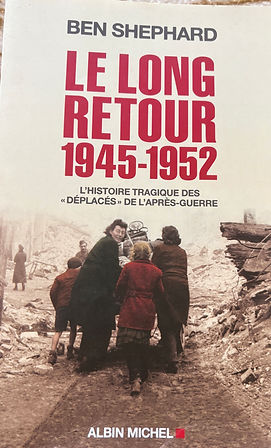
In "The Long Road Home" (2010), British historian Ben Shephard deals with the immense human chaos that followed the end of World War II between 1945 and the 1950s.
The central topic
At the end of the conflict, millions of people found themselves far from home: prisoners of war, forced laborers, deportees, camp survivors, refugees fleeing the Soviet advance. Shephard describes how the Allies — through UNRRA and then the OIR — had to manage what were called "displaced persons" (DP).

Les idées principales
- La libération n'est pas une fin heureuse : pour beaucoup, elle marque le début d'une attente interminable, d'incertitudes et de nouvelles souffrances.
- Le rapatriement, priorité affichée des Alliés, se heurte à des réalités politiques et morales : de nombreux rescapés juifs ou d'Europe de l'Est refusent de rentrer dans des pays où ils n'ont plus rien, ni foyer ni sécurité.
- Shephard montre le décalage entre les intentions humanitaires et la bureaucratie souvent dépassée, mal préparée ou insensible.
- Il suit aussi la naissance de l'État d'Israël et l'émigration massive qui en découle, ainsi que l'installation de nouveaux réfugiés (comme les Volksdeutsche chassés d'Europe de l'Est).
La thèse de l'auteur
La période d'après-guerre, longtemps négligée, est essentielle : c'est là que se dessinent les grandes questions modernes de l'humanitaire, des réfugiés et des migrations forcées. Le livre mêle histoire globale et destins individuels pour rendre ce chaos tangible.
Ben Shephard consacre une large part de son récit au sort particulier des Juifs rescapés, qu'il distingue nettement du reste des « personnes déplacées » (DP).
Un drame invisible au départ
À la libération (1945), les Alliés classaient les survivants par nationalité, non par religion.
Les Juifs se retrouvèrent donc souvent mêlés à des DP d'Europe de l'Est… parmi lesquels d'anciens collaborateurs ou même des gardiens de camps.
Beaucoup ne se déclaraient pas juifs par peur de l'antisémitisme encore vivace.
Leur situation resta longtemps ignorée.
Le rapport Harrison (août 1945)
Envoyé par Truman pour enquêter, Earl G. Harrison dressa un constat accablant : les Juifs étaient traités « comme des êtres humains, mais pas comme des Juifs », isolés dans des conditions déplorables. Ce rapport força les Alliés à créer des camps séparés, souvent gérés par les organisations juives elles-mêmes.
Le désir de Palestine
La majorité des survivants voulaient partir, et surtout rejoindre la Palestine. Or le Livre blanc britannique de 1939 limitait strictement l'immigration juive. Shephard raconte alors :
- la *Bricha, ce réseau clandestin qui fit sortir des dizaines de milliers de Juifs d'Europe de l'Est vers les ports de la Méditerranée ;
- l'*Aliyah Bet, l'immigration illégale, souvent stoppée par les Britanniques, notamment l'affaire de l'Exodus 1947, navire renvoyé de force en Allemagne avec ses 4 500 passagers.
La résurgence de l'antisémitisme
Le point de bascule est le pogrom de Kielce (Pologne, juillet 1946) : 42 Juifs tués par une foule, alors que la guerre était finie. Pour beaucoup de rescapés qui espéraient reconstruire leur vie en Pologne, ce fut le signal du départ définitif — une véritable fuite vers l'Ouest.
Le rôle des camps et des organisations
Les camps de DP en Allemagne et en Autriche (dont Bergen-Belsen reconverti) devinrent des lieux de reconstruction : écoles, synagogues, vie culturelle. Des organismes comme le Joint et la Haganah y organisèrent l'aide et la préparation au départ.
Le dénouement
L'accumulation de ces tensions, le sort des réfugiés et le contexte international pesèrent dans la décision de partager la Palestine (novembre 1947) et dans la création de l'État d'Israël (mai 1948), qui ouvrit enfin à la plupart des rescapés une terre d'accueil.
Nathalie Cau studied theatre at the University of Nanterre, up to the Doctorate level.
She is interested in issues of memory, aesthetics and politics.
In the DP camps, surviving Jews needed to reconnect with an intense cultural and artistic life.
They organize their "society" which will be the last moments of a flourishing Yiddish cultural expression, in memory of that "Before".
These surviving men and women are shaping the contours of a new community that aspires to a new "home".
Nathalie Cau presents and analyzes the representations of these Jewish "displaced persons" using images from theatre, religious festivals, carnivals, sporting events...
It draws on the example of the Jewish DP camp of Belsen in the British zone, and then on those of various camps in the American zone, particularly around Munich.
In the second part, she will examine the different representations of Purim in different camps and some sporting events.
A difficult return
For Polish Holocaust survivors, the end of the war, while it meant the end of suffering, did not bring immediate solutions to their reconstruction.
Most of them had to wait 4 years in "Displaced people" camps before a future opened up.
For the most part, they refused to return to Poland, which had become, for them, a vast cemetery where anti-Semitism was rampant and had claimed nearly a thousand new Jewish victims.
The borders of most countries remained closed until 1948.
Their only remaining hope was to create a home of their own.
This future gained ground in these camps.
On November 29, 1947, the UN General Assembly adopted Resolution 18, dividing Mandatory Palestine into two states, one Jewish and one Arab.
On May 14, 1948, at the end of the British Mandate, David Ben Gurion proclaimed the creation of the State of Israel based on the UN resolution.
Some of the survivors from my family reached Israel in 1949, while others reached England, Canada or Australia.