
Family genealogy
The saga of Abraham Szternis' family
Abraham and Maryem Szternis had six children in 17 years, all born in Warsaw.
My memories
This is by far the most prolific family in terms of offspring.
A large part of it turned away from its Jewishness and assimilated without continuity with its origins.
The trauma of the Holocaust partly explains this.
We remained close to those who stayed within the "Jewish" sphere, which, however, had nothing religious about it, but continued a transmission even if sometimes it seemed tenuous.
My Grandmother saw Anna, the eldest of Abraham's children, whom we called cousin Anjè, quite often.
She had a knack for pinching our cheeks with two fingers to say hello when we were little. I can still see myself recoiling at that gesture!
She had two children: Ita and Ludovic.
My mother, my sister, and I remained in contact with Ita, her daughter. My sister, my young niece, and I had visited her in Nice a few weeks before her death.
Rose was also part of our family circle, along with her husband and daughter Myriam.
We had heard about his brother Robert.
Myriam was a part of our early childhood. She was a schoolteacher and was the first to take my cousin William and me to visit the Louvre. She was also there for my parents' deaths.
Berthe also made an impression on my memory. She was supposed to come to the house, in my Grandmother's time. I associated her with Carolingian royalty because I must have heard this uncommon name when I was studying Pepin the Short and his legendary wife: Bertha Bigfoot.
Finally, through my Aunt Marie, we followed Alfred's stories and end of life in Paris.
The name Lola was familiar to us, without necessarily knowing her.
But I had never heard of Leon or Abraham.

In December 1938,
at the wedding of Marie Kronental,
the daughter of Itchè and Gutchè Kronental,
Part of the Sternis were there:
Anjé and her children
Ita and Ludo, with their respective husbands and wives;
as well as Berthe and Lola. Standing on the right, above my mother (12 years old) and Itchè and Gutchè, the bride's parents.


In 1944,
in Nice
Myriam Ita and Anjè
Anna Szternis/ Wald
For us, she will always be cousin "Anjè"!
Her real first names were Chana-Ryfka, born in Warsaw on 14/04/1892; she was 9 years younger than my Grandmother.
They must have known and met in Warsaw.
She died on October 26, 1977 in Paris.
She married Icek Wald (1889-1924 in Paris) in Warsaw in 1914. They had two children, both born in Poland.
Ita Wald (1915-1999 in Nice)
Ludovic Wald (1918- 2001).
Icek was a watchmaker.
The family emigrated to Paris in 1921.
For Ita, it was the age to go to the public school where she studied. Ludo would follow the same path three years later.
Unfortunately, Icek, who had tuberculosis, died suddenly three years later, leaving Chana/Anna a widow with two children to support.
An energetic and courageous woman, she refused to live off her father. She worked as a cleaner to provide for her children's education, and later created a small craft business using feathers to decorate hats.
At the end of her studies in the 1930s, Ita found a secretarial job. Then she took sewing classes through the ORT (Organization for the Reception of Workers) to become a seamstress. This proved useful, as during the war in Nice, she worked at the Rodier fabric house.
Ita Wald married Michel Cognan in 1938, whom I knew in my adolescence.
During the occupation, Anna and her daughter Ita joined Abraham and Lola who had gone to take the waters in Amélie-les-Bains, near Perpignan, and then they settled in Nice.
Ludo, meanwhile, had married Marie-Antoinette Hebstein and they had a daughter Evelyne born in 1942.
Suffering from tuberculosis, Ludo had to spend a year and a half in a sanatorium during the war, then settled with his family in Cimiez, a district of Nice. The family escaped the roundups.
In the post-war period, Ludo went into the jewelry business and brought his sister into the business when she returned to France. After the war, she went to live in South America.
Ita will divorce Michel. Her uncle Alfred, a jeweller established in Argentina, invited her to come and settle there. She was joined by her mother.
They remained there for several years, until the overthrow of Juan Peron's government in September 1955, with whom Alfred maintained professional relations.
He decided, for fear of reprisals, to leave for Chile.
Ita and Anna returned to France.
Ita will become, alongside her brother, a jewelry wholesaler.
I don't remember his office being located at 197 rue Temple near the Temple metro station.
To get there, after the front doors, you had to push open a swinging door like in Westerns. My sister and I found that very amusing. She gave me my first pearl necklace!
Ita was born with a malformation of one eye.
As a child, she received a severe elbow to that eye, which forced her to wear a glass eye.
It was discreet, but impressive up close.

Left:
the marriage of Michel and Ita in 1938.
Right:
Ludo, Ita, Marie-Antoinette, and Anna holding her little girl, Evelyne, in her arms. 1942/43

Anna


Icek
Ita
Ludovic


Lipa, also known as Léon Sternis
He was the second of the siblings: he was born on December 11, 1894 in Warsaw and died on August 25, 1968 in Nice.
His father had promised him a career as a jeweller, like himself.
He therefore decided to send him to France, a country renowned for its luxury goods. He had a "cousin" who had been living in Paris for a few years (no one knows who he is). Lipa went to join him in April 1914 to learn the art of gem setting.
Could this be Jacques Imowicz's father, Moszek (1890-1968), who was close to the Sternis family in Paris?
The famous cousin did not live up to expectations, and Lipa found himself quite alone and destitute when war was declared: it was impossible to return to Warsaw!
As a Russian citizen (Poland was under Russian rule until 1919 and Warsaw since 1815), he could not join the French army, so he had no choice but to participate in replacing the men who had gone to the front, doing fieldwork in particular.
He was sent to Indre-et-Loire, to Thilouze, a rural commune surrounded by vineyards and large meadows.
He became a peasant-winegrower for three years, in the service of a certain Mrs. Diot.
His hard work was recognized throughout the village. His patron and protector introduced him to the intricacies of Catholicism, and he formed strong friendships in the village.
He will even learn to improve his skills on the violin and mandolin.
Faced with the persistent advances of his widowed protector, who was much older than him, he decided to return to the capital.
Returning to Paris in 1917-18, he made contact with his cousin Eva (my Grandmother) who had to accommodate him for a while and learned leatherworking from my grandfather.
It was there that he met the woman who would become his wife, Fanny (Fajgla Scheindle) Koster. They were married on December 17, 1918.


Léon loved to serenade his family: here with
Fanny and her sister Ida, and their parents,
They too were involved in leather goods in the 1920s.
At Léon's wedding, one of his witnesses was Léon Alter Chwast's wife, my grandfather's cousin, Fanny Kresser, who lived like my grandparents at 7 rue St Claude.
I think my grandparents were unable to get away; my grandmother had given birth to a little boy in Epernon in August 1918.
Léon and Fanny had 8 children between 1920 and 1942.
1- The first Simon Sternis (1920-1994) married Monique Marchandin (1923-1986) and they had François Sternis as a child.
A document he wrote about the history of the Sternis family is circulating among the family.
2- René Sternis (1923-2003) married Jeanine Depperrois (1922-?).
They had 3 children: Catherine, Annie and Emmanuel Sternis.
3- Pierre Sternis (1924-1984) married Thérèse Nello (1926-2020). They had 2 children: Michèle, known as Mickaële, and Hervé Sternis.
We met them at the Sternis-Kronental family reunion in July 2023.
4- Gilbert Sternis (1927-2025) who married Lucy Chancy (1928-2018). They had 3 daughters: Claude Sternis, Marion Sternis and Anne .
We met Claude and Marion at the 2023 family reunion which took place in Normandy in Canouville, at Claude's house.
5- Jacqueline Sternis (1929) married Georges Olifer and they moved to the USA. They had two children: Betty and Edward Olifer
6- Jean-Louis, Sternis (1936-2022)
7- Marie-Thérèse Sternis (1938-2022) married Michel Sarre (1938-2012). They had 3 children: Isabelle, Philippe and Didier Sarre.
We met him at the family reunion.
8- Françoise Sternis (1942) married Pierre Nello (1936).
They had 2 children: Frédéric and Guillaume Nello.
Léon in the interwar period
Ida, Fanny's sister, has compiled her memoirs.
In 1918, the Germans sent long-range artillery pieces (130km) to Paris, which went down in history as the "Pariser Kanonen".
Their function was to terrorize the Parisian population, in order to put pressure on the French government.
Parisians nicknamed her 'Big Bertha'.
They sent 367 shells in spaced bursts in March, then May-June, and finally July until August 1918. More than 250 people were killed and there was a lot of material damage.

Here are the impact points of this cannonade, in red on the map.
No wonder Ida was sick with fear and couldn't go out anymore, not even to work. The doctor advised the family to leave Paris. Léon took them all to Thilouse, to Mme Diot's house.
They found work in the area, Ida as a typist and Fanny as a leatherworker. Léon came to visit them every Sunday.
The plunder
All Jews, French and foreign, were subjected to discriminatory laws, aimed at excluding them from the economic (and political) system by the Vichy government.
The Aryanization Law of July 22, 1941, organized a veritable procedure of "legal theft" throughout the territory.
It imposed a "placement under provisional administration" of all property belonging to persons considered Jewish (except their main residence) for sale for the benefit of the State and for foreign Jews often for the benefit of the Germans.
On March 29, 1941, the General Commissariat for Jewish Affairs was created.
It was in this context that Léon's company was affected.
I went to consult his spoliation file at the Shoah Memorial. It contained about sixty documents relating to the investigations into the property, and exchanges between the prefect of Seine-et-Marne, the appointed provisional administrator, and the General Commissariat for Jewish Affairs.
This lasted from 1941 to 1944. A relatively long administrative procedure, as if "they" were letting the matter drag on.
On August 28, 1941, Mr. Monjaret was appointed administrator of assets.
A situation report was drawn up on August 11, 1941, based on the activity report of May 23, 1940. Everything was audited.
His company was headquartered in the house he owned.
It is written that he no longer has contact with the public and that since June 1941 he has been working as an agricultural worker for Mrs. Widow Moricet at La Couinière in Artanne in Indre et Loire.
Thilouse's memories and contacts enabled him to put his family in safety.
The phrase: "The owner seems willing to liquidate his company" borders on dark humor!
The process of selling the stock and liquidating the company will take almost two years.
We understand from Léon's handwritten letter of August 10, 1945, that the property administrator remained in contact with him and deliberately prolonged the procedure in agreement with Léon.
I don't know the nature of their "arrangement".


Leon,
in Nice,
in the middle of work


The "family reunion" in Canouville in July 2023
Myriam, in collaboration with Claude Sternis, made it possible for the Sternis clan reunion to extend to our Kronental branch.
There we met some of the descendants of our great-great-grandfather Yitsock Sternis, who had lost all memory of their shared past but were delighted to find themselves together again, despite their diverse backgrounds. Claude, a resourceful woman, decided with her cousin Didier to conduct interviews with each of them, preserving a record of their conversations and allowing us to get to know each other better. The families gathered had the following surnames: Sternis, Tamari, Wagner, Sarre, Czalczynski, and Kronental.


Three wonderful days getting to know each other, sharing our stories and our cooking. Our cousins Madeleine and Edgar joined us for a day.

Abraham's Fabulous Journey
and his daughters
Abraham Sternis, my great-grandmother's brother, was a renowned diamond jeweler in his profession.
I don't know if it was a family tradition
or if he himself innovated in this area.
Apparently, he had a strong character and a lot of confidence in the exercise of his profession.
His influence was not limited to Warsaw, or even Poland; he had multiplied international contacts and traveled extensively with his precious stones, from east to west, particularly in the Orient.
He had sent his son Lipa to France in 1914 to train and explore the luxury jewelry market.
His business prospered so well that in 1916-1917, he was prospecting for Tsar Nicholas II. He was one of his brokers for the purchase of part of the jewels of the former crown of Persia, belonging to the Shah of Iran.
He went to Crimea to negotiate and took his wife and daughters with him to Odessa.
Rose, Myriam's mother, spent almost a year studying there.
But history and the Russian Revolution of 1917 were to decide otherwise. The Red Army was at the gates of Warsaw and the armies of the counter-revolution were organizing.
The Red Army arrived in Odessa, certainly in 1918.
Simon, Léon's eldest son, recounted his grandfather's odyssey to his family.
" The Bolsheviks arrived. Very polite, very proper. They didn't brutalize anyone. Very politely, very properly, they took everything (the crown jewels). Giving in exchange, a very official 'Received in the name of the Provisional Government.' "
But Abraham, being a prudent man, had hidden some jewels that allowed him to plan for the future, particularly their journey to Europe, via China and Japan. Abraham knew the way to the East; he knew of the Trans-Siberian Railway, which connected Moscow to Vlasdivostok: more than 9,000 km serving 990 stations.
This train was commissioned by the tsars to connect the far reaches of their empire. It was completed in October 1916.
The route from Odessa to Harbin, China, where they arrived, wasn't exactly direct. They must have found a way to reach, most likely Samara, the Trans-Siberian Railway line.
Their journey must have taken several weeks.
Harbin was a well-known destination for the Russian Jewish community.
The foundation of the "modern" city dates back to 1898, when the Chinese Eastern Railway was built by the Russians.
After the Russo-Japanese War of 1905, more than 150,000 nationals from 33 countries settled there.
In 1918, during the Russian Civil War, the White Army captured the city, which became an important center for the Jewish and White Russian émigré community. Abraham must have thought he was protecting his family this way.

Abraham, his wife and his three daughters, Berthe, Rose and Lola, must have left Odessa (on the map on the left near Sevastopol), then certainly went to Samara in order to take the Trans-Siberian Railway which took them to Harbin.
On the right are the construction dates of the various railway sections. From Harbin, they were able to reach the Shanghai line for Japan.

We do not know how long they stayed in Harbin, but they arrived in Marseille in 1920, according to Myriam who gave me some details of this trip.
From Shanghai, they crossed the South China Sea to Osaka. Abraham had long been involved in the pearl trade with the Japanese. He therefore had contacts.
They presumably took the boat from the port city of Yokohama.
When researching which company operated the route from Japan, one inevitably comes across the "Messageries Maritimes", founded in Marseille in the 1850s, with a dual purpose: commercial and postal.
The opening of the Suez Canal in 1969 allowed ships to make the Marseille-Shanghai-Yokohama journey without transshipment.
I haven't been able to find out which ship the Sternis family might have sailed on, as the First World War destroyed or damaged part of the fleet and the archives. Those ships that were still operational after the war will never regain their former level of luxury.


The stages of the journey westward. Abraham and his little family spent pleasant moments on board. One can imagine that for Berthe, Rose, and Lola, these were unforgettable moments.
The direction of travel reading:
from bottom to top for each of the 4 columns (sections)


Rose Sternis during a stopover during this long journey between 1919 and 1920.
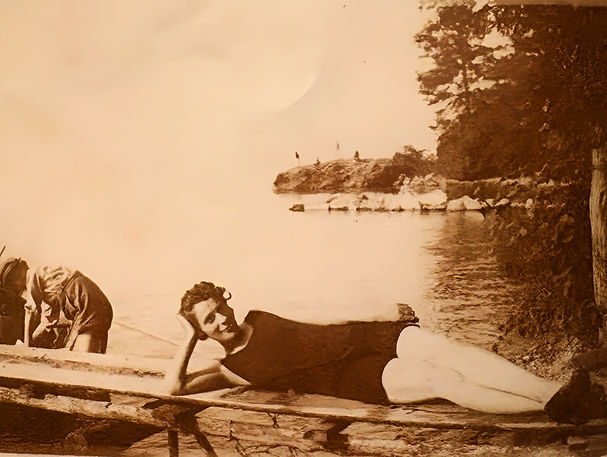

Once they arrived in Marseille, the Sternis family decided, according to Simon, his grandson, to recuperate after their long journey at a spa town in Wiesbaden, Germany. It was therefore in 1921 or 1922 that they settled in Paris.
They settled on Boulevard Magenta, between Place de la République and Gare de l'Est.
My mother never spoke to us about Abraham; we must not have lived in the same world. I don't know if my family associated with him. My grandmother was his niece.
I have no information about their life until 1939, except for his intervention to "help" his son Aron/Alfred who had done some stupid things and to meet his grandchildren.
He lost his wife in June 1931, she was 63 years old, and he lived with his youngest daughter Lola until his death.
He was in Amélie-les-Bains when the war broke out.
He stayed there, not returning to Paris.
He died at the Vernet Hospital in Perpignan, in May 1943.
It was his daughter Rose who took care of his funeral, coming from Saint Etienne de Vicq, about fifteen kilometers north of Vichy, where his family spent the war.


Aron/Alfred Sternis
Aron was the second son of the Szternis couple, but their fourth child. He was born in 1899 in Warsaw and died in Paris in 1981.
He was not part of his parents' fabulous trip.
In 1917, he had to attend cadet school in the Tsarist army.
I don't know how he experienced the Russian Revolution and how he ended up in Paris.
But in Paris, he followed in his father's footsteps and became a renowned jewelry merchant.
He married Monique Birsten-Binder (1907-2003) in 1926. They had two children, Jean Sternis (1927- ? ) and Francine Sternis (1929- ? ).
But to his passion for beautiful stones and their trade was added a risky taste for gambling, a real addiction, which led him to a game that was more than dangerous, as reported by several newspapers, such as "l'Oeuvre" on June 20, 1930:

Alfred and Monique 1926

" Charged with negotiating the sale of precious stones and jewelry mounted by various dealers in the Faubourg Montmartre district, a broker named Alfred Sternis, 35 years old, residing at 58 rue de la Roquette, fled with seven rings adorned with diamonds, a necklace of fine pearls, and a platinum and diamond bracelet that had been entrusted to him. The value of these various jewels is estimated at over 600,000 francs, and inspectors from the special brigade have been tasked with searching for the unscrupulous broker."
Complaints will be filed by about fifteen shopkeepers for an estimated loss of one million francs. He was wanted by the police and by criminals who had lent him money to pay off his gambling debts.
So he fled to Argentina to get away from the danger. His father, heartbroken, repaid the ill-advised loans.
He didn't want his own business to suffer because of his son's tactlessness.
This did not prevent Alfred from being convicted and banned from the territory for 20 years.

Jean, of course, doesn't have many memories of his father. He had a lot of trouble forgiving him for the breakdown of the family unit.
In a letter to one of his cousins, he recalled his only trip to Argentina to visit his father:
" I remember, for example, the sailors on the Buenos Aires ship, with their all-white suits; it was on the way there and back in 1932 and I was their mascot. They photographed me and showed me the engine room, several times.
My parents lived near a white building on which flew the flag with blue and white stripes and a yellow sun.
There was supposed to be a level crossing with dark red trains and an observation platform. " and he added: "I knew he had been convicted in absentia, but he didn't seem like a major criminal to me!"


Alfred has regained his fame in Argentina.
He conducted business transactions for Eva Peron. But the fall of the regime in 1955 prompted him to leave the country and start a new life, once again, in Chile.
There, he met his second wife, Cecilia Drob. She was younger than him but stayed with him until the end of his life.
In Chile, he associated with the least progressive circles, including Pinochet's junta.
I must have crossed paths with him twice in the company of Cecilia, at my aunt Marie's house, because he lived with her when he came to Paris for treatment.
Moreover, on his death certificate, he is domiciled at her address: 289 rue de Belleville in the 19th arrondissement.
He died at the Broussais Hospital, an annex, today, of the Georges Pompidou Hospital.


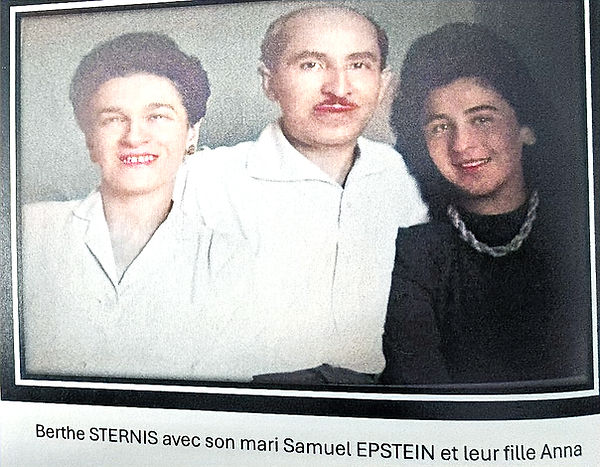
Berthe Sternis/ Epstein
She was born in 1898 in Warsaw and died in Paris in 2002.
Berthe was the third child of the Sternis couple. Like her younger sisters, she enjoyed a pleasant life in Warsaw. She was part of the "Grand Voyage".
Upon arriving in Paris, she was introduced to Samuel Epstein (1888-1950).
She married in 1924 in Warsaw. Her parents, along with Leon and Anna, made the trip for the occasion.


Berthe's marriage gave some members of the Sternis family the opportunity to return to Warsaw in 1924.

I didn't know Berthe, but I think she would have impressed me.
After the birth of Anna Epstein (1927-2022), Berthe declared to her husband that she would not have any more children.
That was how it was, and she kept her word.
I think she must have met with my Grandmother, because her name has remained etched in my childhood memory.
With Myriam, we met a little girl from Berthe, Eliane, who lives in Brussels.


Rose Sternis/Wagner
Rose's family, along with Anna's (Anjè for us) is the one with whom my family has kept the most contact, without cutting ties.
Rose was the fifth child of the Sternis couple, she was born in Warsaw in 1901 and died in the Paris region in 1994.
Her Warsaw youth passed without incident. Her family moved to Odessa in Crimea for almost a year in 1917, where she continued her secondary education.
Then she was part of the fabulous voyage that took them to China, then Japan, and as a passenger on the Maritime Company, to Marseille.

In Paris, she married Joseph Wagner (1901-1988) in 1927 at the town hall of the 10th arrondissement, and they lived on rue Houdon in the 18th arrondissement. He was a leather craftsman.
They had three children:
- Robert Wagner (1928-2020).
He first married Solange Millet (1930-2016) with whom he had 5 children
Patricia, Catherine, Isabelle, Olivier and Frédéric Wagner.
He divorced and remarried Josiane, with whom he had 2 children: Laura and Charlotte Wagner.
- Philippe Wagner (1929- 2017).
He first married Alice Raille, with whom he had a child, Stéphane Wagner. She died of illness at the age of 24.
He remarried, this time to Ursula Gorlitz , and had a daughter: Martine Wagner.
- Myriam was born in 1934.
She married Simon Tamari (1932-2020) in 1961 in Paris.
They had two children: Serge and Nadine Tamari.


Rose is learning the piano under the watchful eye of her teacher and her sister Berthe.
Philippe, Myriam and Robert in 1941

On the left, the Wagner family in their apartment on rue Houdon;
On the right, after class in St Etienne de Vicq, during the war.

Myriam's father, Joseph Wagner, was mobilized in 1939.
Alone with her three children, Rose found refuge in the village of St Etienne de Vicq, where her sons were (or had been) at a summer camp, about fifteen kilometers north of Vichy.
They spent the entire war there. The three children attended school there. Joseph joined them when he was demobilized. He did various jobs for farmers. His courage and abilities were noted.
Everyone in the village knew they were Jewish, but they were respected, except for the Mayor, who, despite his prejudices, could not harm them.
In 1943, Rose learned of the death of her father Abraham in Perpignan. She took care of his funeral and returned with her sister Lola who stayed in the same village.
Around Christmas 1944, when the railway lines between Vichy and Nice were restored, Joseph Wagner took Myriam and Lola to join Anna Wald and Ita in Nice. Lola stayed in a boarding house and Myriam with her aunt and cousin.
With the war over, the whole family returned to Paris.


Rose surrounded by her three children and Simon Tamari

Berthe, Lola, Ita, Abrazam and Joseph Wagner
My memories with Myriam, more so than with Rose - because I was still a child - date back to the late 1950s. Already a teacher, which impressed me, she took me to visit the Louvre with my cousin William: it was the first time I had ever been to a museum.
My sister Catherine remembered that she had given her a "Caroline" album, much more racy than the "Martine" books that praised the fairies of the hearth!
Myriam kept in mind the circumcision of my little brother in November 1955, which took place at my parents' house.
Then life took us down different paths.
Myriam and her family lived in the suburbs, which made it difficult to meet people.
Nevertheless, my parents continued to see Rose and Myriam, sporadically, especially when Rose entered a retirement home.
We reconnected after the death of my parents.
Completely by chance, at the school where I worked, I ran into a fellow teacher. While chatting, we discovered we shared common political views. Upon hearing her name, Catherine Wagner, I asked her if she had any connection to Robert Wagner, a distant cousin of my mother's. She was his daughter. When I spoke with my mother, she confided that her mother and Rose were considering arranging a meeting between them with a view to a possible marriage.
But my mother's youth was in the immediate post-war period, and Robert's too, defied ancestral traditions.
My cousin William told me about his chance meeting with Philippe in a professional setting. They met several times after that.

Completely by chance, at a school where I worked, I found myself in the company of a fellow teacher. While chatting, we discovered we shared common political views. Upon hearing her name, Catherine Wagner, I asked her if she was related to Robert Wagner, a distant cousin of my mother. She was his daughter.
When I talked to my mother about it, she confessed that her mother and Rose were thinking of bringing them together with a view to getting closer.
But my mother's youth was in the immediate post-war period, and Robert's too, defied ancestral traditions.
My cousin William told me about his chance meeting with Philippe in a professional setting. They met several times after that.

Robert in 1949


Myriam and her brothers
Robert and his daughter Catherine


My aunt Marie and my mother
visiting Rose,
in the company of Myriam
My father,
my mother and my aunt Aunt
visiting
at Myriam's
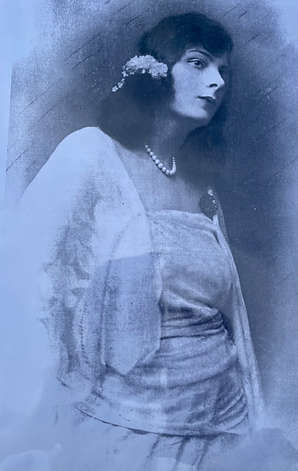
Lola Sternis
She was the youngest of the siblings.
She was born in Warsaw in 1909 and died in France in 1988.
Like her sisters, she had a comfortable childhood and experienced the great adventure of the fabulous journey.
I never knew her, but in our family, she was considered an enigmatic woman. She suffered a great heartbreak that led her down the path of depression, and she had neither husband nor children. She was a beautiful woman. And her name made us dream, a bit like Lola Montes.


Our common ancestors do not guarantee the maintenance of ties.
Over generations, the paths diverge
to the point, sometimes, of losing culture, language, and traditions.
This is the case in all families.
The "cousin reunions" initiated by Claude STERNIS are
One way to stay in touch,
Genealogical memory is another one!