
Family genealogy
The Story of Uncle Jack
Jack left a testimony as part of the Spielberg Foundation.
This is the name he adopted in his Australian life. He was born Itzak in December 1926 and used this name until 1950. In Australia, he changed his surname and anglicized his first name: Czalczynski became Cutler, which sounded more "English".

My uncle, Itzack Czalczynski, will become
Jack Cutler
A sacrificed youth
His mother, Feigle/Fanny Mordkovicz, my father's stepmother, came from the village of Jedrzejow, where Mayer Ber, his other half-brother, the eldest of the siblings, had married in 1938. He remembered it.
He shared some family memories with us, which were a little obscure. Fajgla's sister, Gitla, Monowicz (her married name), had left for Argentina in 1939. Jack and my father corresponded with them in Yiddish for a long time; they lived in Buenos Aires.
More specifically than my father, he remembered the name of his father's brother, Usher (Haim or Pinkus according to his birth certificate), a butcher, and a sister, Ethel (who, in his memories, hosted his mother in Poland when she went to Jedrzejow). Ethel had two sons and a daughter. Her husband's name was Meruel Dembowski.
My father had a poor understanding of the family's connection to Kasriel, whereas Jack had a clearer memory of it.
"We were poor, but we had a very good life, very friendly and happy," he said.
The house, a large room, was also his father's workplace; he was a rope maker. The ropes were used to tie carts to horses. The whole family was involved in their production. His older brother, Mayer-Ber, nicknamed "Malbey," helped his father run the business. Jack often accompanied him to markets in various towns in the Kielce region. Wloszczowa, his hometown, was very popular: many Jewish shops, butchers, tailors… The Jewish community made up about half the town's population. It had synagogues, midrash houses, and little prayers rooms. According to Jack, it was a vibrant and joyful town.
However, his school memories were more painful. He was the only one of the four brothers to attend public school, not the "Heder" like the others, starting in 1933. He completed primary school. (Primary school since independence lasted six years, from age seven to thirteen, followed by a year of preparation for secondary school.) He was about to start secondary school when the war broke out. In that small town, there was no private Jewish school that taught in Yiddish.
To get to public school, he had to walk a long way. He got up at six in the morning to be there by 8:30. The hardest times were the very snowy winters. His teachers weren't "nice" to the Jewish children, who made up about thirty percent of the student body. They made antisemitic remarks and demanded bribes to move up to the next grade, even for the good students.
His schooling covered the years 1933-1939, a period when the nationalist right was waging terrible antisemitic campaigns. These campaigns reverberated in schools and universities. Teachers always tended to believe non-Jews when conflicts erupted, he said. One day, for example, when he was beaten up, the teacher initially ignored him and then told him it was his fault. He often came home with a bloody head and nose. His classmates frequently bullied their Jewish classmates. Resigned, he observed that he was paying the price for being a minority.
After school, he went to the "heder," which seemed more "relaxed" to him. On the other hand, he was too young to participate in the existing youth movements in Wloszczowa: Betar, the communist-leaning Poale Zion, Hashomer Hatsair, and other Zionist organizations.
His two older brothers were more politically active: the eldest, Mayer Ber, had joined the Polish Communist Party, and the second, Shmil, Betar. He liked to follow him on Saturday afternoons, along with his group. They had a large meeting place, and sometimes they marched in uniform. Jack loved wearing one too and playing with a drumstick. He didn't remember any anti-Semitic attacks during these marches. However, on May Day, memorable fights would break out. Yet the city was heavily policed.
Kasriel, his father, was an Orthodox Jew. All the children had received a religious education, but the eldest no longer practiced outside the home. However, out of respect for their father, they observed Jewish traditions, covering their heads when eating, and all the major Jewish holidays were celebrated as a family: Yom Kippur, Passover…
Outside the home, his father was tolerant. He knew the older children were no longer practicing, but as long as they respected the traditions at home, he didn't bother them. However, being much younger than his brothers, Jack (11 years younger than my father) had to accompany his father to the synagogue on Shabbat and holidays. "I couldn't play with the other children; I had to sit next to him!"
War has broken out
When the war broke out, Jacques was thirteen and a half years old; it was the year he learned to put on his tefillin.
No radio at home, but Yiddish newspapers reported on war preparations… It was far away.
They knew it was real when the authorities ordered the population to cover the edges of their windows with tar-coated paper to prevent gas from seeping into their homes. They also had to tint their windows with paint. The following day, the Germans entered the town. It was very quick. The Polish army offered no resistance; they just dropped a few bombs! And the Germans were in the town on the third day of the war. Wloszczowa was sixty kilometers from the German border.
The Germans marched by the thousands, day and night.
"I was very young, I had, of course, no idea what awaited us. I had never known war. For me, it was just an army parading."
A few days earlier, his mother had sent him to look for his brother, Moshe. He was supposed to be drafted into the Polish army just before the Germans arrived. But he didn't find him. He would later learn, perhaps from Schmil, that his unit had left for the Polish part occupied by the USSR, and that he was a prisoner of the Russians.
For Jack, barely a teenager, the first few weeks didn't seem dramatic. It was, he thought, just a new army. He moved between the German army and the prisoners. There was no hunt for Jews yet, and he wasn't recognized as one. He felt quite free and brought home lots of things from the German army—bread, cigarettes. However, his family was very worried and knew what was happening in Germany through the newspapers. For them, it was the beginning of a tragedy, but they didn't have the financial means to leave Poland. His brother, Schmil, was about to leave for Palestine with Betar, but events prevented him. The whole family stayed together until the establishment of the Ghetto.
The first restrictions, for both Jews and Christians, involved food rationing. People started scavenging in garbage cans in various places. Some left the city and headed into the countryside. They bartered to bring back food. Because Jack was young, he felt more at ease. Not looking very Jewish, with his thick hair and round face, he passed through checkpoints fairly easily. At first, things went well, before gradually deteriorating, and then really getting worse a few weeks later when the Germans imposed a curfew from 5 p.m. to 6 a.m. the next day. It became terrible! Sometimes, when the Germans patrolled, or even the gendarmes, they would knock on certain doors. Drunk, they would drag Jews from their homes and torture them in the street, just for pleasure. Kasriel, his father, could no longer go to the synagogue, neither in the morning nor in the evening. He prayed at home. The war immediately impacted his work: the farmers who bought his ropes no longer wanted to come to town. The markets were dismantled by the Germans, who used the spaces for their army. He was dependent on the resourcefulness of his Polish customers. Life quickly became difficult.
Their primary concerns revolved around how to earn a little money and food. As for the young people, like Jack, they continued to play together. When they found a place out of sight of the Germans, they played ball. At first, the parks weren't off-limits to Jews. In fact, their only real fear was still the authority of their parents, who constantly said, "Don't do that, don't go that way!"
Jack remembered that at the beginning of the war, he had even been a little excited. But relatively quickly, worry replaced the excitement, especially because hunger was beginning to gnaw at him.
The wearing of the white armband adorned with a blue Star of David became mandatory a few months later, at the beginning of 1940. Jews could no longer travel or leave the city without authorization, which was very difficult to obtain.
It was certain Jewish organizations, like the Welfare Society, that organized aid. This society existed before the war, as did other community organizations. They lent money to disadvantaged people so they could live. They repaid when they could. They continued to operate during the war. Jews caught without their armbands were beaten, or even disappeared forever. Very religious Jews with long beards were often harassed. Some soldiers would pull their beards, mock them, and never answer to their superiors. They had absolute power over the Jews! Jack remembered a Ukrainian man who had joined the Nazi army. When he patrolled on his white horse, he had made a habit of dragging passing Jews, tied to his horse. Jack himself didn't suffer such acts, nor did his brothers, who often left home and hid in the forest during raids. Kosher meat was only available in the surrounding villages. It arrived wrapped in linen, hidden in a cart under straw. Depending on one's resources, through bartering, one could obtain three, four, or even seven kilos. But bread was very difficult to get; you had to wait in line. It was Jack's job to be at the front of the line. Sometimes, when his turn came, there was nothing left! When he left the house, looking for food or things to barter, fear gripped him. One day his father, who still wore Hasidic clothes and a very long beard, told him to stop, to be careful, and not to endanger the whole family. He had to stop smuggling.
The Time of the Ghetto
Then came the Ghetto in mid-July 1940. All the Poles in the Jewish quarter were evacuated. A small farmhouse, consisting of two rooms, was allocated to the Czalczynski family. There was also a small garden with a cow and a goat. The blacksmith who lived there was moved out of the ghetto. His parents were allowed to take their furniture and clothes in a horse-drawn cart. They shared this house with three other families. Thus ended the black market with the Poles: they were not allowed to trade with the Jews, and the Jews could not leave the ghetto. Barter took place within the Ghetto, using what they had managed to take from their homes. Going to the market was no longer an option. Then rumors began to circulate about roundups of "young volunteers" being sent to labor camps. His brothers went to hide in the forest where tunnels had been dug. Often, Jack was left alone with his parents. He was the one who provided food. He managed to sneak out of the Ghetto and bring them carrots and potatoes. When he managed to go to the surrounding villages with his friend Pinkas Gross (who survived and lived in Haifa after the war), he would approach the German army to get tobacco. He had his own small cigarette-making machine. Together with Pinkas, they cleaned the tobacco, rolled the cigarettes, and packaged them, which they sold to the Poles. Since many smoked, it had become a good business. In any case, cigarettes couldn't be found anywhere else. They also sold them in the ghetto. This way, they were able to bring back food for their families.
The Ghetto was guarded by Poles who had sworn allegiance to the German army. The Germans didn't send them to the front. They watched over the ghetto, and often they were worse than the Germans! Before the war, these Poles hated Jews. And as soon as they had rifles and clubs in their hands, they did whatever they pleased to the Jews: mocked them, made them walk on their knees… Anything that amused them. They were horrible. You could see them patrolling in jeeps, riding horses… The Germans demanded that the young men do odd jobs, like filling in the riverbanks. It was terrible; you had to stand in the water up to your knees and plant patches of grass on either side of the bank, after cutting the grass first. It took two people to carry them because they were heavy. That's how the banks were covered. In winter, carts had to be filled with ice and distributed to various locations: large chunks of ice blocks were cut and salted to preserve them until summer. This was used to preserve meat and other foods. The work was hard from morning till night. If you weren't in charge of the carts and horses, and if you were lucky, you might get to go home early.
The ghetto was cut off from the world. The only information that filtered through about the war came from those who managed to slip out and from the Poles who trumpeted the merits of the German army's advances. It was very hard to hear. At first, there were no deportations per se, but Jews who were well-known and respected in the city were abducted. Germans and Poles demanded ransoms from the families. But even if the families paid, they never saw their relatives again. What they wanted was the Jews' money and their property. In the Ghetto, there was a Jewish police force and administration.
One day in May 1941…
Jack, on a beautiful, warm day, was on his way to meet his brothers. He was wearing his tefillin when the Germans took him. They demanded he tell them where his brothers were. That was the condition for their leaving him alone. They were looking for older Jews. Jack told them he didn't know where they were, so they took him away. That day, the Germans rounded up many Jews. Jack remembers a Lantzmann he met again in Melbourne. The Germans herded them into a place near the synagogue. He caught a glimpse of his parents through the wire fence, and they waved goodbye. That was the last time he saw them. He was fourteen and a half years old. At nightfall, the soldiers loaded them into trucks headed for Skarzysko-Kamienna. They were old, open-topped trucks with high sides to prevent escape. They were so overcrowded that it was impossible to sit down. All the prisoners were packed tightly together. Four guards were on board, one of whom, with his submachine gun facing the prisoners, was sitting on the roof of the cabin. The journey lasted all night. There were certainly some who managed to escape during the night, but the vast majority clung to life, even though the conditions were deplorable. At dawn, everything happened so quickly; they took him to a newly established camp. Skarzysko was divided into three camps, each 10 kilometers apart.
4 years in forced labor camps
He stayed in Skarzysko-Kamienna for almost 3 years
In Jack's camp, the prisoners all slept in one large room. Upon arrival, they found "cornflakes" made from potatoes. They saw rats that had gorged themselves on potatoes, some as big as cats: horrible! Jack stayed there for a few months before being transferred to a new munitions unit.
This labor camp was not a concentration camp. The slaves worked twelve hours a day, seven days a week. Food was strictly rationed, but the prisoners had numerous breaks, well-organized by the supervisors and foremen. It was possible to barter with them and the Polish workers. The conditions were not as deplorable as in a concentration camp. Jack met many people from his town and the surrounding villages, as well as his cousin Perele Fajgenblatt and her husband Abraham Frucht, who had lived in a neighboring town before the war. They could meet up in each other's barracks whenever they had free time. For months and months, they grew accustomed to the misery… Life went on.
By obeying orders, everyone kept themselves out of trouble in this factory where machine gun bullets were made. If a mistake was made, for example, if the bullet wasn't properly seated in its casing, and a German or Polish inspector noticed, the whippings rained down: ten, fifteen for one mistake, and if there were more, it went up to thirty lashes. They could also lock you in a room without windows or light. Jack was whipped one day when he received a bad batch of casings: the markings on the bullets weren't properly aligned. This was noticed during the inspection. But the worst part was working at night. During the day, it was impossible to sleep; people snored and groaned. At work, around three or four in the morning, you'd fall asleep. Then the SS would come and beat you to wake you up. Life was very hard, but the will to survive remained stronger than anything. Sanitary conditions were appalling: no running water, nauseating smells. Moreover, there were many diseases like typhoid. And therefore, many deaths. Jacques remained in this camp for eight months.
In this camp, Jack contracted typhus. There wasn't much to be done, and certainly no medicine. He was isolated in another barrack. He remained lying down for long periods due to a high fever. When the woman who guarded their barrack went out, Jack would take the opportunity to get out of his bunk and plunge his head into a bucket of cool water to bring down the fever. Diseases spread quickly in these barracks, dozens of meters long, with three tiers of bunks stacked one on top of the other. At this rate, he was cured in a week, at the cost of significant weight loss. The "cure" diagnosis was drastic. A German doctor would come to the barrack and draw a white line on the floor. Those who walked perfectly straight along this line were declared cured. Then they could return to work. The others either disappeared, or, the luckier ones, were kept in the barrack.
Just before falling ill, Jack had been considered for a job as a gardener in the camp commandant's garden. The commandant lived in a beautiful manor house outside the town. It was a real stroke of luck. He didn't know how to garden, but the two other prisoners would have taught him. They had enough food for twenty people. And that's when the fever struck. So he lost that job that would have been a lifeline. He went back to the factory. In a new position, he had to drill tiny holes, like pinheads. He had to be careful: at the slightest mistake, he'd be beaten. He stayed in that camp for over a year.
Transfer to a factory in Czestochowa
As the Russians approached, the Nazis transferred them to Czestochowa, further west, by train. These were cattle cars, with a small barred window. The carriage was armored. The train passed through Wloszczowa, and Jack dropped a piece of paper with his name on it. He never knew what became of it, or if his parents were still there. Some Poles had told them that Jews were being deported and that they saw trains full of Jews heading for Treblinka. They added that there, they were gassed. The atmosphere was very tense. The prisoners were gripped by the fear of going there. They had to keep working at all costs to avoid being sent. The train took several days to arrive because the Russians were bombing the railway lines. It stopped along the way, but no one knew where they were.
When they arrived at this new camp, the prisoners were directed to a large, two-story building. They resumed work manufacturing munitions. The conditions were the same as at Werk A. They could barter with the Poles, and everyone thought that conditions hadn't worsened. Sometimes, Poles who were more respectful than the others shared their sandwiches with them. Jack lost some friends there, including the son of a neighbor from Wloszczowa. He had worked during the day, and the Germans had decided to make him work at night. But the Russians were closing in very quickly. The day before the camp was liberated by the Russians, Jack found himself on a cattle car bound for Buchenwald. Because the tracks were bombed, the train took more than a week to arrive. It would stop in the middle of the night and leave again the next day: the journey was mostly made at night.
Buchenwald
In early January 1945, there was a lot of snow. It was bitterly cold; everything was frozen. The prisoners had to spend their first night outside, as there were no barracks. Upon arrival at the camp, their heads were shaved, then they were disinfected and made to put on the concentration camp uniform, along with a long coat and a small head covering. Everyone could see that the situation was going to get worse: barbed wire, SS men everywhere, dogs, electric wires… The camp seemed very well organized. It was 9 km from Weimar. When the city was bombed, the Nazis would take prisoners from the camp to clear debris from the houses and collect bodies from the surrounding area. Jack only did this once. The prisoners would bring back to the camp a piece of bread and a few potatoes they had found there, which they would then hide.
He was assigned a six-digit number: 972130. It was sewn onto the top of his garment. The Nazis called them by their numbers. It was completely different from the labor camps. Each person was assigned a barrack. At the labor camp, Jack was with young men; here, he found himself with "old men." He thought the Nazi guards didn't care about their living conditions. At first, they stayed inside, often lying down, but they could sometimes take a short walk around the barrack. It was difficult because the floor was littered with bodies, and the smell of the gas chambers was oppressive. Every morning, the prisoners carried the dead out of the barracks. They were collected from time to time and burned in the crematoria. Sometimes, to pass the time, they talked amongst themselves. They were asking each other their names and that's how he found his cousin's husband, Abraham, in the building next door.
At the center of the camp was the Appelplatz, a very large open square. Everyone came out of their barracks, lined up, and was counted. If someone was dead and missing, they had to be brought back. If someone had escaped, the prisoners remained standing until the guards found the fugitive or until he surrendered. Escapes were rare, only possible when groups of prisoners went to work outside, near the factories.
Jack was selected to go to an outside "kommando" (work detail). They called his number, and they had to leave within two days. They distributed warmer clothes: thick trousers, boots, and an overcoat with painted red stripes. That way, it was impossible to sell!
It was precisely at that moment that "luck" smiled on him again. The "commander" of the group of young men from the Czestochowa factory, a Czech man named Gustav, noticed him and took him into his group. This saved him from the outer work detail. He took him to Barrack 66, where there were other young men. It was at the far end of the camp, near the electrified fences. He felt a little safer there than in the other barracks. There were thousands of young men in the camp. He would later learn of a women's camp 9 km away. Despite this, the living conditions were very poor: no straw on the sleeping boards, disgusting blankets. From time to time, they had their lice-infested clothes disinfected. It was truly a miserable situation, but after a while, no one paid any attention to it anymore. For food, they were allotted "200 grams of bread, so soggy that if you threw it against a wall, it would stick." This was accompanied by a very "meaty" soup, often lentil soup. In the morning, at 5 o'clock, a kind of coffee was served to them in a tin can. Some people cut their bread into small squares, ate one, and kept the rest for later use. Jack couldn't do that; he ate his bread in less than two minutes. Some stole food while others slept: like dogs against wolves. There was no mercy.
In the barracks, daylight was barely perceptible, so when they were confined there, they did nothing except sometimes chat. They were fortunate to know a scholar, an educated man named Jacky Nukowski. He told the other prisoners stories in Yiddish, anecdotes, and books he had read. Sometimes he gave sermons, telling them they would make it and, above all, not to forget their religious affiliation. This helped them persevere. He survived, like Jack, and they met again in Melbourne.
The winter was terrible, but when the weather was nice, they could go outside their barracks. It was a little different for the political prisoners—German, Russian, Dutch, and even Scandinavian. Jack saw them playing ball. But they were too far away to make contact. The camp stretched for miles and miles. It was as big as a city. If the day was sunny, they would sit outside for a while to get some fresh air and warm up a bit. They also saw Roma people, but they were separated from them and penned up at the edge of the camp. The camp kept expanding while he was there.
Jack had lost all hope of ever seeing his parents and family again. Those arriving from Auschwitz told stories of what had happened there. The prisoners knew and expected to suffer the same fate at Buchenwald. In the six weeks leading up to liberation, planes circled above the camp, leaving trails of smoke and bombing the surrounding area. They regained a glimmer of hope; something was about to happen. The Nazis were becoming increasingly irritable, and the prisoners had to avoid drawing attention to themselves. Gustav, the leader of the youth group, took charge of the assembly area (Appelplatz) in the last month. The SS counted and took groups of young men to be executed outside the camp. Gustav told his young men that immediately after being counted, they had to return to the barracks as quickly as possible. It was a game of cat and mouse. Gustav, a political prisoner, truly protected "his young men." He had a green triangle sewn onto his shirt. He made us make one, so that "his" young men could be distinguished from the Jews. The Jews were more vulnerable than the political prisoners. For three weeks, this little game continued. They heard groups being killed outside the camp. They survived like this, until that day in April when they saw an American tank arrive.

Jack
Elie Wiesel
This photograph, which became famous due to the presence of Elie Wiesel (age 17), also shows Itzack Czalczynski, who was 19, and Naftalie Furst, who was 13, in Block 66 of Buchenwald.
Release
Despite everything, they were afraid to go outside and be shot by the American soldiers. The first thing they did was cut the electricity to the barbed wire. They went to inspect the gas chambers. Then they disappeared for two or three days. It was a bit chaotic: no one to tell them what to do, no one to take care of the survivors. The Russians who had passed through took all the machine guns and went hunting for Germans. After a few days, the food rations arrived. The Americans cooked for us. Unfortunately, many died; no one to tell them how to eat after so many months of deprivation because no one had enough to eat. Jack remembered eating rice, prunes, and pork. So much fat, all of a sudden, caused diarrhea and illness. No one was used to eating fatty foods anymore. Thirty to forty people died that day.
The survivors remained in their barracks for a few weeks while the Americans fumigated the SS living quarters. Then they were transferred there with mattresses, clean blankets… Almost luxury.
The young people in his group remained in Buchenwald for a few months. He was asked if he wanted to return to Poland, but he refused. Rabbi Schacter organized the young people's departure. France agreed to take in many of them, under the auspices of the OSE (Oeuvre de Secours aux Enfants), as did Switzerland.
The OSE (Children's Aid Society) played a significant role in France in rescuing Jewish children. It responded to a telegram from the commander of American troops at Buchenwald: "We have found a thousand Jewish children at Buchenwald. Take the necessary steps to evacuate them without delay." The OSE, in conjunction with the Joint, was entrusted with the care of these children. However, discussions regarding their repatriation were arduous and lasted two months. Ultimately, France took in 480 (notably in Écouis), Great Britain 250, and just over 400 in Switzerland. The OSE became a Jewish organization dedicated to helping disadvantaged children in France in 1933.
Jack was assigned to Switzerland. It was the rabbi who accompanied them by train, a real train with seats and berths.
On the way to Switzerland
The journey lasted a week because the tracks had been bombed and needed repairs. Upon arriving in Switzerland, they faced another problem. Switzerland had agreed to take children, not older teenagers. The Americans had to use all their influence to convince the Swiss. They finally agreed to a single condition: all young people over 16 had to be two years younger. That's how he ended up in Switzerland: he was eighteen! But there he contracted tuberculosis and spent several periods in a sanatorium. He received excellent care. The food was good and balanced, and the rest was invaluable. For him, there was only one problem: too much food. In this center, 350 survivors lived together, including a group from Lugano who were waiting to leave for Palestine.
Once he was recovered, he was sent to Geneva to learn a trade under the auspices of the ORT (Office of Refugees and Stateless Persons). Several fields were offered: dentistry, hygiene, commerce, and engineering. At first, he wanted to become a chef in the kitchens of a large hotel. But he didn't take to it; there were too many onions and garlic to peel! Since he enjoyed working with tools, he finally chose engineering! He searched extensively through lists, registers, and notice boards of the Red Cross and other organizations collecting the names of survivors, without finding any trace of his family. This card later allowed Jack, in France, to receive additional food rations and other benefits in certain areas.
He was alone, and it was very difficult for him. He had no choice but to make friends. Things had changed, and he tried his best. Little by little, life returned to normal. He went out on Fridays and Saturday nights, going dancing. He even met a kind Swiss family, but the war was never mentioned. They didn't ask any questions; he thought they knew but didn't want to talk about it. Language wasn't a problem for him; between German and Yiddish, he managed. Then, to study, he went to French-speaking Switzerland and had to learn French. He stayed in a luxurious villa belonging to the Dutch embassy: three or four people per room, a toilet, a bathroom… pure luxury! Meanwhile, he found his brother Schmil. Since Schmil (it,s likee that he appoints my father) couldn't enter Switzerland and was in Munich, the authorities issued him a stateless person's passport, which allowed him to travel. All his companions received one, as they all renounced their Polish nationality. After this reunion, Jack wanted to join him in Paris, where he had settled at the end of 1946, once he had finished his studies. He obtained a transit visa via Belgium. Another cousin picked him up at the train station; this cousin knew how to obtain a residence permit through connections with the police.
Jack in Geneva in 1946

In Paris with his brother
He stayed in Paris from 1947 to 1949. He worked in the shoe industry with his brother, though he didn't particularly enjoy it. But they had to earn money. Since they were seasonal workers, they only worked half the year. They shared a very old-fashioned hotel room. The shoe trade was very popular in Paris, but there weren't any large factories like in the US or Australia, only many small shops and workshops. He nailed on the soles and cut the uppers. They worked for several small employers. At that time, rationing was still in place, and most people still didn't have enough to eat. As a young adult, Jack received chocolate bars, butter, and a few other foodstuffs. The food supply began to improve with the Marshall Plan.


Jack embarked
June 1, 1949 in Genoa on
the "Syrenia" ship
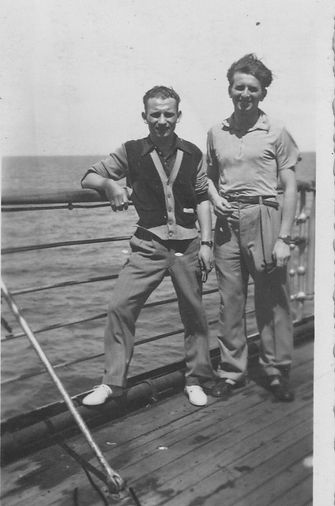
Uncle Jack on the boat en route to Australia, June 1949
On our way to Australia
So Jack set off on a ship, the "SS Sardegna," small but comfortable. He shared his cabin with four other travelers. It was very clean, and the food was plentiful and good. The ship's captain was Greek, and the crew was respectful of Jews. They had a splendid voyage. Four other Jewish emigrants and Jack had left under the auspices of the "Welfare Society." They disembarked in Perth and were taken in by Jewish families of German origin. But the families didn't speak Yiddish well, and Jack didn't speak English.
Fortunately, the Levin family, with whom Jack was staying, still spoke Yiddish. This made his job search and paperwork easier: the Levins helped with translation. His biggest problem for a long time was the language barrier, which made it difficult to integrate into Australian life. Jack had to buy a small dictionary, which he always carried with him. He found work in various small shops and once even worked for a large American company. They were entitled to a tea break in the morning, another in the afternoon, and a lunch break. He couldn't believe it!
Uncle Jack in Perth in 1950

