
Family genealogy
Mother, Suzanne Leizerson
My mother was a real character, a strong-willed woman. When I was little, she was tireless. I still remember the Sunday morning shopping trips: when I went with her, I was always 5 to 10 meters behind her, she walked so fast. My parents worked together in their small shoe factory. She would leave early in the morning, come back at lunchtime to feed us—we never stayed in the cafeteria—and then go back to the workshop, returning around 6:30 p.m. Sometimes, she would go back to the workshop in the evening. She was incredibly energetic.
In the family, everyone called her "Zizi", certainly a diminutive of his Yiddish name, "Zisse Scheindle".
Childhood
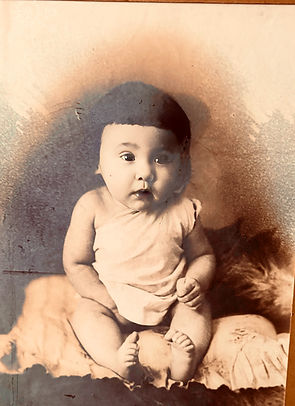
She was the youngest of the siblings, born on August 26, 1926.
It had been reported to my grandmother as a cyst. Hava was 43 years old. Her older sister, Marie, was 12, Annie was 10, and Salomon/Raymond was 8.
When she was born, her family still lived at 7 rue St Claude, 6 of them in a small two-room apartment.
Her parents were not yet naturalized French citizens; they would be two years later.
The political and economic situation was hardly encouraging.
The ruling Left-wing coalition collapsed, various governments succeeded one another, and the franc fell. The law establishing the "foreign worker" identity card had just been passed.
The horrors of the Great War seemed to be receding. Aristide Briand and Gustav Stresemann sealed the Franco-German reconciliation.
In December, they were awarded the Nobel Peace Prize.
Also in December 1926, Pope Pius XI condemned the doctrine of Action Française (anti-Semitic far right) as well as the works of Charles Maurras.
Suzanne was born at the time when Raymond Poincaré led France (until November 1928) as part of a "National Union" government attempting to end the financial crisis.
I know nothing of what her parents thought of the situation in France. In the 1930s, anti-Semitism resurfaced, mingling with the denunciation of "Judeo-Bolshevism," stimulated by economic crises, particularly after the 1929 stock market crash in the USA and the increase in unemployment.
Was it this reality that led her father to write to "Le Populaire", the SFIO's evening daily newspaper, with a circulation of a few tens of thousands? In 1927, Léon Blum was its editor-in-chief.
I do not know the reason for my grandfather's request. But what was passed down to us by my mother was the cryptic response from the SFIO deputy Fiancette (who would later support Pétain): "Gentlemen, foreigners are asked not to interfere in French politics."
My grandparents obtained their naturalization papers in 1928. And in 1931, they secured their relocation to an HBM estate, a three-room apartment with a toilet where the whole family moved in.
I wonder today how they divided themselves among the rooms: four children aged 17 to 5 and 3 rooms? Certainly the kitchen was large. They had a dining room.
So, four children in the same room?
I know this apartment well: I lived here until I was 18. My mother lived here for 38 years.
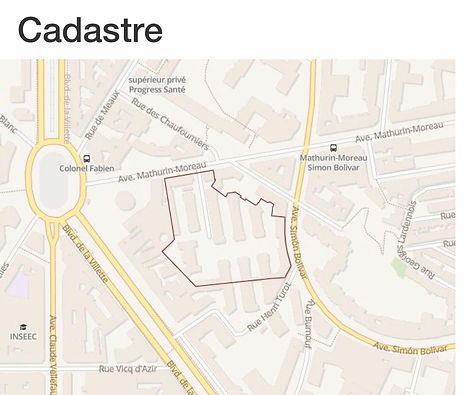
This estate had three entrances, my family's was located at 97/99 Avenue Simon Bolivar, two other entrances, rue des Chaufourniers and Avenue Mathurin Moreau, provided access.
More than 400 families lived there. The construction of this HBM (Habitation à Loyer Bon, Marché - low-cost housing) had just been completed in 1931.
The Leizerson family moved into a new home.
We lived on staircase P, on the second floor, apartment 277.
To access the courtyard of all these buildings, one had to go down a flight of steps with two staircases on each side.
At the back of the courtyard, there was a municipal kindergarten, which welcomed the children of the city.
I don't know if my mother was enrolled there during the year 1931/32.
However, my sister and I attended it from 1954 (for me, later for my sister) to 1957. In October 1957, I started "big school". The CP (preparatory course, first year of elementary school) was still in the premises of the nursery school at 65 Avenue Simon Bolivar; my sister Cathy was enrolled there in the final year of preschool.

The photo on the left shows the city from the steps of Avenue Simon Bolivar.
We were staying in the second block of buildings on the left.
The corner window on the 2nd floor (above the white one) was my parents' bedroom after having been my grandparents' bedroom.
This group of children with Father Christmas, Raymond (on the left under the man in the cap) and mother (first on the right in a dark coat), must date from December 1931 or 32.
It was taken in front of the store (a kind of mini-market of the time) "Goulet Turpin".
On the left, there was a pharmacy and to its left the entrance to 97/99 Avenue Simon Bolivar.

School time
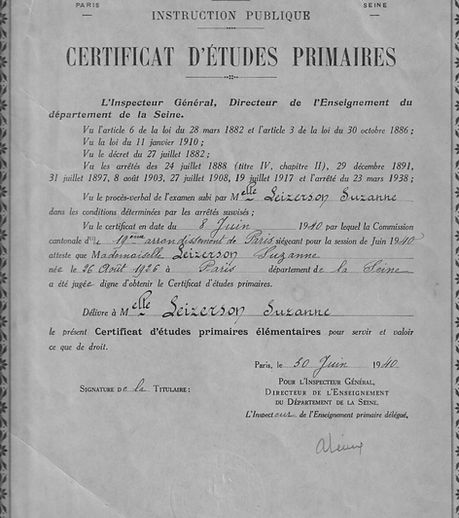
Suzanne was enrolled at the girls' school at 119 Avenue Simon Bolivar, on October 1, 1932. She remained there until June 1941.
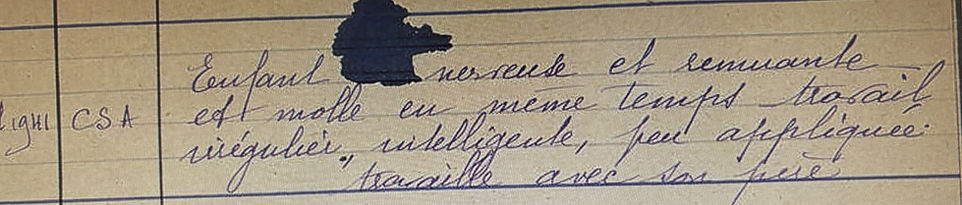
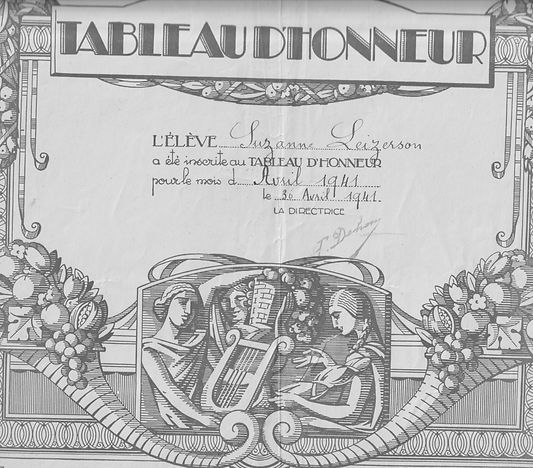
Her schooling seems to have gone smoothly. The final assessment in her school register, dated June 1941, is completely contradictory: "nervous, restless, and listless"? I myself, the headmistress of that same school in 1998, observed that the pre-war headmistresses' assessments were based on very hasty value judgments. Suzanne had been placed on the honor roll in April 1941!
However, the fact that she mentions working with her father may explain her irregular employment. The declaration of war and the year-long presence of Germans in Paris also explain it.
She obtained her primary school certificate in June 1940, after five years of elementary school and two years of post-secondary education. She continued for one more year in a supplementary course to learn accounting. But this was only for one year, because the statute on Jews, defined by the Vichy regime, was being implemented.
The first statute on Jews was published in October 1940. It imposed a biological definition of a supposed Jewish race. It excluded Jews from the civil service, cinema and theatre, the press, and, in the process, authorized and organized the internment of foreign Jews.
I don't know how Mom experienced those decisions. She was 14 years old. Insecurity must have set in quickly.
In June 1941, the second Statute on Jews was enacted, reinforcing their exclusion from the liberal professions, commerce, crafts, and industry. This statute required Jews to report to the police station to be "registered" under penalty of internment. Spoliation was implemented in July 1941, placing Jewish property under provisional administration.
This is enough to sow confusion in the attitude and thoughts of a teenage girl.


Apparently, Suzanne did dance outside of school, culminating in an end-of-year show at the theater on Rue Yves Toudic, near Place de la République. But that's all I can remember about her youthful hobbies.
My biggest regret is not having questioned my mother, as I did with my father, about her childhood, adolescence, and war years.
At ten years old, I don't know how she experienced the Popular Front, nor what her family thought of it. Were there discussions about the actions of anti-Semitic leagues and the reactions of the far right to Léon Blum's arrival in government?
And when Hitler came to power in Germany in 1933, did they take any action, any surge of solidarity with those German Jews seeking refuge outside of Germany? I remember my mother's father referring to German Jews, too deeply integrated into German ideology and nationalism, as "yéké"?
In 1936/38, her sisters were 22/24 and 20/22 years old respectively. No one can tell me how they were affected by the great popular movement and its aftermath.
At the end of 1938, Raymond went into military service, but it was not yet a time for worry.
I don't know how this youngest child viewed the lives of her older siblings who had become adults.
Photos prove that they participated in major family events such as weddings: those of her sisters in 1936 and 1937, that of David Firer, Jean Firer's brother in 1937, that of Marie Kronental in December 1938 and, more surprisingly, that of Szlama/Charles Kronental in April 1941.
1


2
Rencontre champêtre avec Grand-Mère, Annie et Jean. Maman à droite de Claude Parcherwski, en 1936/37
3
Wartime
The German army entered Paris, declared an open city, on June 14, 1940 and took possession of it.
On June 18, the triumphant parade on the Champs-Élysées was filmed by German propaganda.
The occupation apparatus is put in place very quickly.
The capital itself was completely erased, but French officials responded to the directives of the French State established by Marshal Pétain. He obtained full powers on July 10, 1940.
Paris becomes a "regional prefecture". The senior civil servants stationed there are at the service of the military command.
Paris was the seat of the German occupation authorities and, as such, became a target of the Resistance, whose first acts (around 1941) were a reaction to this takeover of the capital.
The daily life of Parisians is centered on food supplies, requisitions, accumulating prohibitions, travel, and news of soldiers imprisoned in Germany.
The population had to live with the anti-Semitic laws of 1940 and 1941, the arrests, the reprisals, the designation of hostages.
The conflict is becoming protracted.
Vichy and German propaganda are being organized and developed.
We learned, in bits and pieces, of some events in my mother's life during the occupation.
When the German order of August 13, 1941, to confiscate the radios from the Jewish population, was issued, they had to bring them to the police station in their district as early as September 1941.
Mrs. Hirvoy, my grandparents' next-door neighbor, offered to exchange their "nice" radio with them and drop off their old one at the police station. It was returned to them after the Liberation.
The 19th district, near Place du Colonel Fabien and Rue de la Grange aux Belles (where many working-class activities took place), saw the development of a vast social network linked to the Communist Party.
The young communists developed numerous activities that could reach large segments of the youth; recreational or popular education activities (book lending, outdoor outings, film screenings, sports, etc.). Mother became involved with the young communists in her neighborhood.
One day my grandfather, opening the large entrance cupboard, stumbled upon the materials to make explosives! When my mother came home, she received the one and only masterful slap of her life.
She was unaware of the risk she was putting her family, who were Jewish, in.
My mother experienced all sorts of restrictions, just like everyone else.
The situation for Parisians deteriorated rapidly, for my family as for everyone else. Then, from September/October 1940, Jews began to live in fear under this regime collaborating with the Nazis.
Long queues stretched outside shops with few or no supplies, and Parisians tried to stock up in the countryside. Some kept rabbits or chickens on their balconies or in their cellars.
This might explain how Victor and Raymond managed to improve their family's standard of living. We never thought to ask them how?
Especially since, in December 1942, the law was introduced requiring the mention "Jew" on identity and food cards.
Jews could only shop in stores between 3pm and 4pm. Needless to say, there was little choice of food.
Gardens, both public and private, are being transformed into vegetable gardens.
An entire economy of recycling (textiles, metals, paper, etc.) and substitute products emerged. Wood and fiberglass replaced leather in shoes,
Shortages encouraged the development of practices ranging from improvisation and bartering to speculation and the black market, where rare or common items were traded at exorbitant prices. Heavily repressed by the Vichy government, the black market nevertheless flourished, partly thanks to German complicity.
In addition to this, there were restrictions specific to the Jewish population.


Mother was hiding her star -
1943.
She is 17 years old.
Handover of radio sets to the local police station.
My grandparents went to register as Jewish in October 1941. My mother was 15 years old.
In September 1942, like her parents, she wore the yellow star.
I never asked her how she felt. Nevertheless, she kept one at home. On the subway, Jews always had to stay in the last carriage.
She told us that one day, she was stopped by an off-duty policeman, well after the 8 p.m. curfew imposed on Jews since February 1942. She was with Daniel, and they were hiding their yellow stars behind books they were holding. They must have been about sixteen and a half. The policeman let them go home after making them promise not to do it again.
I think Daniel must have slept at my grandparents' house sometimes, at times when his parents were hiding outside of Paris. They were still "foreign Jews".
However, I do not know how they were informed of the detention and deportation of Uncle Itchè first (Vel d'Hiv roundup) and of Aunt Gutchè, three months later, taken in the street.
Who told them about Max and Daniel's arrest and transfer to Drancy in May 1943? Certainly Stacha, Daniel's nanny. She acted as an intermediary between them and the family. They knew Génia was at Maison Blanche.
In his last letter, Daniel apologized for the inconvenience he caused them. Is it possible that Mom went to see them in Drancy? Or perhaps she went to their workshop on Rue Corbeau (now Rue Jacques Louvel Tessier), a 10-minute walk from 99 Avenue Simon Bolivar, to check what was happening?
It was through the Vichy police investigation, included in our naturalization file, that we learned Grandfather and Mother had worked as leatherworkers for Parisian companies. Grandfather worked from home, on a piecework basis, for Maison Gosme et Compagnie on Boulevard Beaumarchais. He earned 700 francs a week. Mother, for her part, worked for Maison Pinon on Boulevard St. Martin and earned 300 francs a week. Together, they earned 4,000 francs a month, with a monthly rent of 259 francs, which they paid regularly, according to the investigator's report.
In the housing project where they lived, there were about ten Jewish families. I compared the 1936 and 1946 censuses: almost all the families were still there. My mother told us that only one family was harassed, the Finkelstein family, one of whose sons was arrested for black market activities. I couldn't find the family in 1946, but since I knew them when I was little, through friends of my grandmother, I know that most of them are still alive.
My grandparents' entire family were among the 40,000 Jews in the Paris region who were not harassed during the occupation and who experienced neither roundups nor denunciation. But if the war had continued, everything would have been in place for their annihilation.


The Liberation
First August 1944 for Paris, then May 8, 1945.
It was a moment when the euphoria of the Nazi armies being driven out of Paris must have been mixed with the worry of finding uncles, aunts and cousins.
Mother told us she often went to the Hôtel Lutétia, without finding anyone. It was the place where deportees, survivors of the camps, were supposed to arrive.
Then her father died on October 24, 1945. Stress, grief, and hardship took their toll on his health. He was 67 years old!
It was a very difficult time. She was 19 years old and had a mother to support, who did not work.
She told us she had worked in an administration office as soon as things returned to normal.
She was an activist with her communist friends.
At the end of the war, the French Communist Party (PCF) was the leading workers' party in France, basking in the glory of its martyrs of the Resistance. Its discourse was not revolutionary: it supported the battle for reconstruction with the motto "produce first, then make demands".
It presents itself as the party of unity and national rebirth and outlines the contours of "brighter tomorrows" in stark contrast to the daily shortages experienced by the French.
The PCF participated in the government from 1944 to 1947, at which point popular reaction against shortages placed it in opposition.
Its numbers surged, and Mom was swept up in the whirlwind of hope, until one day, attending a large rally at the Stade Charléty, she was shocked to see the leaders gorging themselves on canapés while the public was, for the most part, starving. She stopped believing in speeches and promises and distanced herself.
Nevertheless, she continued to see her friends, meeting them on holidays and outings.
I think my grandmother didn't approve of that.
And she sought to introduce him to men who were "good" in every respect... and preferably Jewish!
First it was Robert Wagner, declined by both sides, then came my father's turn, available and handsome, even though he was 11 years older.

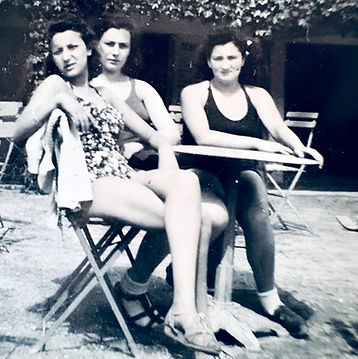

Mother, with her friends, on summer vacation, after the war.


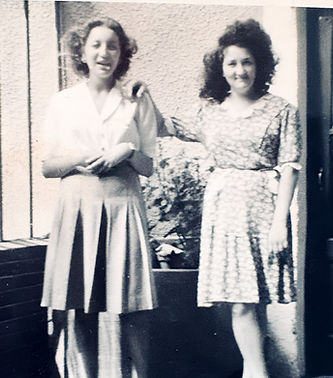
Mother's acquaintances in the years 1946-1948


The first dance in 1949 with my father, whom the whole family would call Samy.

My parents and little Gérard Leizerson, Raymond's son, who would die two years later.
My parents with my father's little cousin, Zyggy Landschaft and his future wife Régna, at Buttes Chaumont in 1949.

And then the wedding at the Notre Dame de Nazareth synagogue in July 1950, under the auspices of Rabbi Meyer Jaïs, many strangers, with the exception of Annie.

Besides my parents, I identify, in the foreground: Madeleine, I think of Monique, the daughter of Raymond and Jacky Firer.
To their right are Aunt Genia and Marie, and between them, Grandmother.
To the left of Jacky are Charles and Hélène Kronental.
To their right are Raymond and I think Renée.
Behind mom Ita Wald.
Annie is at the very top and Maurice Odesser is below.
The others are unknown to me.

In front of my parents, Madeleine, a young stranger, Aunt Genia, and above her on the left, Charles Berliner


Who were they on their honeymoon with?

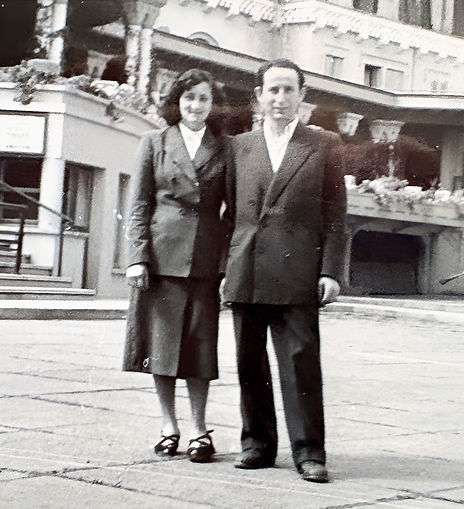

My parents on their honeymoon, in the mountains near Morzine.
`And certainly in the same year, either towards Lake Annecy, or near the sea.
August 1950


Summer holidays 1951, pregnant mother: I was due to be born on September 25, 1951.

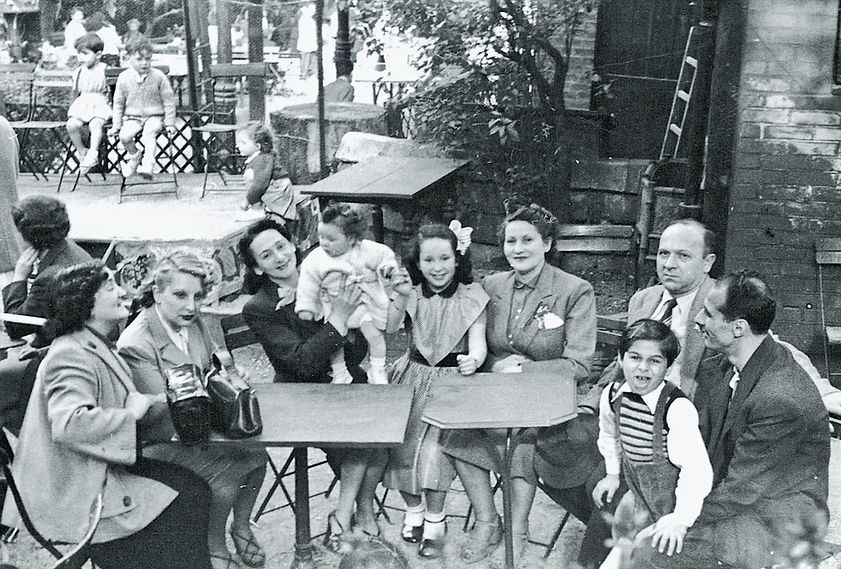
early 1952


My sister Cathy arrived on March 17, 1953
Where were they? Probably in the summer of 1953.
With my aunt Annie. She was supposed to look after Cathy when my parents went out for a walk.
And undoubtedly with Marie, Victor and William Doukhan.


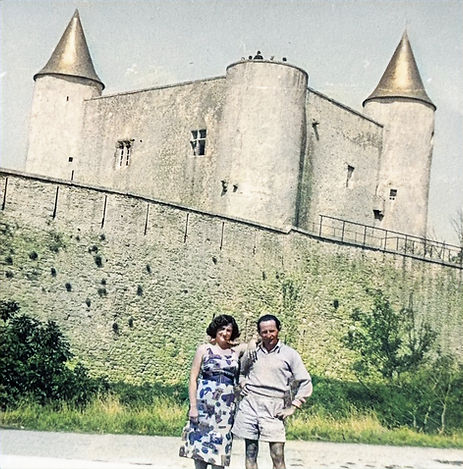
My parents opened together
a small shoe factory,
first on Boulevard du Temple in November 1950, according to the trade register, then transferred to 37 rue Clavel, in the 19th arrondissement, where we have always known "the workshop" as we called it.
It was the Czal Establishments.
My father had considered changing his surname to Calzalli.
I don't know why he gave it up. But it became his shoe brand, inscribed on the insoles of the shoes they made.
My parents worked together and it wasn't always simple or easy.
Since my father only became French in 1958, my mother was legally the owner of the company.
She was in charge of accounting, customer relations and the finishing touches (the final touches on the shoes).
My father created the designs, handled the cutting, and managed the various other stages of shoemaking. He also took care of the deliveries, initially by scooter and later by car...
I remember often staying in the car on Saturdays, double-parked while he dropped off the shoes at the shops.
They worked for major brands like Jorcel, Manfield, and many small shoe shops.
They had about ten employees, some of whom worked on a contract basis at home.
The smell of leather and glue haunted me throughout my youth, and I knew when my father had come home from work, just by that smell.
I don't have any photos of the workshop from its beginnings, but my brother-in-law had the good idea to take some before my parents retired and liquidated their business. It hasn't changed in thirty years.
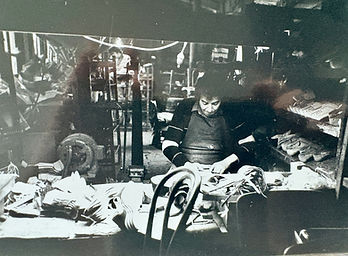


One month a year was for family relaxation.
We went on holiday every year, often to the seaside, the Atlantic or the Mediterranean, later the Balearic Islands, Italy and even Romania
When we were little, my sister and I would join my father, sunday mornog, who was sleeping in, and he would tell us stories about Yiddishland. This was the beginning of our connection to Jewish culture. When it was time for school, our parents tried to enroll us in the Lucien de Hirsch Jewish school, near our home. But we didn't eat anything at lunchtime, so Mom put us in the public school and came to feed us every day. We never ate in the cafeteria until high school.
During our adolescence, they sought to connect us with a Jewish youth movement: this was the CLEJ (Club Laïque de l'Enfance Juive – Secular Club of Jewish Children) and Corvol, its summer camp. Our secular Jewish identity was forged there. We would discover the history of the Bund. It was for us a school of Jewish culture and history.


