
Family genealogy
My Leizerson family
She came from Warsaw
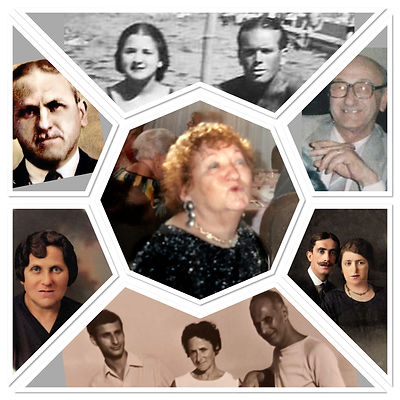
My grandfather Herschen Gedalia Leizerson
From my grandfather's family, those I knew well,
These are my uncle and my two aunts whom we spent a lot of time with when we were little (not my uncle because of a severe family feud in the 1950s).
I knew that one of Grandfather's sisters was married to one of Grandmother's brothers. They were deported from Paris-Drancy in 1942-43
In his naturalization file, Grandfather mentioned a brother and sister who had gone to New York before the Second World War, but I don't know when!
I searched in vain for this Maurice Leizerson. Finding Lola seemed more difficult, as I imagined she must be married, which complicates the search.
He was born in 1878 in Warsaw.
He decided to leave Warsaw in November 1911.
For what?
The reasons are unclear. He certainly sensed that he had no future in Warsaw, or that he was wanted for not having done his military service.

My grandfather was a leatherworker .
I don't know if that was his profession in Warsaw.
He was 33 years old when he arrived in Paris.
I also don't know what route he took to leave Warsaw and come to Paris, but my mother said that he left Warsaw under the name Raabe.
I always knew two things about my grandfather.
- He had crippled his leg to avoid military service.
If he was conscripted at 21, it must have been around 1899.
His naturalization file states that he did not do his military service in Russia.
- He left Warsaw under the surname Raabe.
My mother didn't know why. This suggests he had a problem in Warsaw. But what was it? Was he wanted, and why?
It was necessary to investigate to find out where the name Raabe came from.
They were married in a civil ceremony in Paris in August 1914, at the town hall of the 3rd arrondissement.
-
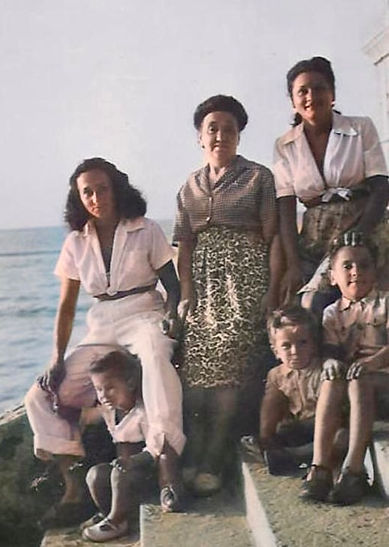
My aunt Marie was born in October 1914 (on the left).
-
My aunt Annie was born in the middle of the war in 1916 (on the left).
They were both born in Paris.
My grandmother is in the center; she is 66 or 67 years old. This photo was taken in 1949 or 1950.
My aunts are on vacation with their mother and children.
-
My uncle Raymond, on the other hand, was
born in August 1918
but not in Paris.
I deduce from this that my pregnant grandmother
was evacuated around the beginning of 1918.
Raymond was born in Epernon, apparently not
at the hospital (his birth certificate states
the name of the midwife who delivered the baby
Grandmother and her place of residence).
In early 1918, the Germans were strafing Paris.

After his birth, he lived with his sisters
and his parents at 7 rue Saint Claude.
The family moved to the 19th arrondissement in 1931.
My mother, Suzanne Leizerson
My mother was born on August 26, 1926.
She is 8 years younger than her brother Raymond, 10 years younger than her sister Annie and 12 years younger than Marie.
It was a small cyst that was reported to my grandmother, who was 43 years old at the time.

She is a schoolgirl at the girls' school at 119 Avenue Simon Bolivar in the 19th arrondissement of Paris.
She must be about ten years old.
She is a few months old.

Grandfather's life in Paris
Exempted from conscription for the war of 1914-1918 (as he was in Poland, after being crippled), he found work as a leatherworker and even later opened a small workshop in the Marais district of Paris.
When he registered in the Police Prefecture's registry on July 11, 1912, it was stated that he was married to Hava Kronental, that he lived at 7 rue Saint Claude, that he arrived in Paris on December 1, 1911, and that he was a leather goods worker.
Among the family papers, I found a business card from Gustave Leizerson presenting his leather goods factory, specializing in rich and fancy items, located at 126 rue Amelot Paris XIéme. No date.
In the Parisian archives, I found only one trace of Grandfather's professional activities , as a leather goods maker at 99 avenue Simon Bolivar, his home at the time, declared in July 1932.
I think his factory didn't work out, like that of his cousin Léon Alter Chwast who founded his in 1923 but went bankrupt in 1926.
The Leizerson family lived as a family of five, then six, at 7 rue saint Claude, on the edge of Pletzel, for 19 years, in a small "two-room" apartment.
There were six of them when my mother was born in August 1926. And they received family members who were visiting Paris.
A written testimony from a distant relative, Ida , in the immediate aftermath of the First World War, mentions the presence of Lipa/Léon Sternis, my grandmother's first cousin, at their home as an apprentice leatherworker, around 1917/18.
" He ended up at the home of this leather goods maker, who happened to be the husband of his cousin Eva. They had three daughters and a little later a son, but at the time, they were very young ." (...)
There was already an error if there were indeed 3 children, it was two girls and a boy - if this took place at the end of 1917 or the beginning of 1918, Marie was 3 years old, Annie 1 year old and Raymond would not be born until August 1918, not in Paris but in Epernon.
" I believe their combined workshop and living space was located on rue de Belleymes, in the 11th arrondissement. " (...)
Second mistake, my grandparents' apartment was separate from the workshop, the former on rue St Claude, the latter on rue Amelot.
" One evening, coming home from work, Fanny (who would later marry Léon), distraught, told my parents (Ida and Fanny's parents): the boss and his wife - I don't remember their name but I know that the woman was called Eva - went out tonight and locked Léon in his small room.
The boss was a very suspicious man and had locked Léon in, probably to make sure he wouldn't receive anyone... or that he wouldn't take anything out of the house. And yet Eva was Léon's cousin, but her husband didn't take that into account. (...) The next day Fanny noticed a piece of bread and a sardine on the table, leftovers from Léon's "supper." This saddened her even more.
Two new pieces of information: Léon worked at Grand-Père's and slept in the workshop, and Fanny was also supposed to work there.
The writer, Fanny's sister, places the scene in 1917. I imagine that if Grandfather employed two people in addition to himself, his business must have been thriving. But what troubles me about this account is that it contradicts everything positive that was said about Grandfather, particularly his kindness and helpful nature...
I think my grandparents' relationship with Lipa Sternis must not have been very good.
It was Léon Alter Chwast's wife who was the witness for the couple at their wedding in December 1918, and not my Grandmother.
To my knowledge, they were not among my family's regular relatives, whereas some of Lipa/Leon's sisters were.

My grandparents were members of the Society of Friends of Warsaw
Membership continued until our time, or more precisely until the death of my parents. I remember that as children, we accompanied our parents to the Society's banquets.
I had to do some research to find out the history of this society. A large part of our family is buried in their family vaults in the Bagneux cemetery in Paris. I don't know when my grandparents joined this "Landsmanschaften." These mutual aid societies aimed to protect Jewish immigrant populations who had precarious legal status.
They were created towards the end of the 19th century and multiplied between the two world wars. But unfortunately the archives were destroyed in 1940, to prevent them from falling into the hands of the Germans and collaborators.
When Grandfather was naturalized in 1928,
He had to apply for social housing, which he obtained in 1931, a three-room apartment/kitchen, at 99 Avenue Simon Bolivar, a low-cost housing complex in the 19th arrondissement, which had just been built.
I know this accommodation well since I lived there until I was 18.
The four children attended school, the first three in the 3rd arrondissement. I haven't been able to find their names in the school registers where they must have been enrolled. They are missing from some of the schools in the 3rd arrondissement.
But I found my mother's registration at the girls' school at 119 Simon Bolivar Avenue. I was the headmistress there from 1998 until my retirement in 2015. We were fortunate enough to have all the school records dating back to 1879. I was able to show it to my mother!
The four children obtained their school certificates.
Only my mother went on to study afterwards, a business course, which was interrupted by the war.
I don't know much about the life of the family and my grandfather in Paris, nor of their reactions to the political climate they had to face.
The reconstruction years after the First World War must not have been easy, with an extreme right wing, through leagues, spreading anti-Semitic and nationalist poison.
At the same time the family benefited from the new modernity: a beautiful radio, a horn record player and many 78 rpm records.
Of course, the apartment didn't have a bathroom, but the kitchen, a large room, provided a space for washing up. There was a toilet, however.
My grandfather was politically engaged and read Le Populaire, the SFIO's newspaper. My mother told us he was a socialist. He wrote to the letters to the editor; I don't know the content of his request. But what was said in the family was that the reply he received outraged him: " Gentlemen, foreigners, you are requested not to meddle in French politics ." It was signed by Eugène Fiancette, the SFIO deputy for the 19th arrondissement. This sorry fellow was declared an outsider of the SFIO in 1934 and appeared on Pierre Laval's list in the 1935 senatorial elections. He voted to grant full powers to Pétain in 1940.
I don't know how my grandparents experienced the Popular Front. But as a child, my mother taught us "Au devant de la vie" (Facing Life), almost an anthem of the Popular Front, taken up by the PCF (French Communist Party) from a social song set to music by Shostakovich and lyrics by Jeanne Perret.
My mother always told us that her father took care of her schooling. He followed her studies. She remembered that once, while away at summer camp, she fell ill, and it was her father who came to get her.
However, he was not in good health. He had impressive asthma attacks and could stand at his bedroom window, gasping for air, for much of the night.
We do not know if this was the reason for his death, or the deprivations of the war, or the non-return of his sister, his brothers-in-law and his nephew Daniel, perhaps all of the above, he died in November 1945.
This caused my mother a lot of grief.


