
Family genealogy

Uncle Moszek, known as Max, and his family
I think my grandmother was particularly close to her brother Max. He was the only one still alive of the siblings she raised.
He must have been between 3 and 5 years old when their mother died.
And my grandmother, 14 years his senior, took on that role.
Max was born on April 15, 1997 in Siedlecz and not in Warsaw.
It was a city 90 km from the capital.
Why did my great-grandmother give birth there?
Did the family live there? How long did they stay in the city?
Her youngest sister, Hana, was born in 1999 in Warsaw, so two years later. I wondered why no children were born between 1885 and 1894, a period of nine years.
Did they spend that time in Siedlcez? And why?
There was a strong Jewish community in Siedlecz since the 16th century.
A Jewish hospital had existed there since the 18th century.
At the time Max was born, half the city's population was Jewish.
Yet another mystery, which may never be solved?
I know nothing of Max's childhood, except that he communicated in Polish with my Grandmother and that he had learned music, particularly piano and violin.
Grandmother took a trip to Poland: she left Paris on 18/08/1921 and returned on 20/02/1922. Did she return with her brother Max, or did he arrive a few months later?
Nevertheless, he came to Paris in 1922 and from there prepared for the arrival of his wife, Golda/Génia Zandman, whom he had married in Warsaw. (We have always called her Aunt Génia).
Until he found the apartment at 5/7 rue Corbeau, in the 10th arrondissement, he lived with his sister at 7 rue Saint Claude. He was 25 years old at the time.
I don't know if he was a leatherworker in Warsaw, but he was in Paris.

On the back of this photo, written in Polish by Max to his sister:
"I'm sending you this photo as proof of my eternal gratitude."
From your brother Max.
Genia and Max were married in a civil ceremony in Paris on April 15, 1924: they were then living at 5/7 rue Corbeau, in the 10th arrondissement.
My grandmother was one of the witnesses.
My research in the Paris civil registry revealed that Max and Génia had their first child, Salomon Kronental, on June 18, 1924. Sadly, he died a year later, on July 12, 1925, at Trousseau Hospital. No one in the family had mentioned it. Madeleine didn't know. However, it seems that Génia was deeply affected and suffered her first bout of depression. We don't know the cause of his death.
When you search on Wikipedia for what used to happen at 5/7 rue Corbeau, you can read:
"With 168 one-room apartments, it was, until its demolition in 1998, the largest slum in Paris."
What was the situation in 1924? When Max and Génia lived at number 5, it was a 4-story building, offering modest comfort, with one "toilet" for 16 apartments. The building was connected to the Parisian sewer system (1884).
It had been preempted by the State after the vote on the law separating Church and State, in 1905. Many Republican Guards lived there.
This building initially housed Belgian and Italian immigrants, then immigration from Eastern Europe developed.
Gradually, from the 1920s onwards, the social composition changed, with Polish Jews becoming the vast majority.
In 1927, the State sold the building to a private individual, Abraham Chmoulovsky, who increased the height of the building (3 more floors) and modernized it (connection to gas and electricity, running water in the new buildings, and two toilets for 8 apartments).
During the war, the building was looted, a property administrator took over its management which declined until its demolition in 1999.
The owner was deported and murdered.
There is a documentary film
on the history of the site, written and produced by Thomas Pendzel,
one hour, dating from 2007.


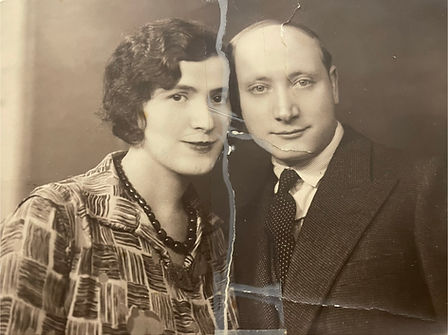
Genia and Max,
Left in Warsaw; right in Paris.
But was it at the time of the change of ownership, or a little before, that Max and Genia moved to number 11 on the same street, where they set up their workshop?
Madeleine, Max and Génia's daughter, told me that on the occasion of this move, Génia's mother, Chana Zandman, born in 1865, was arriving in Paris.
Chana was at Marie Kronental's wedding in December 1938. My mother put her hand on her shoulder. Her maiden name was Trembacz. Her brother was a famous painter in Poland. He died in 1941 in the Lodz Ghetto. I will do some research on him later.
Max and Génia met the Topor family there, to whom they gave the apartment when they moved to rue d'Albouy (which became rue Lucien Sampaix after the war) to a larger apartment with a bathroom and toilet. That was on September 1, 1939.
Two months after their civil marriage in Paris (the religious ceremony had to take place in Poland), Génia gave birth to a first son, Salomon Kronental, born on June 18, 1924.
Unfortunately, he died at Trousseau Hospital a year later, on July 12, 1925.
I don't know what caused his death.
Trousseau Children's Hospital was at the forefront of the fight against infectious diseases at the time.
This death caused Genia to experience her first bout of depression, from which she had difficulty recovering.
Madeleine, the youngest, born in 1941, was unaware of the existence of this first child.
It was my research in the Parisian archives that revealed this to us.

Nevertheless, life went on and Daniel, their second son, was born on November 30, 1926, four months after my mother.
He will become her playmate.
I bear his name.
,
Genia and Max lived off the income from their custom hoof trimming workshop and had many clients.
They were able to afford to take advantage of paid leave, introduced from 1936 onwards by the Popular Front.
Many photos show them by the sea. Life there must have seemed much more pleasant than in Warsaw.


Max and Genia had a whole network of friends and Daniel was often part of it.


Max, as a leather craftsman, became involved in the "Society of Friends of Warsaw". Madeleine knew that in 1939, he was considered as its future President, before the dark times arrived!
Only one photo remains, from the pre-war period, in which Max appears; everything else was destroyed so that the Nazis could not seize the documents.
Max appears in this photo from the "Society of Friends of Warsaw", in 1935.
He is standing at the very top, on the left.


Then the dark times arrived!
Madeleine, the couple's third child, was born in July 1941. Sensing the difficult times ahead, and also due to another bout of depression suffered by Génia, Max and Génia entrusted her to a nanny in Fontainebleau. They had asked Daniel's nanny, Stacha, to pay her regularly, which she did until the Liberation.
Madeleine's memories were intertwined with visits from her parents and Daniel, the teddy bear her brother had given her, and the kindness of her nanny, who acted as a mother to her until she was 5 years old. She looked after other children, and Madeleine loved to cuddle with her.

Madeleine, a baby at her wet nurse's in 1941.
Madeleine was 5 or 6 years old at the time of the liberation.

Meanwhile, towards the end of 1941 or the beginning of 1942, Max, Génia and Daniel left their apartment on rue d'Albouy and went into hiding.
Two sources allowed me to reconstruct the tragedy that befell them:
- the case of the dispossession of Max's small business and
- Johanna Lehr's book, "In the Name of the Law: The Daily Persecution of Jews in Paris Under the Occupation," where a chapter is devoted to the arrest of Génia.
In the case of the dispossession (in french : spoliation) of some forty documents
- the French administration displayed a mad zeal in plundering the property and money of the Jews-,
It is mentioned that the family was not at home at the time of the Vel' d'Hiv roundup on the morning of July 16.
" Mr. Kronental was to be arrested on the 16th of this month, but this Polish Jew is in a clinic, very ill. Mrs. Kronental has been committed to a sanatorium, having lost her mind. Only a fifteen-and-a-half-year-old son remains, Jewish but French, who left the 8th grade at the Lycée Buffon to run his father's business. He works with a female worker. (The business has maintained a reduced level of activity)."
This is a leather-skimming business, a rather rare specialty in the area. The equipment is relatively substantial. There is no stock of merchandise, as the leather-skimming trade is exclusively a craftsman's trade." (extract from the letter sent on July 7, 1942, by Mr. Georges Lasfargues - provisional administrator of assets - to an inspector of the Commissariat for Jewish Affairs).
In another letter, we learn that in 1937, Max employed 5 workers.
It is reiterated that Daniel was running the company because "his father had been in hospital for many months."
In response to the UGIF's request rejecting the appointment of the property administrator, Mr. Lasfargues - who clearly had to mistreat Daniel to extract information from him - sent a letter to the General Commissariat for Jewish Affairs on November 27, 1942:
"These two Jews (Moszek Kronental and his wife) were not in a nursing home, as the son had repeatedly told me. They had simply run away.
Today, Kronental's minor son admitted to lying to me, but he maintains, against all likelihood, that he does not know the address of his parents, with whom he has had no contact since the beginning of July 1942.
The only female worker employed in the company told me that the parents lived in a small hamlet near Juvisy.
The son, having told me during our conversation that his parents (at least his father) were in a nursing home in Juvisy-Sur-Orge, now claims that they were in Seine-et-Oise. But he couldn't see them, since he is forbidden from leaving the Seine department.


Thus, we can imagine the journey of the Kronental family on the eve of the Vel' d'Hiv roundup.
They left their apartment; only Stacha, Daniel's nanny, had the key.
Aunt Genia, after the birth of Madeleine in July 1941, had another depressive episode. She was in a clinic. What Daniel says is true. In a certificate of attendance from the Maison Blanche psychiatric hospital, issued in December 1953, one can read:
" Notion of a previous manic episode, following childbirth and treated in a free health center from December 1941 to July 1942 - and of a previous depressive episode, 16 years before her entry to Maison-Blanche, following her first childbirth."
In a letter dated January 1, 1942, addressed to his mother's brother, Daniel wrote:
" My parents are currently in a clinic. I had a little sister, Madeleine, she is now 9 months old (,,,). Following her birth, my mother became mentally ill. She remained in a neuropsychiatric clinic. And my father had a peritonsillar abscess. But now, he is better and they are both recovering."
Daniel used his parents' past illnesses to fuel his story and protect them from the estate administrator! It must not have been easy for such a young teenager to go through.
His parents must indeed have been in the suburbs.
Mom told us that once, she and Daniel were taking the metro home after curfew. A policeman stopped them, but told them: "Hurry back and don't go out again after curfew!"
I don't know if it was late 42 or early 43, nor if Daniel was living with my grandparents while his parents were away.

This letter from Daniel
to his uncle
date of January 1, 1942.
Marcelle is her uncle's wife; he is her mother's brother.
On May 13, 1943, Max, Génia and Daniel returned to their apartment on rue d'Albouy because a reading of the gas and electricity meters was posted.
When they heard the doorbell ring, they went to open it, but it was the French police, from the special Jewish Affairs department of the judicial police!
Johanna Lehr found the reports stipulating their arrests, Genia's nervous breakdown and her being sent to the depot's infirmary, as well as the transfer of Max and Daniel, on the same day to Drancy.
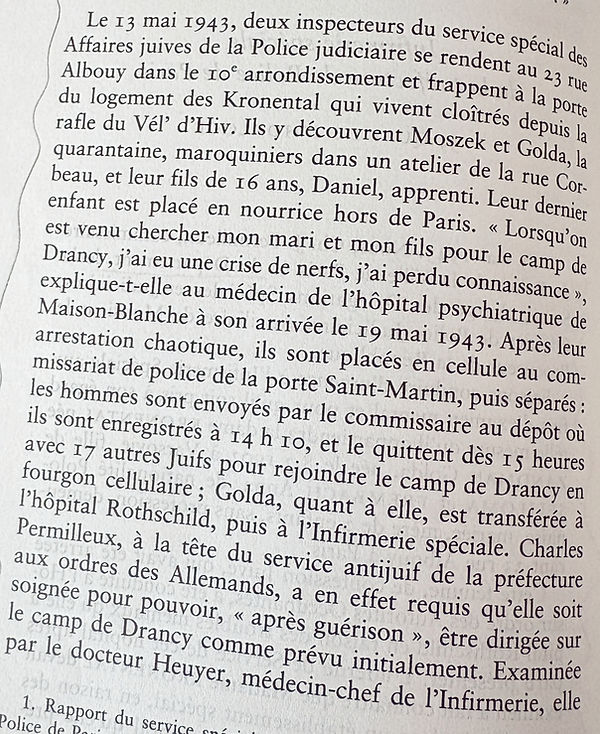
In her book "In the Name of the Law", about the daily persecution of Jews in Paris under the occupation, Joahanna Lehr devotes a chapter to the special infirmary of the Police Prefecture.
The only archive that was not destroyed concerns the case of Aunt Genia.
The sequence of events is chilling.
The author relied on the report of the Special Service of Jewish Affairs of the Prefecture, concerning the sending of Golda Kronental to the special infirmary on May 13, 1943.
She was not "manageable" by the police officers.
This will save his life.

The chapter begins as written on the left.
And the last sentence is:
" from Drancy on the orders of the German authorities; after recovery, she will be sent to this internment camp ."
For historian Johanna Lehr, this document is exceptional because all arrest reports of the "Permilleux brigade" were destroyed in December 1949 by the head of the Archives department of the Prefecture.
This is the only document signed by Charles Permilleux himself, at the time when he took over the special service for Jewish Affairs, in November 1942 and in the summer of 1943.
The end of the story was dramatic for Max and Daniel, more "lucky" for Genia.
Max and Daniel stayed almost two months in Drancy, which they left for Auschwitz on July 18, 1943 on convoy no. 57 with 1000 people including 137 children.
On Daniel's page, you will find letters from Drancy that inform us about their conditions of survival in Drancy.
Only 43 people returned from convoy 57, including 16 women.
For your information : This convoy included Henry Bulawko (24 years old); Rabbi Samy Stourdzé (25 years old), a member of the resistance; Alma Rosé (37 years old); Hélène Rounder (21 years old), a survivor;
Armand Steinberg (32 years old), one of the three survivors of the Sainte-Catherine Street roundup (Lyon) - whose testimony was read at the trial of Klaus Barbie - a doctor, a centenarian. He was the subject of a documentary: The Impossible Witness ;
Alice Hohermann (40 years old); Gabriel Bénichou (16 years old), survivor; his sister Raymonde Israël (28 years old) and his brother-in-law Moïse Israël (32 years old), survivor; Alma Rosé (36 years old), the conductor of the Auschwitz women's orchestra.
What Génia learned after the war from two returning deportees (Ernest Skalka and Abram Mandel) at the Hotel Lutétia (regrouping place for deportees): Max had worked until September 15, 1943 and was killed by a bullet from a guard because he could no longer carry a stone.
As for Daniel, according to what Madeleine knew, he died during transport.
As for Aunt Genia, she was eventually transferred to the Maison-Blanche Psychiatric Hospital, where she was protected by a network of dedicated and efficient doctors, nurses, and medical staff. She remembered acting as a caregiver and knitting various garments for the patients.
She was discharged from the hospital on January 6, 1945.
It will take her a year to get his apartment back (which had been completely emptied) and to find accommodation for her daughter.
The battle to secure recognition of the deportation of her husband and son Daniel took several years, as did the recovery of Max's business assets.
Madeleine remembered that the first times they were able to return to 21/23 rue d'Albouy (which became rue Lucien Sampaix after the war), she and her mother had to share a spoon to eat and slept on the floor!
Génia remarried in 1948 to Félix Fajnberg, who had also lost his family. He adopted Madeleine.
Daniel and Max (with the first name Mosczek) Kronental appear on the Wall of Names at the Shoah Memorial in Paris, under the year 1943.


Félix was totally adopted by our family, he was, like Génia and Madeleine, at all the parties, even on vacation.
For my 11th or 12th birthday, he gave me a gold signet ring with my initials engraved on it.
On the left, with Madeleine and Génia, certainly in 1948.
On the right in 1952, with my Aunt Marie holding me up, Victor and Zizou, my cousin.
Félix died in 1963
Aunt Genia passed away in 1973. She was 71 years old.