
Family genealogy
The shtetls where the Czalczynski and Landschaft families lived
And Warsaw
for Kronental and Leizerson
You can click on the name of the sthetl to read it directly
Kielce
Checiny
Wodzislaw
Lopuszno
Miechow
Malogoszcz
Jedrzejow
Wloszczowa
Warsaw
Kielce
The establishment of the Jewish community in Kielce was very late but extremely rapid, due to religious prohibitions and then legal reforms.
Unlike other regions of Poland where Jews had been settled since the Middle Ages, Kielce remained closed to them for centuries.
A historical ban (until 1862)
Until the end of the 18th century, Kielce belonged to the bishops of Krakow. The latter strictly applied the statute of Privilegium de non tolerandis Judaeis, which formally prohibited Jews from settling or trading in the city.
Even after the city came under Austrian authority and then under the tutelage of the Russian Empire (Congress Kingdom) at the beginning of the 19th century, residency restrictions remained maintained by the municipality.
Jewish merchants from neighboring towns (like Chęciny) could do business there during the day but had to leave in the evening.
The emancipation decree of 1862
The historic turning point came in 1862, when Tsar Alexander II of Russia issued a decree of emancipation. This reform granted Jews equal civil rights and, most importantly, the complete freedom to settle in cities that had previously been forbidden to them.
From that date onwards, immigration accelerated:
-
1860: Only 31 Jewish families live illegally or by special permission in Kielce.
-
1873: The town has nearly 1,000 Jewish inhabitants.
-
1897: The Jewish population reached 6,400 people, representing approximately 27% of the total population.
Economic and industrial development
The settlement has solidified thanks to the community's economic dynamism. Newcomers are investing heavily in local businesses and the extraction of natural resources from the Sainte-Croix mountains.
They open tanneries, sawmills and control a large part of the bakeries and retail businesses in the city.
Jewish shareholders founded large industries, including a major cement factory (1896) and the large Heiman glass factory (1897).
Large industrial families (like the Zagajskis) developed the surrounding limestone quarries (notably the Wietrznia site).
Cultural Zenith and Destruction
At the beginning of the 20th century, Kielce became a major Jewish cultural center. A large synagogue was built there between 1902 and 1909, accompanied by dozens of prayer houses, schools (yeshivas and cheders) and political organizations (Zionists and Bundists).
On the eve of World War II in 1939, Kielce had approximately 24,000 Jews, representing one-third of the city's population.
This flourishing community, whose history ultimately lasted less than a century, was completely annihilated by the Nazi occupiers in the Kielce ghetto and the Treblinka extermination camp.
What remains today of the Jewish community of Kielce: two major traces:
• The Great Synagogue of Kielce.
This large early 20th-century brick building survived because the Nazis converted it into a prison and depot. Used after the war for state archives, a major architectural project transformed the building into the House of Understanding , a cultural center dedicated to the memory of the Holocaust and Jewish history.
• The 1946 Pogrom Monument : Located at 7 rue Planty, this memorial commemorates the incredible pogrom that occurred after the war, where Jewish survivors returning home were murdered by a local mob.
The settlement of Jews in the localities surrounding Kielce took place according to very different dynamics.
While Kielce was closed to them, several of these towns (often called Shtetls) had long-established and very large Jewish communities, while others followed the Kielce model with a late settlement in the 19th century.


These various views of Kielce are taken from "sztetl.org.pl": a view of Kielce, the Jewish street Ulca, two views of the synagogue, in the 1920s and 30s. The synagogue renovated today, the cemetery and the burial of the Jewish victims of the Polish pogrom of 1946.
Checiny
The historic heart and refuge of the region
Unlike Kielce, Chęciny has one of the oldest Jewish communities in the region, documented as early as 1465.
• The regional cradle: As Kielce prohibited access to Jews, Chęciny became the hub of the community. It was here that Jews from all over the area (including Kielce) came to bury their dead in a vast cemetery located on the slopes of the royal castle.
• An overwhelming majority : During the 19th century, the Jewish population became largely the majority, reaching up to 76% of the total population in 1856 (more than 2,800 inhabitants).
They controlled the local economy, including the salt trade, distilleries, and bakeries.
The material traces of Jewish life in these localities vary considerably. While some places have benefited from major restoration projects, others now offer only empty spaces or fragments hidden under vegetation, the Nazis having methodically destroyed the infrastructure and desecrated the cemeteries to reuse the tombstones (matzevot) as building materials.
The most preserved and memorial site, Chęciny is home to the most spectacular and best-presented heritage in the region.
The Great Synagogue has become a museum
Beautifully restored, it has reopened as the Jewish Cultural Memory Center in Chęciny. The building has regained its splendor with its mansard roof, women's galleries, and an interior portal carved from local marble. Today, it is a must-see multimedia exhibition space dedicated to local Jewish history.
Cmentarz żydowski
Located on the slopes of the royal castle hill, this vast space still preserves more than 150 tombstones (the oldest dating back to the 17th century), scattered among the trees. It is one of the most picturesque and poignant cemeteries in the region.


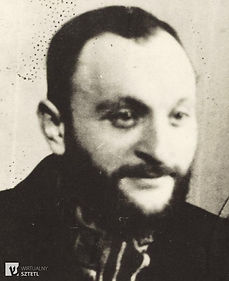

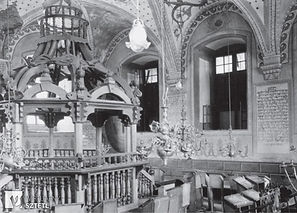

These photos are taken from the website "sztetl.org.pl", managed by the Polin Museum: at the top: the synagogue in 1946 and now renovated, then the interior of the synagogue in 1939.
Below, Szymon Huberband, rabbi and historian, alongside Emmanuel Ringelblum. He died at Treblinka. The "Judenrat" of Checiny in 1942 and the current Jewish cemetery.
Lopuszno
Agricultural and artisanal colonization in the 18th century
Jewish settlement in Łopuszno began in the 18th century.
• Origin of migrants : Records show that the first Jewish families arrived from neighboring towns, notably Chęciny and Włoszczowa.
• Social structure : Unlike in large industrial centers, the Jews of Łopuszno integrated as local artisans, livestock and grain traders, or tavern managers.
In 1846, of the 34 civilian houses in the village, 20 belonged to Jewish families (bakers, tailors, shoemakers, tanners).
In 1884, the Yizkor Book reported that Łopuszno had 587 Israelites out of 828 inhabitants: the Jews were therefore by far the majority.
The community also spread to neighboring villages, including Snochowice, Olszówka, Sarbice, Jasień, Jedle, Korczyn, Dobrzeszów, Wólka Kłucka, Kuźniaki, Strawczyn, etc.
In 1939, the community numbered just over 600 people.
Today, Łopuszno : An almost total void of memory.
Its destruction was almost total, but citizen initiatives are trying to save what remains.
• The cemetery has disappeared : There are no longer any standing headstones on the half-hectare site, now treated as a wooded communal park.
During the war, the Germans uprooted the graves to pave the ground in front of the gendarmerie and to build roads.
• Meager fragments saved : Local activists from the Leaders of Dialogue network found a few rare pieces of matzevot in rubble or surrounding fields and symbolically placed them on the site of the old cemetery.
The synagogue no longer exists. The last one, housed in a wooden building, has completely disappeared.

The search for traces of Lopuszno was unsuccessful: I only found this fragment of a tomb at the site of the town's former Jewish cemetery. It will be necessary to contact the Kielce archives.
Małogoszcz
A late arrival linked to trade
In Małogoszcz, Jewish settlement occurred later, intensifying especially during the 19th century.
Economic role: Jews settled there mainly as merchants, taking over the majority of the shops in the marketplace over the decades.
An independent Jewish cemetery was not established there until the end of the 19th century. Before that, the local community relied on the religious infrastructure of Chęciny for rituals and burials.
An abandoned cemetery
The Jewish cemetery was once isolated, on the outskirts of the village; today, it is a plot of land overgrown with vegetation. Most of the tombstones were stolen or broken during and after the war. A few bases and fragments occasionally emerge from the undergrowth. There is no longer a community or an active memorial on the site.
The same restrictive model as Kielce
The history of Jędrzejów is very similar to that of Kielce. The town was historically owned by the Cistercian monks of the local abbey, who forbade Jews from settling there.
• 19th century emancipation: It was only after the abolition of territorial restrictions by the decree of 1862 that Jews were able to legally settle there in large numbers.
• Rapid growth: As soon as the doors opened, the community grew at an impressive rate to become a dynamic craft and commercial hub (particularly in shoemaking and textiles), with several thousand members before the Second World War.
Memorial and architectural traces
• The Ghetto Monument: On the site of the former ghetto, a plaque and a monument commemorate the deportation of thousands of Jews from the city to Treblinka in 1942.
• The old cemetery: Partially devastated during the war, the site has been cleaned up. A memorial has been erected there using fragments of headstones found in the town.
• The urban fabric: In the historic center, several brick houses and former shops once run by Jewish families are still visible, although repurposed.
Jędrzejów
The same restrictive model as Kielce
The history of Jędrzejów is very similar to that of Kielce.
The town was historically owned by the Cistercian monks of the local abbey, who forbade Jews from settling there.
• 19th century emancipation : It was only after the abolition of territorial restrictions by the decree of 1862 that Jews were able to legally settle there in large numbers.
• Rapid growth : As soon as the doors opened, the community grew at an impressive rate to become a dynamic craft and commercial hub (particularly in shoemaking and textiles), with several thousand members before the Second World War.
Memorial and architectural traces
• The Ghetto Monument : On the site of the former ghetto, a plaque and a monument commemorate the deportation of thousands of Jews from the city to Treblinka in 1942.
• The old cemetery : Partially devastated during the war, the site has been cleaned up. A memorial has been erected there using fragments of headstones found in the town.
• The urban fabric : In the historic center, several brick houses and former shops once run by Jewish families are still visible, although repurposed.
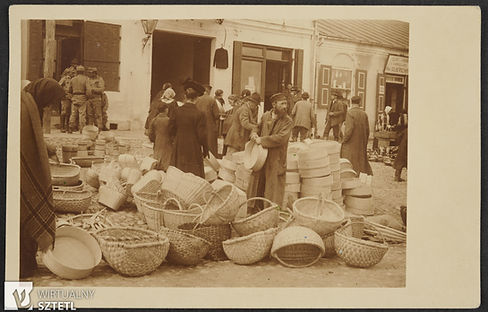


At the top, 4 photos of the Rynek, the market square: you could find everything you needed for daily life there.
Below, the site of the cemetery where not much remains.
Finally, a photo of the first convoy leaving for the Treblinka camp
WODZISŁAW
Wodzisław is much further southwest than Kielce, about 15 km southwest of Jędrzejów.
But above all, its Jewish community is very old.
Jews are documented there from the 16th-17th centuries and Wodzisław very early on became an important community center.
In the 17th century, it was even considered one of the main Jewish communities in the Krakow region.
And unlike Kielce, where the community is relatively recent, Wodzisław therefore has a historical depth of several centuries.
Wodzisław had a genuine community infrastructure.
Between 1918 and 1939, the Wodzisław kehilla had jurisdiction over:
Sędziszów
Nagłowice
Mstyczów
Nawarzyce.
Sędziszów did have its own Jewish population, with its own shops, school and social life, but it did not have an autonomous religious community during the interwar period: it depended on Wodzisław.
In the mid-1920s, the community owned: a synagogue;
two houses of prayer; a heder; a mikveh; a cemetery; two morgues; a house for the caretaker.
In 1929, it had approximately 4,500 members, a figure that includes the wider community and not just the inhabitants of Wodzisław itself. And most importantly for understanding its economic life: the income from ritual slaughter also came from Wodzisław and Sędziszów. This confirms that a real institutional and economic link existed between these two towns.


A monument erected in memory of the community, the building of a synagogue still standing and another in ruins.
Miechow
The history of the Jewish community of Miechów (located about 80 kilometers southwest of Kielce) has great similarities with that of Kielce and Jędrzejów.
It is characterized by an absolute historical religious restriction, followed by a rapid development, before an almost total eradication of which today there remain some important commemorative monuments.
Implementation : A late unlocking and a modern integration
For several centuries, the history of Miechów was entirely shaped by the Order of the Knights of the Holy Sepulchre, who owned the town.
• A strict prohibition : Under the authority of the religious order, Jews were formally forbidden from residing or acquiring property in Miechów. Until the mid-19th century, no Jew lived there legally.
• The boom after 1862 : Everything changed with the emancipation decree of 1862. As soon as the restrictions were lifted, immigration was massive. The Jewish community grew at an impressive rate.
• A modern and integrated community :
Unlike the surrounding towns with their very conservative Hasidic traditions, historians and the Books of Remembrance (Yizkor Books) describe the Jews of Miechów as particularly modern.
On the eve of the war, a large part of the community had assimilated culturally, adopting the codes and clothing of Western Europe.
• Demographic weight : In 1939, the Jewish population represented approximately 40% of the total population of the city (Jews also occupied 30% of the seats on the city council). They controlled a major share of the wholesale trade, exporting grain and livestock to Silesia and Germany.
In 1941, German forces confined more than 2,000 local Jews in a partially enclosed ghetto south of the city, before liquidating the area in 1942 and sending the population to the Belzec and Treblinka extermination camps.
The remains and memorial traces today
Unlike Włoszczowa or Łopuszno where the void is almost total, Miechów retains very identifiable official monuments and memorial sites.
• The Monument to the 630 Martyrs of 1942 : This is the most important memorial in the city. Located on the site known as "Pomnik poświęcony pamięci 630 Żydów", this monument pays tribute to the 630 Jews who were brutally executed on the spot by the Nazis in 1942, including those too weak or sick who could not walk to the deportation trains.
• The Historic Synagogue (Miechwity Street): The building of the former synagogue, dating from the early 20th century, still exists. Although it was looted and stripped of all its interior religious ornaments during the Occupation, the exterior walls survived. The building was converted after the war and now houses administrative offices (a road safety education and training center), but its general form remains recognizable in the urban landscape.
• The Jewish cemetery (Powstańców Street 1863): Established in the 19th century during the founding of the community, it was almost entirely razed by the Germans. However, the area has been demarcated. Although the original rows of headstones are no longer present, the site serves as a place of remembrance.
• Chodówki Forest (Las Chodówki): Located on the immediate outskirts of Miechów, this forest contains hidden mass graves. It was here that the Gestapo and the German gendarmerie carried out mass executions of Jews from the ghetto and Polish resistance fighters between 1941 and 1944. A memorial section is preserved there.


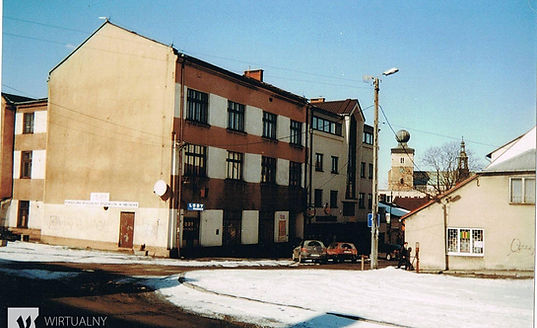
The streets of Miechow at the beginning of the 20th century.
A stele in memory of the vanished Jewish cemetery.
Another stele in memory of the victims killed in the woods behind Chodow.
Finally, the building of the former Miechow synagogue, now housing offices!!!!
Wloszczowa
Jews settled in Włoszczowa in the 17th century
Local sources indicate that Jews established a permanent presence in Włoszczowa in the 17th century. The town itself obtained its town charter in 1539.
This means that, unlike some small neighbouring localities where the Jewish presence is much later, Włoszczowa has had a Jewish presence for several centuries.
By the 19th century, the community was already well established: synagogue, community institutions, commerce and artisans. It then developed considerably during the 19th century.
A community that has become very important
At the beginning of the 20th century, Włoszczowa was actually a city with a large Jewish majority.
In 1897, there were 2,528 Jews, which was just under three-quarters of the city's population.
In 1921, Jews still represented more than 53% of the population of Włoszczowa. They also participated in municipal life: several Jewish citizens sat on the municipal council.
This is therefore an important characteristic of Włoszczowa: it was not simply a village where a few Jewish families lived among the Poles; it was a real shtetl with a structured and numerically very large community.
How did the Jews of Włoszczowa make a living?
Trade and crafts occupied an essential place.
After the First World War, Jews operated more than 300 workshops and small factories, usually family businesses.
The sources describe in particular: food shops; bakeries; fabric and clothing stores; haberdashery shops; craft workshops; various small shops.
The testimonies collected by the Virtual Shtetl project give a fairly vivid image of the Rynek (market square), with Jewish shops set up around the square and in the adjacent streets.
A highly organized religious and political community
Włoszczowa possessed a true żydowska gmina, that is to say, an organized religious community.
In the interwar period, several currents were represented:
-
the Orthodox and Agudat Israel;
-
the Zionist generals;
-
the Mizrachi.
In 1931, following a change in the community's administrative status, a new council was elected. Its members included Nuta Albersztajn, Mordka-Dawid Zilbersztajn, Szlomo Goldsztajn, Icek Rajchman and other local notables.
Włoszczowa and the surrounding localities
Jewish communities did not always function as completely isolated units. Włoszczowa is located approximately 50 km west of Kielce. Sources also show links with neighboring communities, including Szczekociny, Lelów, and Kurzelów. For example, some people recorded in Włoszczowa marriage records originated in Kurzelów, and vice versa.
The Holocaust period
In 1939-1940, the situation changed radically.
The Germans occupied Włoszczowa at the beginning of September 1939.
A Judenrat is created and the Jews are subjected to forced labor.
In 1940, approximately 2,700 Jews lived in Włoszczowa, representing about 42% of the population at that time. This number had increased, in particular, due to the arrival of refugees from Szczekociny, Przedbórz, and other parts of Poland. A ghetto was subsequently established, and the community was ultimately destroyed during the Holocaust.
The community of several thousand people was wiped out during the Holocaust.
But the Jewish presence has not completely disappeared from the landscape of Włoszczowa.
Today we find mainly: places of memory, traces of the old Jewish quarter, the memory of the synagogue, local historical research, cemeteries and, where they have survived, tombstones, monuments and commemorative plaques, descendants and associations that maintain the memory of the Jews of Włoszczowa.
The municipality is trying to showcase the region's historical heritage.


A view of the city "before", the location of the Jewish cemetery which no longer exists and a photo of a Jewish kindergarten and a school classroom from the 1930s
For the period 1914-1918,
In 1914, Polish territories were still divided between three empires:
Territory
Russian Empire: Central Poland, Warsaw, Kielce
Austria-Hungary: Galicia, Krakow, Lviv
German Empire: Poznań, Western Silesia
The war is therefore taking place on Polish territory, but Poland is not yet a state.
1914 Russian Empire still in place.
war is coming to the villages
At the beginning of the war, the Russian army was still present.
But the German and Austro-Hungarian armies gradually advanced eastward. In 1915, the Gorlice-Tarnów offensive caused the collapse of the Russian front.
1914-1915 The front arrives: Łopuszno – Małogoszcz – Włoszczowa – Kielce with fighting and population displacements.
In the summer of 1915, the Russian army abandoned virtually the entire Kingdom of Poland. The territories were then divided between two occupying administrations:
a German zone, with Warsaw as its centre;
an Austro-Hungarian zone which notably included Kielce, Radom and Lublin. The Austro-Hungarian military administration was initially called the Militärgeneralgouvernement Kielce, before being transferred to Lublin in October 1915.
1915 Russian retreat and Austro-Hungarian occupation of the southern part of the district.
1915 caused a massive population displacement
When the Russian army withdrew, it practiced a "scorched earth" policy in certain sectors: evacuations, destruction of crops and property, forced displacements.
The number of refugees caused by the Russian retreat in Polish territories is estimated at around 1.5 million.
For Jews, the consequences are particularly significant.
Even before the war, the Russian authorities had an extremely distrustful relationship with Jewish populations.
In 1915, Jewish populations were displaced into the interior of the Russian Empire, sometimes under duress, because the Russian authorities suspected them of sympathizing with the German enemy.
1915-1918 Austro-Hungarian administration and profound disruption of economic life.
1918 Disappearance of Empires: birth of independent Poland.
1918-1921 Administrative and community reorganization.
1921 New Poland: Kielce becomes the major regional center, while Wodzisław retains an exceptionally large Jewish community.
A tragic and common end
Most of these interconnected communities suffered the same tragic fate under Nazi occupation.
In 1942, during the liquidation of rural ghettos by the Germans, the Jews of Łopuszno and Małogoszcz were rounded up and forcibly transferred to the ghettos of Chęciny and Jędrzejów.
From there, almost the entire Jewish population of these localities was deported and murdered at the Treblinka extermination camp.
Warsaw
The first Jews in Warsaw: 14th–15th centuries
The first documented Jewish presence in Warsaw dates back to the early 15th century. The municipal register of 1421 already mentions ten Jews living in the city. A more structured community later emerged around the "Jewish street" (Żydowska Street), in the Old Town area.
But this presence is very precarious:
expulsions in 1455, 1483 and 1498;
In 1527, Warsaw obtained the privilege of non tolerandis Judaeis, allowing the city to prohibit Jewish residence;
Jews can nevertheless return temporarily, particularly during fairs and parliamentary sessions.
If a Jewish ancestor was located in Warsaw before the 18th century, he certainly stayed there without being a permanent resident.
16th–18th centuries: Jews around Warsaw
The restrictions in Warsaw had a very important consequence: Jews settled outside the administrative boundaries of the city.
The key location is Praga, on the right bank of the Vistula.
The Jewish community of Warsaw itself explains that, until the end of the 18th century, Jews were prevented from settling in Warsaw proper, and they concentrated particularly in Praga: a document stating that a family is "from Warsaw" does not necessarily mean that they lived within the city walls of Warsaw.


Representations of medieval Warsaw. Polin Museum
1795–1808: The Great Turning Point
Following the partitions of Poland, Warsaw passed under different administrations, then belonged to the Duchy of Warsaw (1807–1813).
From the end of the 18th century onwards, the possibilities for community organization became much more important.
In 1799, Jews were allowed to form their own communities, which truly enabled the development of the "kehilla" of Warsaw.
In 1808, however, the authorities still imposed significant restrictions and created a regulated Jewish quarter. A large part of the Jewish population then resided in the north of Warsaw.
Our Leizerson and Kronental families are not necessarily originally from Warsaw. Many migrations to Warsaw took place between 1795 and 1840.
But the figures show that Warsaw was by no means "empty" of Jews around 1800.
In 1792, there were approximately 6,750 Jews in Warsaw, a figure that is probably an underestimate.
In 1797, after the transition to Prussian administration, there were approximately 7,700 to 9,200 according to various sources, and in 1804, approximately 11,600.
By 1810, the Jewish population numbered approximately 14,600–18,000 people.
So, when Herschek Kronental is likely to be a young adult or already settled in Warsaw, there is already a substantial Jewish community.
But above all, growth after 1795 was partly due to immigration.
A historical source specifies that German-speaking Jews arriving from Prussia, Silesia, and other regions flocked to Warsaw at that time. This could explain our surname, Kronental.
19th century: movement towards the north of Warsaw
This is where the great Jewish Warsaw that we know in the 19th century truly begins.
The main sectors become:
Nalewki – Muranów – Nowolipki – Nowolipie – Leszno – Tłomackie.
Nalewki gradually became the commercial and residential heart of the Jewish population.
Tłomackie became a major religious and intellectual center; it was there that the Great Synagogue was built in 1878.
Muranów, Nowolipki and Nowolipie, on the other hand, became districts with a very high Jewish concentration.
And above all, the population growth is spectacular:
The Jewish population of Warsaw grew rapidly.
1792 ~ 6,750; 1810 ~ 14,600; 1813 ~ 8,000; 1864 ~ 72,000; 1917 ~ 363,400
1939~400,000
The figures vary slightly depending on the source and whether one considers religion or identity, but the evolution is undeniable: in the 19th century Warsaw became one of the largest Jewish centers in Europe.

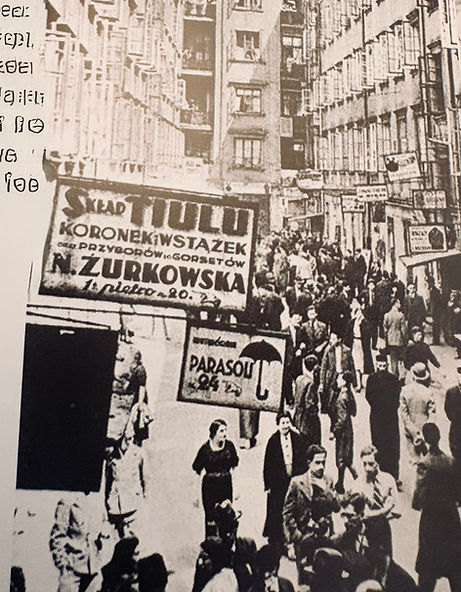

Warsaw in the 19th and 20th centuries. Muranow was the Jewish quarter.
Nalewski Street, the Jewish shopping street.
1864–1914: The Great Population Explosion
By 1864, Jews already represented about 33% of the population of Warsaw, with some 72,000 people.
We must therefore imagine a veritable Jewish city within Warsaw, with:
synagogues, shtiblekh (small prayer houses), schools, markets, trade associations, charities, printers, bookstores, community institutions, courts and religious organizations...
This explains why, in documents from the second half of the 19th century, "Warszawa" may appear as the place of origin of a person who was born in a small village but whose family later urbanized in Warsaw.
1918–1939: Warsaw becomes a huge Jewish center
After the rebirth of Poland in 1918, the Jewish community in Warsaw was extremely important.
The city then possessed an extraordinarily diverse Jewish life: Yiddish and Hebrew were spoken there; a daily newspaper was read; people went to Yiddish theaters; Jewish schools were opened, some secular, others religious; there were political movements (Zionist, Bundist, Orthodox, assimilated, etc.), professional associations, religious organizations...
In 1917, Jews represented approximately 41% of the population of Warsaw.
It is this Warsaw that will be destroyed by the Holocaust.
1940–1943: the ghetto
However, it is important to clearly distinguish the historic Jewish quarter from the Nazi ghetto.
The ghetto was created in October 1940. It encompassed a significant part of the former Jewish quarters, but it did not exactly correspond to the historical "Jewish Warsaw".
At its peak, approximately 450,000 Jews were confined in an area representing only about 2% of the area of Warsaw.
Deportations to Treblinka began in July 1942 and the ghetto was definitively destroyed after the Jewish uprising of April-May 1943.


Life in the Ghetto and after moving in 1940 became organized.
The plan of the Ghetto: the large one and the small one, linked by a bridge that spans Chloda Street, which remained "Aryan".
The Ghetto, completely razed in 1943, and image displayed at the Polin Museum


In present-day Warsaw
One can see the Nozyk synagogue, the only survivor of the thirty or so synagogues that existed before.
Traces remain in the memory of the Ghetto:
-the marks of the Ghetto wall, and some buildings on the edge of the ghetto,
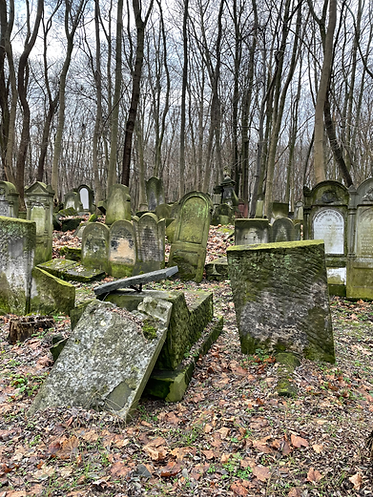
- the Okopowa cemetery with its 150,000 overgrown graves. We searched in vain for those of our family, whose location we nevertheless knew.
- And the memorial to the Ghetto fighters, in front of the Polin Museum, in the former Jewish quarter of Muranow




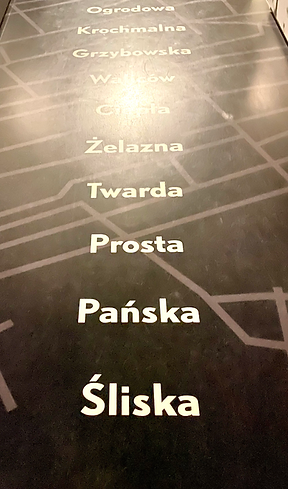
At the Polin Museum, a grand staircase displays the names of the Jewish streets of Warsaw

Smocza Street (Smotshè in Yiddish) was one of the poorest streets in the Jewish quarter of Warsaw between the two world wars.
This is the one that the Israeli writer and journalist Benny Mer chose to reconstruct its history and attempt to trace the destiny of its inhabitants, often very modest people, tailors, market vendors...
This first-person narrative is based on considerable research through archives and testimonies. Its main sources are the Yiddish press of the time, newspaper articles, advertisements, news items, but also written testimonies, literary fragments, poems, and oral testimonies.
Through this street, the author brings to life the entire Jewish life in Poland between the two world wars.
Thanks to the Yad Vashem Holocaust Victims Documentation Center, Benny Mer was sometimes able to trace the fate of these inhabitants after 1939, and find out who was locked in the ghetto, who died there, who fought there during the uprising, who was murdered at Treblinka, or who was able to escape extermination after fleeing or hiding.
But the originality of this book also comes from the fact that the author continues his investigation beyond the war to understand what became of the street after 1945, how it was transformed and rebuilt.
This is a new dimension of the meticulous work of remembrance accomplished in this narrative.