Family genealogy
From writing to literature
Jewish folktales have varied origins, often linked to oral traditions passed down from generation to generation.
These stories were a means of education, preservation of cultural identity, and strengthening of community ties.
Although often written down later, they are deeply rooted in Jewish oral tradition, illustrating the wisdom and values of the community.
They were mainly transmitted by:
* The rabbis who told these stories during classes, festivals, and community events to teach moral and spiritual lessons.
* The elders, the oldest members of the communities, played a key role in oral transmission, sharing these stories with the young.
* In some communities, storytellers, itinerant artists, or specialist storytellers traveled to entertain and educate through stories.
* And of course, families: this oral tradition also passed through family meals and rituals, where parents, especially fathers, told stories to their children.
My father, who worked hard all week, would take advantage of sleeping in on Sunday mornings to tell us stories he'd heard in his childhood. I found some of them in collections later, but the one that made the biggest impression on my sister and me was this one:
"A father had welcomed his son and daughter-in-law, who had just gotten married, into his home. A few years later, they had a child. The child grew up and needed a room. The daughter-in-law was beginning to feel that there wasn't enough space in the house. She asked her husband to put her father up in the garden shed."
With winter and the freezing cold approaching, the father asked his little boy to bring a blanket to his grandfather.
The child took the blanket and grabbed a pair of scissors.
He cut the blanket in two, much to his father's surprise.
But what are you doing here? Have you seen how cold it is? Your grandfather needs all the blankets.
And the child replied: "When you are old, the second half will be yours."
Of those I remember, the most famous are
- the "Golem of Prague", a mud creature animated by a rabbi to protect the Jewish community;
- the "stories of Rabbi Nahman of Breslov", mystical narratives and spiritual lessons on faith and life;
- "The Rabbi's Pigeon" illustrates lessons of wisdom and compassion towards others;
- the story of "The Eagle and the Tortoise", a fable highlighting the importance of patience and perseverance,
- or the "Tale of the Tanner", highlighting the themes of redemption and change.
These stories were a means of education, preservation of cultural identity, and strengthening of community ties.
They were collected and formalized by writers, anthropologists, and folklorists in the 19th and 20th centuries, contributing to the preservation of this rich narrative tradition.
Myths, legends and folk tales reflect in Jewish tradition, as in any tradition, the soul of the people through its wisdom, its sufferings, its whims.
It is a heritage to be rediscovered, which comes to us from afar and which often, as oral tradition dictates, begins with... a question, for the formula "Amol iz geven".... Once upon a time....

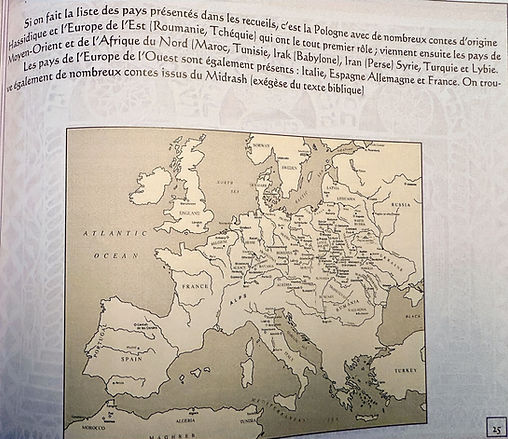
In 2011, Le Medem organised an exhibition on Jewish folk tales, of which this is the presentation booklet.
Far from being exhaustive, it was based on the research of folklorists from the late 19th and early 20th centuries. This partial view focused on folk tales.