
Family genealogy


A bit of history
The main outlines of its history can be found in a brochure published on the occasion of its 50th anniversary, in 1960 .
It was at the end of what was called the "Belle Époque."
We tend to remember its legends more readily than its realities.
Beneath the apparent idyllic lifestyle of the century's youth, social conditions were revealed whose injustice now seems obvious.
The French Jewish community, while obeying praiseworthy and charitable sentiments, still harbored fears of the great upheavals of the Dreyfus Affair.
The working classes watched, not without apprehension, the arrival of these thousands of men, too often ready to accept, by force of circumstance, working conditions on the margins of weak regulations.
By instinct and necessity, immigrants grouped themselves according to their shared origins into mutual aid societies.
Gradually, they integrated into French life, started families there, and saw their social condition evolve, transform, and improve.
It is 1910, and Jewish immigration from the East remains low, although the causes that motivate it remain permanent.
Those who arrive are separated by language, lifestyles, and sometimes even the hostility of the environments they suddenly find themselves in.
They tend to gravitate towards each other, drawn by shared origins, with no other concern or worry than simply being together.
Living conditions are difficult and many, despite some charitable efforts but without an overall perspective, experience real hardship.
The association was created on April 19, 1910.
under the name of
" Sickness Fund for Jewish Leatherworkers ".
Members arrived quickly in large numbers.
For me, the whole question is whether Herschen and Léon Alter joined it as soon as they arrived in Paris?
The meetings were held at the Landau restaurant, on Rue des Rosiers.
The monthly contributions were 1.50 francs.
During this period of social struggles, unemployment was unfortunately common in the leather goods profession, and the members, who already numbered around one hundred, were severely affected.
The practical objective of the association will be to help them, to the best of its ability.
This does not exclude other concerns, even doctrinal ones.
For example, a passionate and characteristic discussion arose concerning the right of a worker member who became an employer to remain in society.
Should the original character of the association, as intended by its creators, remain in its pure state, or should it allow for a potential social evolution?
Could "coexistence" between workers and small business owners, because it was not a question of "Big Business", be conceived?
The problem was not resolved in principle but in practice, since a compromise allowed former members who had become bosses to remain in the association; on the other hand, the recruitment of new members could only be done in working-class circles.
The First World War would bring to a close the first period of the association, whose activity would be reduced.
The Second World War hit society hard, and it only began to recover after liberation.

In the aftermath of the war, 1914-1918
The association gradually came back to life.
It was decided to change the name of the Society and it adopted the name of
“ Society of Jewish Leather Goods Makers of Paris”.
But this title did not meet with the approval of some members whose social condition had gradually changed and improved.
And on March 26, 1921 , the name was finally adopted
“ Society of Friends of Warsaw”,
But to recall its origin, we will add that it was created by Jewish leatherworkers.
The association moved into a decidedly mutualist and cultural space.
The headquarters were moved to Boulevard du Temple, to the Bonvalet salons.
The plight of the Jewish leather workers in Warsaw remained a concern, and the association showed its solidarity by sending funds through the Jewish press in Warsaw (Haint and Volks Zeitung).
But it was cultural activity in Paris that would leave a particular mark on the association.
Literary evenings like the Peretz evening, and celebrations like Hanukkah, involved the members themselves, their families, and went beyond the societal framework.
In addition to a Jewish choir, a small troupe of Jewish amateur artists was created. Evenings dedicated to Yiddish literature and poetry were also organized.
Their performances were a great success in the Jewish community.
The Society gave its support to the Federation of Jewish Societies of France, of which it would become one of the strongest and most dynamic elements, as well as to the school colony.
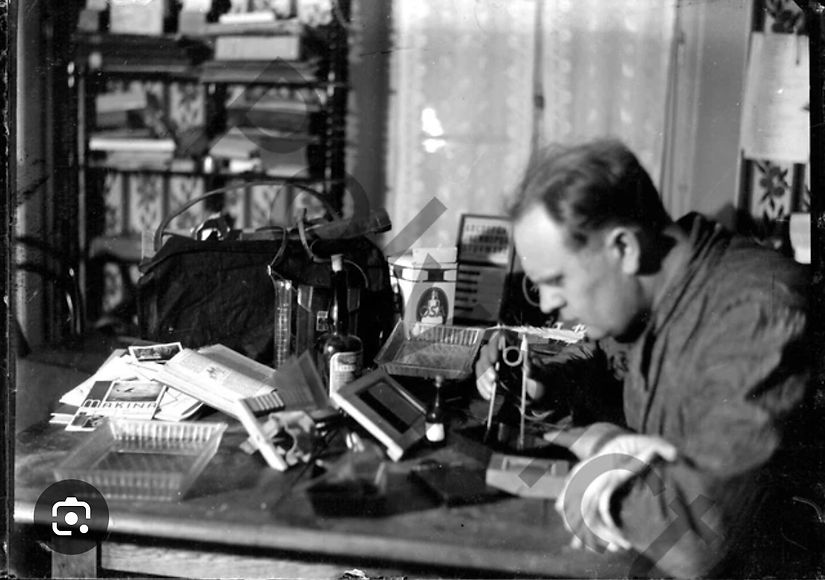
Immediately after the Liberation , the reorganized Council faced numerous and daunting tasks. They had to consider the many children whose parents had been massacred, save them, and provide them with a home and a profession.
Numerous associations have dedicated themselves to this immense task.
Among these was the School Colony, in which the Society actively participated.
During the occupation of Paris, the Colonie Scolaire had an active Resistance network, one of whose main activities was the rescue of Jewish children. Its leader, David Rapoport, was deported.
More than a third of its members perished in the camps or under the bullets of Nazi executioners and their accomplices.

Recreating feelings of solidarity and mutual aid, bringing people together, helping those who find themselves destitute of everything, these were the imperative tasks of the Society.
In the period of great hardship that followed the Liberation, it was necessary to help the survivors to recreate a home, to acquire equipment and tools for work.
A loan fund, which had already existed before the war in a modest form, was able, thanks to funds coming from America, from societies of Warsaw origin, to help many artisans, and facilitate their integration into economic life.
The years go by and are all marked by acts of solidarity.
The mutualist charter made it a duty to provide assistance to those afflicted by misfortune. Membership gradually increased, and charitable activities multiplied in connection with the vast organization of the Seine Mutual Federation (FMS), to which the Society had been affiliated for over 30 years. It became necessary to provide coverage for those members who did not receive any benefits in case of illness. A significant section was established, comprising small business owners, tradespeople, and some members of the liberal professions. Members of this group of "Non-Insured Social Security Members (NAS)" thus found themselves protected from hardship.
One of the problems that all mutual aid societies were addressing was that of old age. The Federation of Jewish Societies of France acquired a large estate in Boissise-la-Bertrand, in Seine-et-Marne, which, in a verdant setting, housed about a hundred elderly men and women, who found there a traditional Jewish home. I remember that we went there with our parents, but to see whom?


The Society's Golden Book includes: Aunt Genia (wife of Max Kronental), Grandmother, Father, Aunt Marie and Victor.
