
Family genealogy
Isaac or Itszack Kronental known as “Uncle Itchè”
Isaac Kronental was born in Warsaw on March 17, 1885.
He was the second child of Moshe-Aron and Sura-Scheindle Chwast.
I know nothing about his childhood and youth in Warsaw.
He married his brother-in-law Goscia Leizerson's sister.
He became a father in 1910, then in 1919: Szlama and Marie Kronental.
He was a leather goods maker in Paris, was he one in Warsaw?
I do not know the reasons that made him, his family and his father leave Warsaw, except for the resurgence of anti-Semitism in the new Polish Republic, post-World War I and the presence of his brother and sister in Paris.
Her father, Moshe-Aron, had lost his last daughter, Chana, in 1904 and he lost another, Sabina, in 1920, aged 26.
His son Moszek/Max had left for Paris in 1922.
Was that also the reason for this final departure?
Nevertheless, the family found themselves in Paris, living at 14 rue Moreau (12th arrondissement) in 1925.
They arrived on March 27th, Itzack had just turned 40.
I also don't know if he spent much time with my Grandmother and her brother Max. In my childhood, I always heard about 'Itchè and Gutchè'.
My mother was very attached to them.


The photos at the top show a very young Itzack, presumably in Poland. I cannot identify the man next to him.
In the photos below, one is still in Warsaw, certainly in the 1920s.
The other was taken in December 1938; he was 53 years old.


Deportation
Uncle Itchè was the first to be deported, during the Vel d'Hiv roundup, on July 16, 1942.
According to his daughter-in-law, a police officer left him for an hour before returning. His wife had to leave, but he stayed behind.
I think he was taken directly to Drancy.
He was deported on July 22, 1942, on convoy no. 9 with 996 other people.
At Auschwitz, "he was registered under number 51,794".
He was therefore sent to "work," unfortunately or perhaps not for a short time, since a camp record indicates his death on August 5, 1942.

Itzack Kronental (1885-1942) is listed on the wall of names, under the year 1942, at the Shoah Memorial in Paris.
Genia Kronental (1884-1943) is also listed there in the year 1943.


Szlama/Charles Kronental, the son of Itchè and Gutchè
Szlama was therefore born on October 26, 1910 in Warsaw.
He was named after his maternal grandfather Szlama Leizerson and was the first grandchild of Moshe-Aron.
He therefore completed his primary and possibly secondary education in Poland.
I know nothing about these Polish youth.
He arrived in Paris when he was 15 years old.
He was not educated, he went straight to work, perhaps with his father and certainly with Uncle Max as a leatherworker, because that was his profession.
Marc, his son, believes that he associated with trade unionists in his profession, perhaps from the CGT, and that he became interested in communist ideas, without being a card-carrying member. Perhaps also through the "Société des maroquiniers de Paris" (see the history of the Society of Friends of Warsaw).
Szlama was therefore born on October 26, 1910 in Warsaw. He was named after his maternal grandfather and was the first grandchild of Moshe-Aron.
He therefore completed his primary and possibly secondary education in Poland.
I know nothing about these Polish youth.
He arrived in Paris when he was 15 years old. He did not attend school; he immediately went to work, perhaps with his father and certainly with Uncle Max as a leatherworker, because that was his profession.
Marc, his son, thinks that he associated with trade unionists in his profession, perhaps CGT, and that he became close to communist ideas, without being a card-carrying member.
He was naturalized in July 1936, just after the Popular Front.
He had to do his military service in 1938 in the 151st Artillery Regiment.
And he was mobilized during the Phoney War: a letter sent to Hélène on February 26, 1940, attests to this:
"For the moment, we lead a fairly quiet life, and I'm not complaining."
The card bears a stamp: "Those at the rear must help those at the front by subscribing to ARMAMENT VOUCHERS." When the Germans broke through the Maginot Line, he and others managed to leave before the Germans arrived, in a truck to the south of France, where he was demobilized.


At the top, on the left Charles is still in Poland, so before he was 15 years old, and on the left Charles in 1929, as a young man.
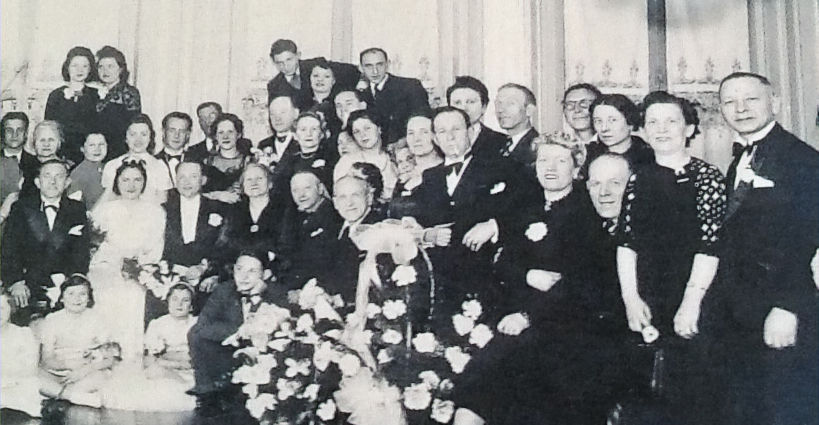
Her marriage, during the war, in 1941, brought together all the family who were still in Paris.
I can see my mother and my aunt Annie, Hélène and Jacques Goldenberg, (3rd row on the left);
my grandparents, Charles' parents and Helen's parents, Uncle Max and Aunt Genia (on the right side) and I think Daniel crouching in front of Gutchè.

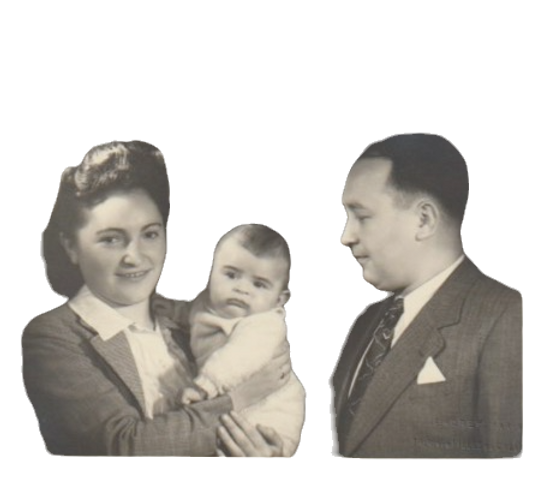
Hena/Hélène, who would later become Charles' wife, recounts their meeting:
" I used to take the pieces of leather cut at the workshop to the leather dresser Léon (actually it was Max) Kronental, uncle of my future husband, on rue Corbeau in the 10th arrondissement, near the République.
His wife thought I was nice and decided to introduce me to her nephew Charles (“Szlama”).
At that time, Charles was doing his military service.
We met in 1939 and six months later we were married on April 27, 1940."
I suppose she made a mistake, because according to the Parisian archives, the civil marriage took place on April 24, 1941, at the town hall of the 3rd arrondissement. Their witnesses were Héna's father, Szulin Prager, and her brother-in-law, Marcel Katz.
"We moved into a rented 3-room apartment on the 3rd floor of 57 rue de Turenne which would become our permanent home.
We registered as craftsmen with the Paris Chamber of Trades.
Our small workshop suited us very well.
A small, long room with a small window overlooking the gigantic courtyard of a building on Rue du Parc Royal.
We had set up a large trestle work table with two marble slabs for leatherworking. At the back, we had two small low cabinets with a drawer where we stored tools, cardboard templates for cutting leather, wadding, and cardboard.
In the middle of the table we had set up a bowl of superglue which was heated with an electric burner. This bowl had two compartments, one for rinsing the brushes with water and one for the superglue which melted in the water.
The table was fitted with a zinc sheet for cutting leather with a leatherworker's cutter, which Charles sharpened with a triangular file.
We had installed high shelves to store the rolls of leather, lining, and fabric."
And then came the time of war and persecution.
And tragedies occurred.
" Unfortunately, this entire installation was going to be disrupted by the war.
The first roundup of foreign Jews, organized by the Police Prefecture, took place on May 14, 1941.
On June 2, 1941, the Vichy government, headed by Pétain, promulgated the "Special Statute for Jews".
After multiple conferences between the heads of the Gestapo and the delegates of the Vichy government, it was decided that the wearing of the "badge" – that is to say the yellow star – would become compulsory from June 7, 1942 for any Jew who had reached the age of six.
Jews in the unoccupied zone were exempt, following the Vichy government's refusal to implement this decree, a refusal motivated primarily by the fear of disapproval reactions from all French people.
We therefore had to flee to the "free zone" and abandon all our possessions!
Charles therefore left with Marcel to cross the demarcation line with Mr. Duchateau, a man of Free France.
Then Ida (his sister) and I left 4 months later. Charles.
We had found a rental at 16 rue Faillebin in Villeurbanne, where we could practice leather goods.
Ida and Marcel settled in Clermont-Ferrand.
Charles and Helen in Lyon
from 1942 to 1944
"We were going to stay in Villeurbanne for 3 years, 1942, 1943 and 1944.
Since Jewish men had to stay home because they risked being arrested by the police, I did all the shopping. We didn't wear the yellow star, but our papers indicated that we were Jewish, because like everyone else, we had gone to Paris to get them, following the Pétain law.
We eat poorly with our food cards and 80 grams of meat per week!
However, we worked as pieceworkers for a leather goods maker who supplied the leather, and we made wallets from the scraps. We traded these for potatoes, which saved us. Later, we met a grocer who sold food on the black market, which improved our situation.
It was around this time that I learned to sew properly on a machine. I had gotten a sewing machine by chance: a shopkeeper who sold us needles for hand-sewing leather (!) was listening to "Radio London" in his store. Since I was staying to listen too, he said to me, "Are you for Free France?" I nodded. That's how we became friends.
He provided me with the sewing machine and all the sewing supplies. Of course, this machine cost us a lot, but it was essential.
We had settled in with old furniture. Our bed had bedbugs! After saving up, we were able to buy a brand new bed.
We read the Swiss press and listened to "Radio London" in secret because we had to bring all the radios to the police station. We listened to Pierre Dacq: "Radio Paris lies! Radio Paris lies, Radio Paris is German!"
We sometimes went to the cinema. It was dangerous and not very interesting. We also played cards with friends.
So we were making our money with this one single client!
He was very angry with us when we left Villeurbanne to return to Paris, which had been liberated on August 24, 1944.
I was pregnant at the time with Marc, who was due to be born in Paris on April 11, 1945.
Meanwhile, my parents had settled in Clermont-Ferrand where they made leather goods. We corresponded using special national postcards, writing trivialities to avoid being discovered by the Germans. Curiously, my parents wrote to us in Yiddish and were not bothered!
Ida, who was pregnant, and her husband Marcel were denounced and deported to Auschwitz where they were gassed and burned.
My in-laws were wearing the yellow star. They had stayed in Paris .
They were rounded up in 1942 and annihilated at Auschwitz."

She concludes her testimony as follows:
" Charles' aunt, nicknamed 'Aunt Eva' (actually Hava Kronenthal), was very lucky. She stayed in Paris and wore her star! She was a vigorous and very optimistic woman. Everyone liked her because she was always joking."
Marie, the sister of Charles and Raymond Zantman, her husband, lived in Mauriac in Auvergne, from where they sent us Cantal cheese!
Albert, (Hélène's brother), who was not to be married until 1946, had gone to join the resistance in Clermont- Ferrand where he was hiding.
"At the end of the war, we returned to rue de Turenne.
Our cousin Suzanne, nicknamed "Zizi," paid our rent every three months. She made everyone believe we came home every night!
My neighbor, a police commissioner, was ready to take over our apartment! He lived in the apartment of our current neighbor on the 3rd floor, Mr. Schneider, a French teacher at the Lycée Charlemagne.
"At the end of the war, we returned to rue de Turenne.
Our cousin Suzanne, nicknamed "Zizi," paid our rent every three months. She made everyone believe we came home every night!
My neighbor, a police commissioner, was ready to take over our apartment! He lived in the apartment of our current neighbor on the 3rd floor, Mr. Schneider, a French teacher at the Lycée Charlemagne.
So I gleaned two additional pieces of information:
- My Grandmother's vigorous and optimistic character.
It wasn't entirely by chance that my grandparents' family escaped deportation. They were among the 25,000 French Jews who were naturalized in their case in 1927/28.
Their naturalization files included the reports of the "denaturalization" investigations conducted on them, as on thousands of other "French" Jews, with the aim of stripping them of their French nationality. No doubt, if the war had continued, I wouldn't be alive today!
- The other piece of information that was unknown to me: my mother, every quarter of the war, for 3 years, went to pay the rent for Charles and Hélène's apartment!
Despite these ties, our families lost touch after the war and I don't know why!
Marc, Charles' son, remembered coming to my parents' house for the circumcision of our little brother in 1955.
He told us that all the children present (my cousins in particular) were eating around the large kitchen table.
My mother would have asked: "Who wants sirloin steak? Marc would have replied: I want the real thing!"
I think that after my Grandmother's death in August 1957, our families drifted apart.


After the war, times were more favorable.
Charles and Hélène wanted to have the following engraved on their tomb in Bagneux:
Their original birth names: Szlama and Hena.
The paths of my genealogical research led to our reunion.
It was a real joy to find Marc, one of Charles' sons, and his two sons, Thierry and Laurent, even if we did not understand the reason for such a distance.
They are part of our closest family.
Charles was a first cousin of my mother, on both his father's and mother's sides!
Marie Kronental,
the daughter of Itchè and Gutchè
The reunion with Marie's family was more chaotic.
Marie's daughter, Mireille, contacted me through our cousin Madeleine Kronental, Max's daughter.
She sent me family photos, the existing traces of her grandparents' deportation.
She had not lived in a Jewish world like we did, although, with the help of old age, she considered herself a "Zionist".
It turned out she was more of a Netanyahu groupie. We didn't share the same views!
She did, however, give me some information about her family.
His mother married Salomon Zantmann, born in 1910, in December 1938. He was 28 years old and an engineer. He was born in the 12th arrondissement of Paris and lived on rue du Faubourg St Antoine.
It wasn't far from Moreau where Marie lived.
Salomon Zantman desperately wanted to integrate himself into the lower middle class he associated with, particularly in his work.
The witness at their wedding was Marie's brother, Szlama, who was on leave: he was in the army.
The whole family gathered at their wedding.
According to Mireille, her father was distancing himself from the Jewish community and seeking to "assimilate" more than anything, even expressing, after the war, his desire to be Catholic.
His petit-bourgeois world satisfied him, and he didn't seek to cultivate family relationships. Mireille told me that her mother found our families not intellectual enough. I therefore understood their estrangement.
This did not prevent Marie from obtaining her shoes from my parents' workshop for a while.
And then one day it all stopped!
In any case, Salomon, her husband, who went by the name Raymond, was sent to Auvergne to oversee the construction of a bridge, if I understood correctly. His small family accompanied him.
They were there when war was declared and they stayed in the town of Mauriac, sub-prefecture of Cantal.
The city was in the zone not occupied by the Germans until November 11, 1942 (occupation of all of France).
I don't know how they fared during the war, whether they were harassed or not, whether they were linked to the Resistance, which had some notable exploits around Mauriac?
The fact remains that they did not bring, or could not bring, Itchè and Gutchè, Marie's parents who were deported.
Apparently, Marie kept in contact with her cousin Charles, since Hélène says she received Cantal cheese from them in Lyon.
Marc will tell me that Marie's husband's life was problematic after the war. He worked in the oil industry and often went to Algeria.
He embraced the ideology of "French Algeria".


Marie Kronental,
on the left upon his arrival in France around 1925;
on the right, a young girl circa 1937/38.


Marriage of Marie Kronental and Salomon/Raymond Zantman, in December 1938.
At the top right, representatives of the Sternis family: Hana Wald, her daughter Ita and her husband Michel, her son Ludo and his wife, Lola and Rose. Mother is above Itchè and Gutchè, and to the left are Max, Génia, and Daniel crouching.
In the photo on the left: Grandma is next to Max and Genia, above Itchè and Gutchè.
Below: Raymond and Marie
Mireille and her father in Mauriac in 1940 and 1943.


Mireille was trying to reconnect with her old family.
But this desire transformed into allegiance to the right-wing and far-right Israeli government. She sent me increasingly reactionary videos, which made me furious and I let her know it. A definitive falling out ensued. I didn't know that at the same time, her son died in a house fire. This saddened me, even though I didn't know him.
But fundamentally, it was the label of "not intellectual enough" that was unacceptable, like a class distinction! The estrangement continued...